Dwejra · Gozo
Dwejra
The west coast headland that carries more famous dive sites per square metre than anywhere else in the Maltese islands: Blue Hole, Inland Sea and Tunnel, Azure Reef, Coral Gardens, Coral Cave, Rogers Cave, Crocodile Rock and Fungus Rock.
Sea conditions
Excellent right now
Flat, sheltered and calm
Forecast for the site, updated 01:33 AM
- Waves
- 0.3 m
- from SE
- Wind
- 8 km/h
- SSW, gusts 14
- Swell
- 0.2 m
- 5 s period
- Sea temp
- 28 °C
- air 27 °C
Next 7 days
Sunrise 06:47, sunset 19:06
Exposed to wind and swell from: W (270°), NW (315°), SW (225°), N (0°). Diveable in most settled conditions but ruled out by strong westerly and northwesterly wind or swell, which is why trips here are so often cancelled between November and March. The Blue Hole and the Inland Sea hold on longest because both are pockets protected by rock, and locals often keep Dwejra for the afternoon when a breeze has closed other coasts. Best season: April to November, with the calmest water and warmest sea from June to October.
Dives at Dwejra
Inland Sea & Tunnel
Dwejra, Gozo
Blue Hole
Dwejra, Gozo
Azure Reef
Dwejra, Gozo
Coral Gardens
Dwejra, Gozo
Coral Cave
Dwejra, Gozo
Rogers Cave
Dwejra, Gozo
Crocodile Rock
Dwejra, Gozo
Tal-Barba Cave
Dwejra, Gozo
Whale Cave
Dwejra, Gozo
The dive
Dwejra is less a dive site than a small country of them. Park once and you can reach half a dozen entries on foot, all of them cut into the same hard grey coralline limestone, all of them dropping into deep clean water within a few fin kicks of the shore. Two entries do most of the work: the shingle beach inside the Inland Sea lagoon, and the sinkhole known as the Blue Hole a few hundred metres south along the headland.
From the Inland Sea you swim out through an eighty metre tunnel and arrive on a wall in twenty six metres. From the Blue Hole you can go north over the boulder field left by the Azure Window, south past Coral Gardens to Coral Cave and Rogers Cave, or simply potter in the shallow amphitheatre if the swell is up. Boats add Crocodile Rock and Fungus Rock offshore, and Tal-Barba cave up the coast to the north.
The catch is the weather. This whole coast faces open water to the west, so a winter depression parked in the central Mediterranean shuts the lot down for days at a time. In summer it flips: the mornings are glass, the car parks fill by nine, and the same tourists who photograph the cliffs are queueing for boat trips into the tunnel while you are diving under them.
Dwejra is a protected area, part of a Special Area of Conservation and once on Malta's tentative list for UNESCO World Heritage status, so treat the corals in the caves and the fragile shallows as things you look at rather than things you touch.
- Half a dozen world class entries within walking distance of each other
- The eighty metre Inland Sea Tunnel out onto a deep wall
- The Blue Hole sinkhole and its underwater window
- The boulder field left behind by the Azure Window
- Caves, chimneys and vertical rock in every direction
Typical plan
Most visitors do two dives here in a morning: tunnel first while the tourist boats are still warming up, then a Blue Hole entry for the Azure Reef boulders or a southward run to Coral Gardens and Coral Cave. Plan around twenty five to thirty metres for the deeper leg, keep something in reserve for the swim back to the entry, and finish shallow where the light and the fish are. Nitrox is worth having, and a torch earns its place at every cave here.
What the bottom looks like
- 1Blue Hole window9 m deep · 15 m out
- 2Coral Gardens shallows12 m deep · 40 m out
- 3Azure Reef boulder field25 m deep · 70 m out
- 4Seaward mouth of the Inland Sea Tunnel26 m deep · 90 m out
- 5Coral Cave28 m deep · 120 m out
- 6Outer wall running south to Crocodile Rock45 m deep · 165 m out
Bare coralline limestone, boulder debris and vertical rock faces, with sand only appearing well offshore below forty metres.
Who you might meet
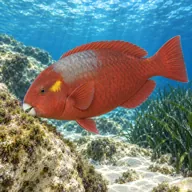
Mediterranean parrotfish
Almost always · Sparisoma cretense
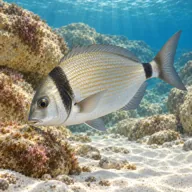
Two banded seabream
Almost always · Diplodus vulgaris
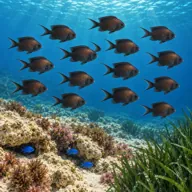
Damselfish
Almost always · Chromis chromis
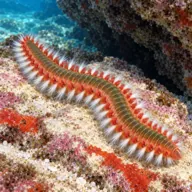
Fireworm
Almost always · Hermodice carunculata
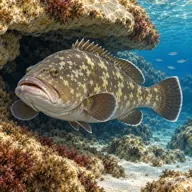
Dusky grouper
Often · Ċerna
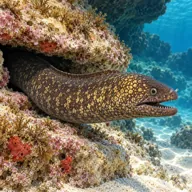
Moray eel
Often · Morina
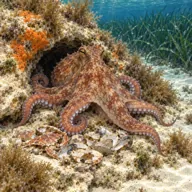
Octopus
Often · Qarnit
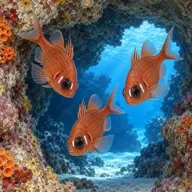
Cardinalfish
Often · Apogon imberbis
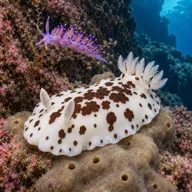
Nudibranchs
Often · Various doris and flabellina · Spring
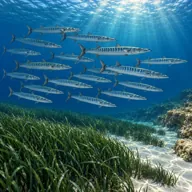
Barracuda
Sometimes · Lizz · Late summer
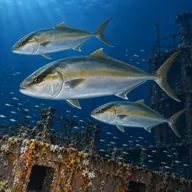
Amberjack
Sometimes · Aċċola · Autumn
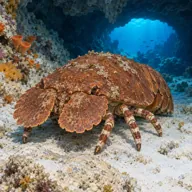
Slipper lobster
Sometimes · Scyllarides latus
Getting in and staying safe
Several car parks serve the area and which one you want depends on the dive. The lower car park by the Inland Sea sits beside the fishermen's boathouses and puts you a few steps from the lagoon. The upper road past Dwejra Tower gets you closest to the Blue Hole, and from there it is roughly two hundred metres of awkward walking over bare rock. Kiosks, cafes, toilets and outdoor showers are available near the Inland Sea, and it gets genuinely crowded in high summer with non divers, so early starts pay off. Boats for Crocodile Rock and Fungus Rock usually run from Xlendi or Mgarr rather than from Dwejra itself.
- Fully exposed western coast, swell builds fast and the exits get dangerous
- Long carries over bare, uneven, sometimes slippery limestone
- Tourist boats running in and out of the Inland Sea tunnel
- Deep water immediately offshore, easy to run up decompression
- Overhead environments at Coral Cave, Rogers Cave and Tal-Barba
- Unstable boulders on the Azure Reef
- Crowds and competing dive groups in summer
- Jellyfish in late summer
A bit of history
The headland is a textbook of coastal collapse. The Inland Sea is a flooded sinkhole linked to the open Mediterranean by a natural tunnel, Fungus Rock is a sea stack left behind when its connecting arch fell, and the Azure Window was an arch of Lower Coralline Limestone that finally came down in a gale on the morning of 8 March 2017. Dwejra Tower, built by the Knights in the 1650s, stands above the bay and once guarded Fungus Rock, whose rare parasitic plant was prized by the Order as a medicine and protected by force.
Divers say
Sign in to rate this site and leave a note for the next diver.
- No reviews yet. First one gets bragging rights.
Further reading: Wikipedia, Dwejra Bay · Visit Gozo, Dwejra · Atlantis Gozo dive site guide · Malta Info Guide, Dwejra Bay