Dwejra · Gozo
Coral Cave
A huge, well lit cavern cut into the Dwejra wall, its ceiling and sides upholstered in colourful corals. The mouth starts around seventeen metres and runs down to the seabed near thirty.
Sea conditions
Excellent right now
Flat, sheltered and calm
Forecast for the site, updated 01:33 AM
- Waves
- 0.3 m
- from SE
- Wind
- 8 km/h
- SSW, gusts 14
- Swell
- 0.2 m
- 5 s period
- Sea temp
- 28 °C
- air 27 °C
Next 7 days
Sunrise 06:47, sunset 19:06
Exposed to wind and swell from: W (270°), NW (315°), SW (225°). The cavern itself is deep enough to be calm, but the whole approach and the shore exits belong to the exposed Dwejra coast, so westerly and northwesterly weather closes it. Visibility inside is usually excellent provided the group keeps its fins up. Best season: May to October.
The dive
The approach is pure theatre. You follow a vertical wall south from Coral Gardens, the rock drops away beneath you, and then a semicircular mouth roughly thirty metres wide simply opens in the cliff. The top edge sits at seventeen or eighteen metres, the bottom at around twenty eight to thirty, and the cavern reaches fifty or sixty metres back into the rock.
Inside, the floor is sand and fine silt and it ramps upward towards the back until it meets the ceiling at about twenty one metres. That ceiling and the side walls are the point: they are genuinely carpeted in different corals, false corals, sponges and small growth, and even at the back there is enough daylight to see it without hammering the walls with a torch.
Treat it gently. The growth here is fragile, contact kills it, and exhaled bubbles trapped against the ceiling do damage too. Keep off the walls, keep the silt on the floor where it belongs, and do not linger under the same patch of roof for long.
There is a hole at the back of the cavern that leads further in. It is not a place for recreational divers. Two divers died there in 1999, and once the silt is up, navigation inside becomes a very different problem.
- Thirty metre wide cavern mouth appearing out of a vertical wall
- Ceiling and walls covered in dense, colourful coral growth
- Enough natural light to see the colour without a torch in your face
- Links easily with Coral Gardens, Rogers Cave and the Blue Hole
- Classic Dwejra wall diving on the approach and the way home
Typical plan
Enter at the Blue Hole or Coral Gardens, follow the wall south and descend to the cavern mouth at around twenty five metres, taking your deepest point near the boulders at twenty eight to thirty. Spend ten minutes inside the open cavern without going near the back hole, then exit right, follow the wall north and stage your ascent along the reef, finishing shallow at Coral Gardens. Nitrox 32 makes the profile much more comfortable, a torch is essential, and plan the swim back before you plan the depth.
What the bottom looks like
- 1Vertical wall on the approach16 m deep · 55 m out
- 2Boulder tumble in front of the cavern27 m deep · 100 m out
- 3Semicircular cavern mouth, roughly thirty metres wide24 m deep · 110 m out
- 4Back of the cavern where the sand floor meets the ceiling21 m deep · 165 m out
- 5Wall past thirty metres on the way back north32 m deep · 205 m out
Sand and fine silt inside the cavern, boulders across the entrance, and bare vertical limestone on the approach.
Who you might meet
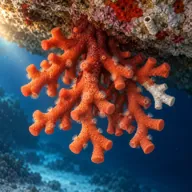
False coral
Almost always · Myriapora truncata
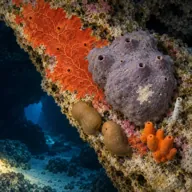
Encrusting sponges
Almost always · Various
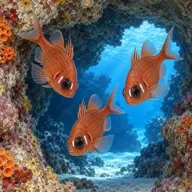
Cardinalfish
Almost always · Apogon imberbis
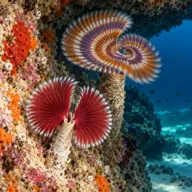
Tube worms
Almost always · Serpulid fan worms
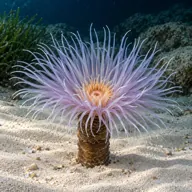
Fireworks anemone
Often · Cerianthus membranaceus
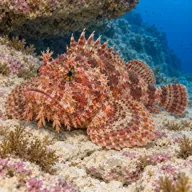
Scorpionfish
Often · Scorpaena scrofa
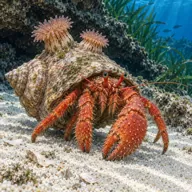
Hermit crab
Often · Dardanus species
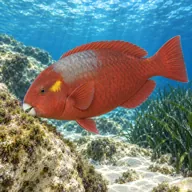
Mediterranean parrotfish
Often · Sparisoma cretense
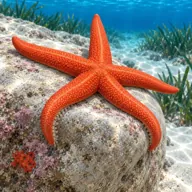
Starfish
Often · Hacelia and Echinaster species
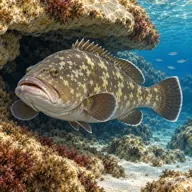
Dusky grouper
Sometimes · Ċerna
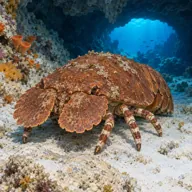
Slipper lobster
Sometimes · Scyllarides latus
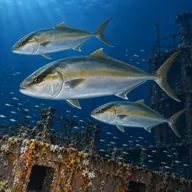
Amberjack
Sometimes · Aċċola · Autumn
Getting in and staying safe
A shore dive, reached through the Dwejra entries rather than having one of its own. Most groups enter at the Blue Hole or over the Coral Gardens rocks after parking up near Dwejra Tower and walking out over uneven limestone, roughly five minutes from the car. You can also come from further afield, through the Inland Sea tunnel or from above Rogers Cave between Big Bear and Little Bear, and exit at whichever entry suits the conditions. Facilities are back at the Inland Sea.
- Overhead environment, well lit but still a cavern with a ceiling
- Fine silt on the cavern floor, one careless fin kick ruins the visibility
- The passage at the back is a genuine cave, two fatalities there in 1999
- Depth in the high twenties combined with a long swim back to the entry
- Decompression obligation builds fast if you dawdle at the mouth
- Fragile coral growth damaged by contact and by trapped bubbles
- Surge at the shallow parts of the return route in westerly swell
A bit of history
The cavern is a natural erosion feature in the Lower Coralline Limestone wall between Coral Gardens and Rogers Cave, opened along bedding planes and joints in the rock. It carries a grim footnote: in 1999 two divers lost their lives in the constricted passage at the back of the cave, which is why every briefing here draws a hard line between the open cavern and the hole behind it.
Divers say
Sign in to rate this site and leave a note for the next diver.
- No reviews yet. First one gets bragging rights.
Further reading: Gozo Aqua Sports, Coral Cave Dwejra · Gozo Dive, Coral Cave · Atlantis Gozo dive site guide