🐟 Fish · Epinephelus marginatus
Dusky grouper
Ċernain Maltese
The watchful heavyweight of the Maltese reef
Meet the Dusky grouper
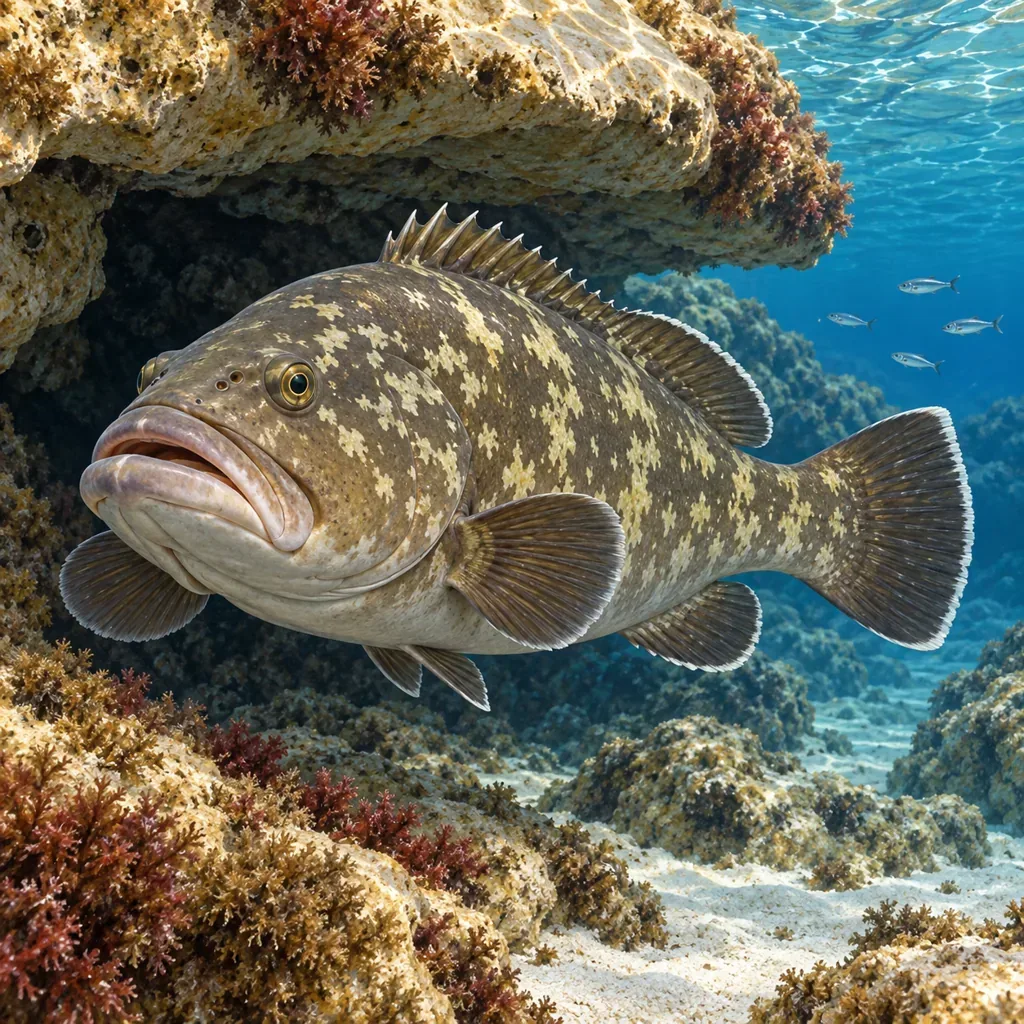
A heavy, deep-bodied fish with a broad head, thick rubbery lips and a huge downturned mouth. The body is brown to grey-green, dusted with pale cream blotches that come and go as the fish changes mood, and the rounded tail and soft fins usually carry a thin pale edge. The pectoral fins are large and fan-shaped, and the fish sculls with them rather than swimming hard. Divers in Malta most often meet animals of 40 to 80 cm, though a well-fed adult on an unfished ledge can reach well over a metre.
Groupers are solitary and territorial. Each one holds a home hole under a boulder, a crack in a drop-off or a cave mouth, and the same individual is often found in the same spot dive after dive. It will usually hold its ground while you drift closer, turn side-on to show its bulk, then slide back into the hole and peer out at you. Around Malta, Gozo and Comino they turn up on almost any healthy rocky site with big boulders and undercuts, from about 5 m down to the limits of recreational depth.
They are far scarcer here than in well-protected Mediterranean reserves, because Maltese groupers have been targeted by spearfishers and hook-and-line fishers for generations. Sites with a no-take culture, such as the Ċirkewwa area, tend to hold the boldest and largest fish, and a big ċerna that lets you approach is a sign of a reef that has been left alone.
When to look: All year, with the most relaxed encounters from late spring to autumn when warmer water draws them up onto shallower ledges.
Diving with them
- Approach on a slow diagonal rather than head-on, keep your breathing quiet and stop before the fish backs into its hole; it will often come out again once you stay still
- Look under big boulders, along the base of drop-offs and at cave entrances, and check the same overhang on every dive because groupers are creatures of habit
- For photographs, pre-set your strobes and shoot on the first approach; a spooked grouper rarely gives you a second chance on the same dive
- Never chase one into its hole or block the entrance, and never feed it, which makes it fearless around spearfishers
- Juveniles of 15 to 30 cm sit in very shallow rocky shallows and are easy to overlook among the rocks near entry points
Can it hurt you?Harmless
Harmless to divers. It has no venom and no interest in you, and even a large adult will retreat into its hole long before it does anything else.
Easily confused with
- Goldblotch grouper (Epinephelus costae, Maltese Dott) is slimmer, greyer and marked with golden-brown flecks rather than pale cloudy blotches
- Mottled grouper (Mycteroperca rubra, Ċerna tat-tikek) has a longer, more pointed head and a squarer tail
- Painted comber (Serranus scriba) is a miniature look-alike at a glance but rarely exceeds 20 cm and has a blue-scribbled snout
Where to meet them: 128 sites
Further reading: FishBase – Epinephelus marginatus · MaltaToday – ERA plan on spearfishing pressure on ċerna · Population structure of dusky grouper within Malta's Fisheries Management Zone · Sea Stuff – dusky grouper in Malta and Gozo · Il-Miklem – Maltese fish names (Ċerna)