🐟 Fish · Serranus scriba
Painted comber
Burqaxin Maltese, also Brieqex
A small painted predator with a sky-blue belly
Meet the Painted comber
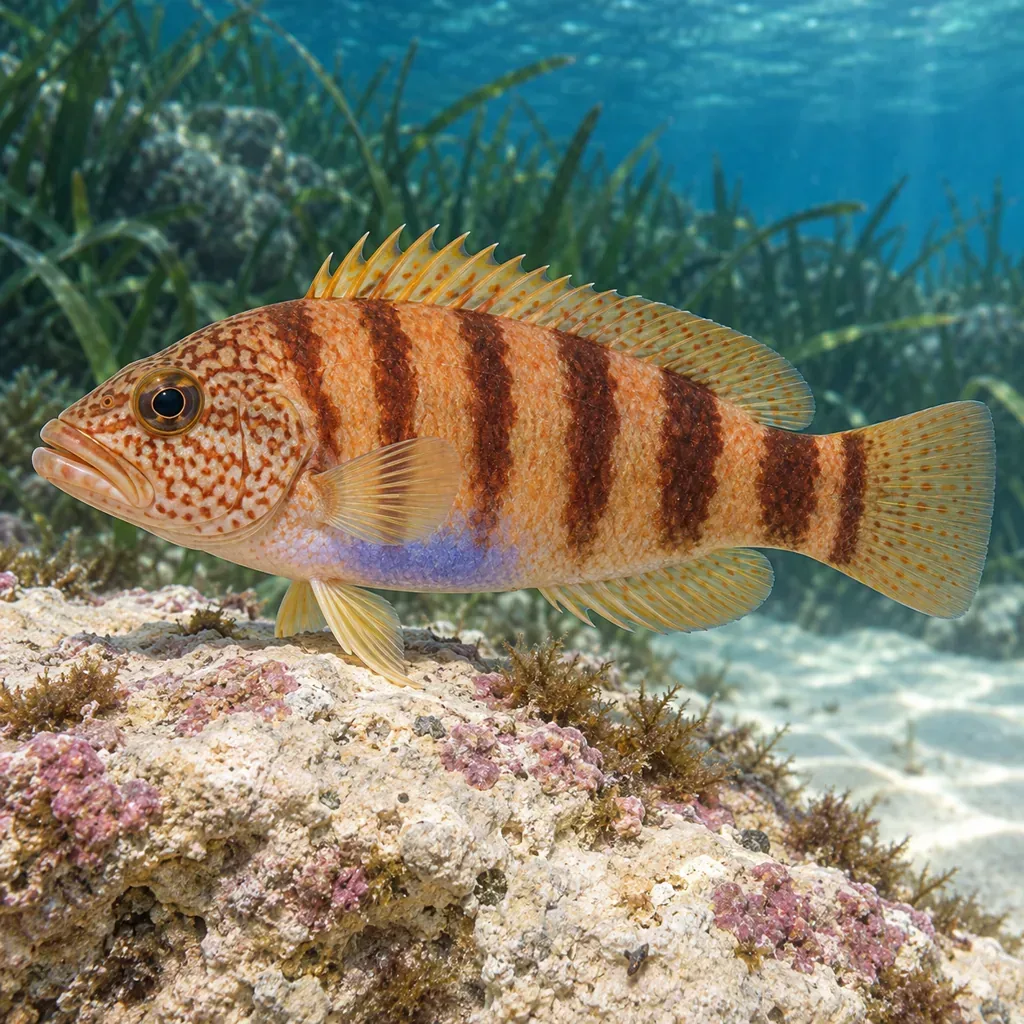
The painted comber is a miniature grouper and behaves like one. The body is stocky and slightly compressed, with a big head, a large mouth and a long dorsal fin whose spiny front section is joined to the soft rear. Five to seven dark brown-red bars cross the body and get wider and darker towards the tail, over a background of warm orange-brown. Two things make it unmistakable: a patch of luminous pale blue and violet on the belly between the pectoral and pelvic fins, and a tangle of reddish-brown scribbles on the cheeks and snout that gave the fish its Latin name scriba, the writer. Most Maltese fish are 15 to 25 cm; the record is around 36 cm.
It is one of the easiest reef fish to find around Malta, Gozo and Comino, sitting propped on its pelvic fins on a rock, a ledge or a patch of Posidonia rhizome between about 3 and 40 metres. Look in the transition zone where boulders meet seagrass or sand: Ċirkewwa's shallows, Għar Lapsi, Wied iż-Żurrieq, Xwejni, and the boulder slopes of almost any shore dive. It hunts small crustaceans, worms and fish by ambush, drifting a little and then lunging, and it will often follow an octopus or a foraging diver to grab whatever gets flushed out of the rock.
Painted combers are simultaneous hermaphrodites, carrying working male and female tissue at the same time, and pair up to spawn from spring into early summer. They are bold, inquisitive and tolerant of divers, which makes them one of the best subjects for a first macro or portrait photograph in Maltese water.
When to look: All year and all day, with most activity at dawn and dusk and a noticeable boost in boldness during the spring and early summer spawning season.
Diving with them
- Look for a fish sitting still on a rock rather than swimming; it perches on its pelvic fins and watches you.
- Approach slowly from the side and low, and it will usually hold position long enough for a close portrait.
- The blue belly patch only fires up in direct light, so a torch or strobe from slightly below brings out the colour that ambient light kills.
- They are opportunists: fan a little sand or lift nothing at all and one will still appear beside you hoping for a flushed shrimp.
- On night dives they sit motionless and washed-out in crevices, so check ledges with a soft beam before you pass.
Can it hurt you?Harmless
Completely harmless. The dorsal spines are stiff enough to prick if you grabbed the fish, but there is no venom and no reason to handle it.
Easily confused with
- Comber (Serranus cabrilla), which is slimmer, paler and has orange-brown horizontal lines along the flank crossing the bars, and lacks the bright blue belly patch
- Brown comber (Serranus hepatus), which is much smaller and squatter with a distinct dark blotch on the rear of the spiny dorsal fin
- Juvenile dusky grouper, which is browner, more mottled with pale spots and lacks the red facial scribbles
Where to meet them: 18 sites
HMS Kingston
Malta
Ras id-Dawwara
Malta
Sultan Rock
Comino
Further reading: FishBase: Serranus scriba (size, depth, hermaphroditism, habitat) · Il-Miklem Maltese thematic dictionary: Burqax (pl. brieqex) = painted comber · Atlantis Gozo Diving: painted comber around Malta and Gozo