Anchor Bay · Malta
Scorpion Cave
A big, bright cavern on the south wall of Anchor Bay with an entrance wide enough that the exit never leaves your sight, plus an air pocket under a domed roof where you can pop up and grin at each other. One of the gentlest introductions to overhead diving in Malta.
Sea conditions
Excellent right now
Flat, sheltered and calm
Forecast for the site, updated 01:45 AM
- Waves
- 0.3 m
- from SE
- Wind
- n/a
- Swell
- 0.2 m
- 5 s period
- Sea temp
- 29 °C
Next 7 days
Exposed to wind and swell from: W (270°), NW (315°), SW (225°). The cave sits nearer the mouth than the rest of the bay, so it feels weather before the inner sites do. Anchor Bay is the classic answer to a hard north easterly when Cirkewwa and the north coast are unusable, but put any west in the wind and the cave entrance starts to breathe uncomfortably. Best season: May to October. Early morning is better in high season, before the boat traffic and the swimmers arrive..
The dive
Getting there is half the fun. From the jetty ladders you follow the southern wall out of the bay over a jumble of collapsed limestone, past boulders the size of small cars, and after about 150 metres the rock face opens up. The mouth hides behind one particularly large block at somewhere between six and ten metres, so it is easy to swim straight past it on your first visit and slightly embarrassing to be led back to it by your guide.
Inside, the first few metres are fully submerged, then the roof lifts into a dome and you can surface into a genuine air pocket. It is a proper party trick for a newly certified diver: regulator out, torch up, everyone talking at once in a limestone bubble with the sea slopping against the walls. Back under, the floor sits at roughly eight metres near the opening and shallows gently as the passage runs on, and because the entrance is so wide the whole first chamber glows with that filtered sapphire light that makes cave photographs work.
Beyond the bright section the cave continues a long way inland, which is why local instructors use it for line laying and navigation practice. That part is not a sightseeing swim, it is a training environment, and it needs proper cave kit and training. For everyone else, the cavern zone alone is plenty, and the shallow depth means you can linger.
- Surface into a domed air pocket without any overhead training needed
- Entrance so wide the blue exit is visible from inside
- Shallow enough that nitrogen is never the limiting factor
- Excellent macro and cardinalfish photography in the twilight zone
- Boulder swim along the south wall on the way there and back
Typical plan
A single twelve litre is ample. Drop off the jetty ladders, follow the southern wall out at six to nine metres for around 150 metres, and find the entrance behind the big boulder at ten metres. Work into the first chamber, surface in the air pocket for a minute, then back out along the same line. Return over the boulders and finish in the shallows inside the jetty with a long, lazy safety stop. Sixty minutes with gas to spare is normal, and the maximum depth barely touches ten metres.
What the bottom looks like
- 1Fallen blocks along the southern wall9 m deep · 120 m out
- 2Sand pockets between the boulders at the entrance10 m deep · 145 m out
- 3Wide cave mouth behind a large boulder10 m deep · 150 m out
- 4Domed chamber with the air pocket8 m deep · 170 m out
- 5Inner passage used for line and navigation drills7 m deep · 220 m out
Broken limestone boulders and rubble at the entrance giving way to a silty sand floor inside the chamber.
Who you might meet

Cardinalfish
Almost always · Re tat-trilji

Cleaner shrimp in the cracks
Almost always · Gamblu
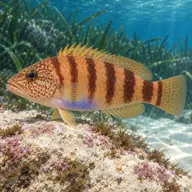
Painted comber
Almost always · Serran
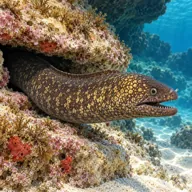
Mediterranean moray
Often · Morina
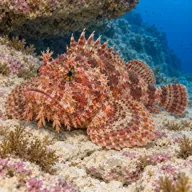
Red scorpionfish
Often · Ċippullazza
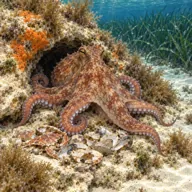
Common octopus
Often · Qarnit
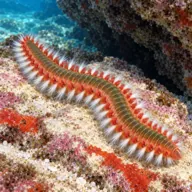
Bearded fireworm
Often · Busuf · Summer
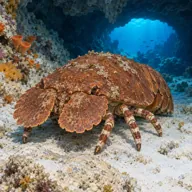
Slipper lobster
Sometimes · Ċikala
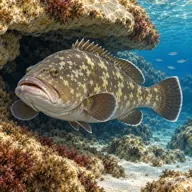
Dusky grouper
Sometimes · Ċerna
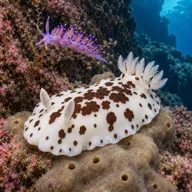
Nudibranchs on the cave walls
Sometimes · Spring
Getting in and staying safe
Park at Anchor Bay above the bay and follow the dirt track down to the concrete jetty on the south side, opposite the film set village. The jetty has ladders on the inner face, so entry and exit are easy in kit. From there it is a surface or shallow swim of roughly 150 metres along the southern wall. Toilets, cafes and the usual tourist facilities are up at the Popeye Village entrance. Carry a torch each, even though the first chamber is bright.
- Overhead environment, so no silt kicking and no wandering past the daylight zone without cave training
- Surge pushing through the entrance when there is any westerly swell running
- Tourist and pleasure boats working the bay mouth in summer
- Bad air is theoretically possible in a sealed pocket, so treat surfacing inside with a little caution
- Sharp and slippery limestone on the boulders at the entrance
- Visibility collapsing quickly in the bay after rough weather
A bit of history
The cave is a natural feature of the Upper Coralline limestone that forms the cliffs on this stretch of coast, hollowed out by wave action along a weakness in the rock and partly floored by blocks that have fallen from the roof and the cliffs above. The nickname comes from the shape of the system, with a main body and two side passages that read like claws on a survey sketch. The bay itself owes its modern fame to the 1980 Popeye film set on the shore above.
Divers say
Sign in to rate this site and leave a note for the next diver.
- No reviews yet. First one gets bragging rights.
Further reading: New Dimension Scuba: Anchor Bay and Scorpion Cave · Dive Shack Malta: Anchor Bay · Seashell Dive Centre: Anchor Bay · Malta Dive Sites: Anchor Bay