🐟 Fish · Scorpaena scrofa
Red scorpionfish
Ċippullazzain Maltese, also Ċipullazza, Ċepullazza, Skorfna ħamra, Skorfna
A lump of red rock with eyes
Meet the Red scorpionfish
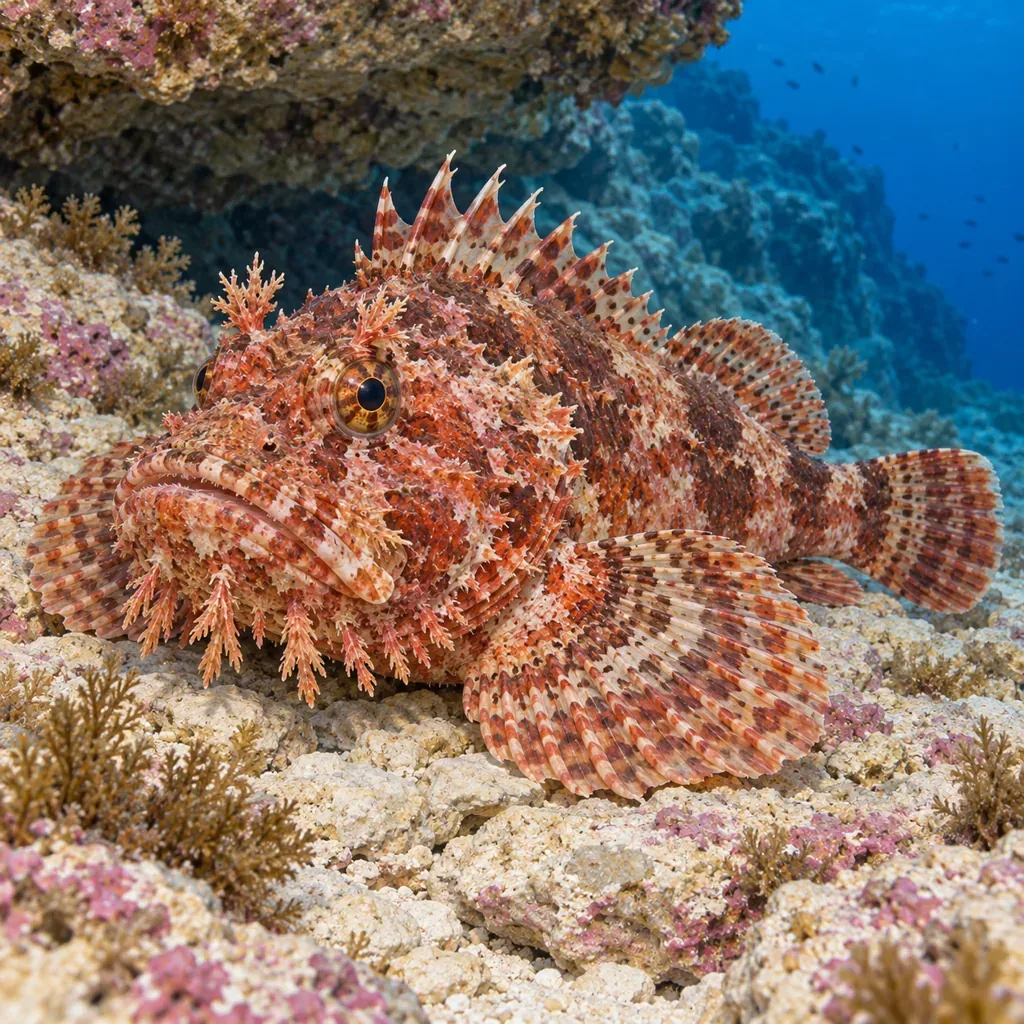
A squat, big-headed fish that looks more like encrusted stone than an animal. The head is enormous for the body and covered in bony ridges, spines and ragged skin flaps, with a fringed tassel hanging under the chin and feathery tabs above each eye. Colour runs from brick red and rust through pink to mottled brown, blotched and marbled so that the fish disappears against algae-covered rock. The pectoral fins are big and rounded and are usually spread flat on the bottom like hands.
It does not swim so much as sit. A red scorpionfish picks a spot on rock, rubble or the sand at the edge of a reef and waits, sometimes for hours, then engulfs a passing fish or shrimp with a sudden gulp. If you come too close it will hold absolutely still rather than flee, which is exactly why divers kneel on them. Around Malta and Gozo they are common from a few metres down the rocky slopes to well past sport-diving depth, and they are especially easy to find on rubble at the foot of walls.
Maltese fishermen use two names for the same fish depending on its size: the smaller ones are skorfna or skorfna ħamra, while a big mature fish is a ċippullazza, the prize of a good fish soup. Two smaller relatives share the same ground, the black scorpionfish and the small red scorpionfish, so check the size and the chin tassel before you decide which one you have found.
When to look: All year, and easiest to spot in the late afternoon and on night dives when they sit out in the open waiting to ambush prey.
Diving with them
- Look for the eye and the line of the mouth rather than the fish; the outline only resolves once you have found the eye
- Check where you put your hands, knees and camera tray on rubble and ledges, because this is the animal you are most likely to lean on by accident
- They tolerate a very close approach, so a slow macro or wide-angle close-focus shot works well if you light the head from the side to show the skin flaps
- Never try to move one or poke it out of a hole; the dorsal spines are the whole problem
- On night dives they often sit fully exposed on open rock and are much easier to find than by day
Can it hurt you?Can hurt you
The spines in the first part of the dorsal fin, and spines on the gill covers and pelvic fins, carry venom in a groove at their base. Stings almost always happen when someone kneels on, grabs or handles the fish, and cause immediate intense pain, swelling and inflammation that can last for days.
First aid: Get out of the water, wash the wound with seawater and remove any obvious spine fragments, then immerse the limb in hot water (about 45 C, as hot as can be tolerated without scalding) for 30 to 90 minutes, which breaks down the heat-sensitive venom. Take painkillers, check tetanus cover and see a doctor if pain persists, if the wound is deep or if any sign of infection appears.
Easily confused with
- Black scorpionfish (Scorpaena porcus) is smaller and browner with long branched tabs over the eyes and no chin tassel
- Small red scorpionfish (Scorpaena notata) rarely passes 20 cm and has a dark blotch on the spiny dorsal fin
- The invasive devil firefish (Pterois miles) is unmistakable by its long banded fan-like fins, and is far more dangerous
Where to meet them: 159 sites
Further reading: Sammut, Dangerous creatures of the Maltese sea Part 1 (venomous species and first aid) · FishBase – Scorpaena scrofa in Malta · Atlantis Gozo – scorpionfish on Gozo dive sites · Il-Miklem – Ċipullazza / Ċepullazza · Wikipedia – Scorpaena scrofa