Dwejra · Gozo
Azure Reef
The Azure Window fell into the sea in March 2017 and left behind a mountain range of raw limestone blocks that runs from just under the surface to past forty metres. It is the newest famous dive in Malta and it is still settling.
Sea conditions
Excellent right now
Flat, sheltered and calm
Forecast for the site, updated 01:33 AM
- Waves
- 0.3 m
- from SE
- Wind
- 8 km/h
- SSW, gusts 13
- Swell
- 0.2 m
- 5 s period
- Sea temp
- 28 °C
- air 27 °C
Next 7 days
Sunrise 06:47, sunset 19:06
Exposed to wind and swell from: W (270°), NW (315°), SW (225°), N (0°). Fully open to the west and northwest and the shallow boulders surge noticeably before the surface looks bad. Best in flat summer mornings. Visibility here is frequently outstanding, thirty metres and more, because there is almost no sediment on the new rock. Best season: May to October.
The dive
This is what a collapsed landmark looks like from underneath. Blocks the size of buildings lie stacked and tilted where they landed, edges still sharp, faces still pale where they broke. Guides call it the Azure Alps and the nickname fits: you swim over ridges and down canyons, past peaks that rise out of the deeper blue, and the scale is genuinely difficult to photograph.
The shallow part, roughly three to fifteen metres, is a maze of gaps and slots with plenty of light. Further out the blocks give way to steeper rock that falls past forty metres. Between them are swim throughs and passages, and you can see where the yellow rock of the old arch roof sits against the whiter stone of the pillar that used to hold it up.
Life is slowly moving in. Nine years on, algae have taken the upper surfaces, sponges and encrusting growth are spreading, and fish have colonised the cracks, but large stretches are still bare moonscape compared with the older reefs either side. That contrast is part of the appeal: you are watching a reef being born.
The important caveat is that the pile is not stable. Rocks have shifted in winter storms since the collapse, and threading the tunnels formed between blocks is not the same as diving a solid cave system. Enjoy the architecture from the open side.
- Swim over the actual remains of Malta's most famous landmark
- Canyons and ridges of freshly broken limestone from three metres to past forty
- Visible difference between the old arch roof and the pillar stone
- A brand new reef being colonised in real time
- Superb visibility thanks to the clean, sediment free rock
Typical plan
In at the Blue Hole, out through the window, then north over the boulders on a gentle descent to around thirty metres among the bigger blocks. Turn there, work back up the ridges to the shallow maze at six to twelve metres, and spend the last part of the dive playing in the light before returning through the arch. Forty five to fifty five minutes, nitrox 32 is a good fit, and take a torch for the gaps and a reel only if you are trained to use it.
What the bottom looks like
- 1Blue Hole window, the way in9 m deep · 20 m out
- 2Shallow blocks, the Azure Alps14 m deep · 45 m out
- 3Passage at the foot of the fallen pillar22 m deep · 80 m out
- 4Deeper stacked blocks and canyons29 m deep · 110 m out
- 5Outer wall falling past forty metres38 m deep · 160 m out
Freshly broken coralline limestone blocks with sharp edges, lightly dusted in algae, sitting on steep bare rock.
Who you might meet

Damselfish
Almost always · Chromis chromis

Two banded seabream
Almost always · Diplodus vulgaris

Salema
Almost always · Sarpa salpa

Mediterranean parrotfish
Often · Sparisoma cretense

Octopus
Often · Qarnit
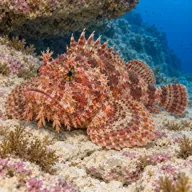
Scorpionfish
Often · Scorpaena species
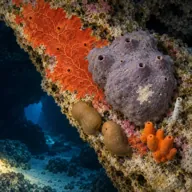
Encrusting sponges
Often · Various
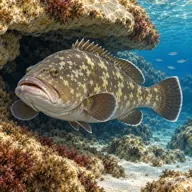
Dusky grouper
Sometimes · Ċerna
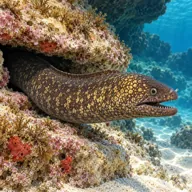
Moray eel
Sometimes · Morina

Barracuda
Sometimes · Lizz · Late summer

Amberjack
Sometimes · Aċċola · Autumn
Getting in and staying safe
There is no separate entry for the reef. Divers park up by Dwejra Tower, make the rough two hundred metre walk to the Blue Hole and use it as the front door, heading north once they are out through the window at nine metres. The shallow end of the boulder field is only a short swim away, so the reef works as a second dive when legs are tired. Facilities are back at the Inland Sea car park.
- Unstable boulders, the pile still moves in winter storms
- Tunnels and gaps between blocks that are overhead environments without being proper caves
- Very sharp fresh rock, easy to cut a glove or a hose
- Surge among the shallow blocks in any westerly swell
- Navigation, the boulders look identical once you are among them
- Depth creep, the outer slope passes forty metres quickly
- The Blue Hole entry and exit, with its awkward ladder in swell
A bit of history
The Azure Window was an arch of Lower Coralline Limestone about twenty eight metres high and twenty five wide on the Dwejra headland, and for decades it was the single most photographed object on the Maltese islands, filmed for productions including Game of Thrones. Chunks had been falling off for years. From 3 December 2016 walking on the arch carried a fine of 1,500 euro, an attempt to protect both rock and visitors. On the morning of 8 March 2017, after a gale, it collapsed completely at around 9:40 and left nothing above water. The event was recorded on seismometers on the islands.
Divers say
Sign in to rate this site and leave a note for the next diver.
- No reviews yet. First one gets bragging rights.
Further reading: Wikipedia, Azure Window · SSI, collapsed Azure Window, a new dive site is born · Atlantis Gozo, the Azure Window underwater · DIVE Magazine, scuba diving Gozo and the new Azure Window