🐟 Fish · Sparisoma cretense
Mediterranean parrotfish
Marzpanin Maltese, also Marżpan, Pappagall
Red and grey reef grazer with a beak like a parrot
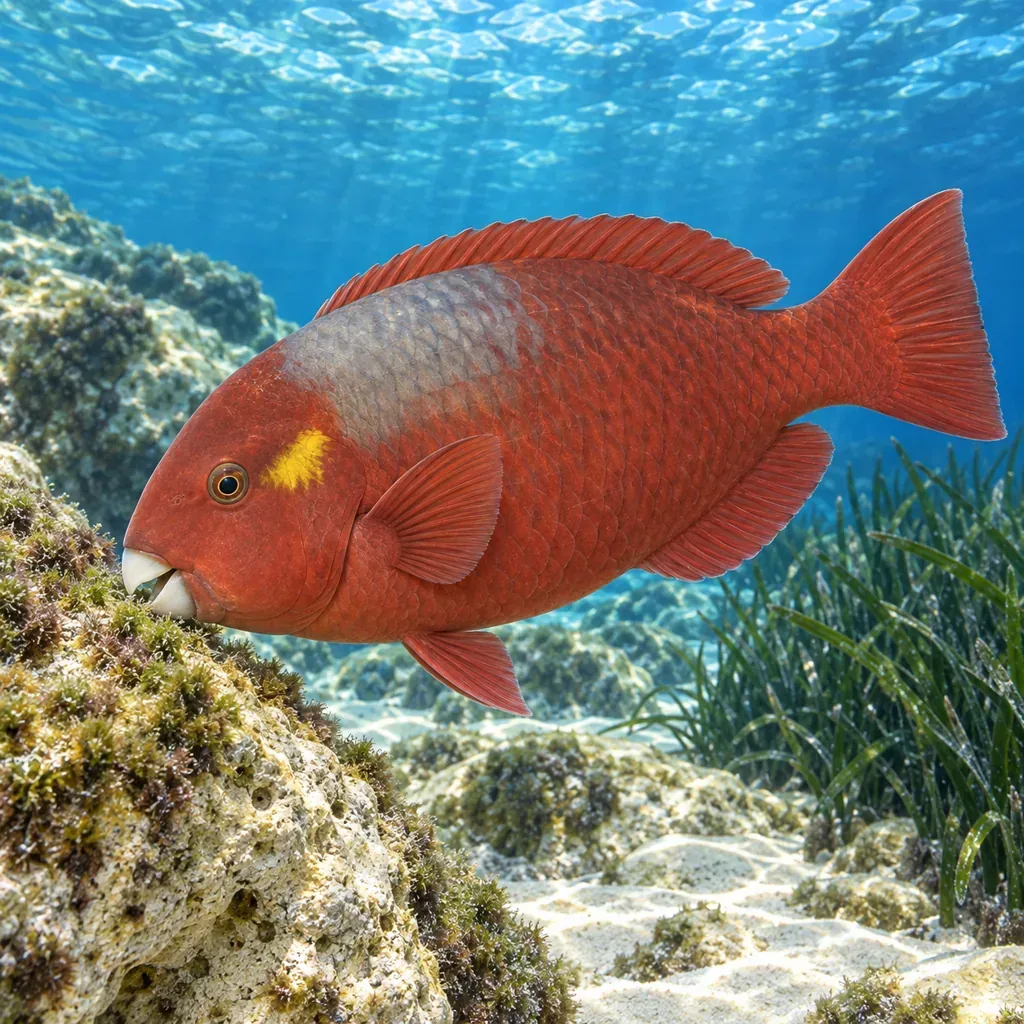
Meet the Mediterranean parrotfish
The only parrotfish you will meet in Maltese water, and the colours run the opposite way to the tropics. The bright ones are the females and young fish: brick red to scarlet over most of the body, with a pale grey saddle across the back behind the head, a yellow patch behind the eye and a red tail. The males are the drab ones, a plain grey-brown all over with a slightly darker head. Both have the same stubby, deep body and the fused beak-like front teeth the family is named for.
It grazes algae and turf off bare limestone, and you can often hear it before you see it - a dry scraping click as the beak works the rock. It moves in a stop-start way, nipping at a boulder, jinking a metre or two, then nipping again, usually alone or in twos and threes. Typical fish are 25 to 30 cm, and a big one is about half a metre.
Around Malta, Gozo and Comino it lives on shallow rocky reef, boulder slopes and the rocky edges of Posidonia meadows, from a couple of metres down to about thirty. It is a warm-water species and has been becoming steadily more common and more widespread in the central Mediterranean as the sea has warmed, so shallow snorkel-depth sightings that were once a novelty are now routine in late summer.
When to look: Best from June to November when the water is warmest; numbers drop off noticeably in the cold late-winter months.
Diving with them
- Listen for the scraping click on the rock - it will often lead you to a fish you have swum past
- Approach diagonally rather than head-on; it tolerates a slow diver but bolts from a direct charge
- The red ones photograph beautifully in shallow water where natural light still carries the colour - deeper down you will need a strobe
- Shallow boulder ground in three to ten metres is the reliable place to look, not the deep wall
- Check the grey ones too - divers often log only the red fish and miss the males entirely
Can it hurt you?Harmless
Harmless. The beak is for scraping algae off rock, it has no spines or venom, and it will not come close enough to bite anything.
Easily confused with
- At a distance a large ornate wrasse can look similar, but the wrasse is slimmer, faster and has no beak
- Grey males are sometimes logged as juvenile seabream - look for the blunt head and the fused front teeth
Where to meet them: 37 sites
Dornier Wal XI
Malta
Mtahleb
Malta
Ras il-Qala
Gozo
Further reading: FishBase - Sparisoma cretense · JMSE - Northward spread of Sparisoma cretense in the Mediterranean · Il-Miklem - Maltese fish names (Marzpan) · Vassallo History - Maltese, English and Latin fish names