Malta
Mtahleb
A wild, barely visited stretch of the west coast under the cliffs, with big fallen boulders, caverns and a wall that keeps going past sport-diving depth. Most people end up at Migra Ferha instead, which is exactly why this one stays empty.
Sea conditions
Excellent right now
Flat, sheltered and calm
Forecast for the site, updated 01:47 AM
- Waves
- 0.4 m
- from ESE
- Wind
- n/a
- Swell
- 0.4 m
- 5 s period
- Sea temp
- 29 °C
Next 7 days
Exposed to wind and swell from: NW (315°), W (270°), SW (225°). This coast catches everything off the open sea to the west. A northwesterly or a leftover groundswell rules it out completely, and even a moderate breeze makes the shore entry dangerous. Pick a calm summer morning with an easterly blowing offshore. Visibility, when you do get in, is usually excellent, commonly 25 metres and often better. Best season: June to September, on flat days with the wind off the land. Early morning is best before the afternoon sea breeze builds..
The dive
Mtahleb is the bit of coastline people drive past on the way to somewhere easier. The land above is terraced fields and chapel-quiet silence, and the shore below is a chaos of limestone blocks that have come off the cliff over the centuries and piled up underwater into a landscape of canyons, overhangs and dark slots.
Underwater it reads as a series of steps. Boulder fields first, then ledges and small caverns cut into the rock, then a wall that tips over and disappears well past 60 metres. Nobody dives the bottom of it recreationally. The good stuff sits between 15 and 40 metres, where the blocks are big enough to swim between and the overhangs hold cardinalfish and the occasional grouper who clearly has not met many people.
Because hardly anyone comes here, the fish are less twitchy and the rock is unscarred. The flip side is that there is no infrastructure at all. No ladder, no buoy, no dive centre round the corner, no phone signal worth relying on.
Online information on this specific spot is thin, and most of what exists is really about Migra Ferha a little way down the coast. Go with someone who knows the entry, or go by boat and skip the argument entirely.
- Boulder canyons big enough to swim through, with almost no other divers
- Caverns and overhangs cut into an unscarred limestone wall
- Fish that have not learned to be shy
- Dramatic cliff scenery above water as well as below
- A genuine off-the-map dive rather than a queue at a ladder
Typical plan
Treat it as a multi-level wall dive with a hard ceiling you set yourself. In at the boulders, drop along the rock to 30 to 35 metres, work the overhangs and cavern mouths for eight to twelve minutes, then walk yourself back up the wall shallower and shallower, finishing among the blocks at 10 metres and shallower for the last quarter of the dive. Nitrox 30 is the sensible gas, a torch is not optional in the overhangs, and you should be back on the rocks with plenty in the tank because the exit is the hard part.
What the bottom looks like
- 1Shallow block field at the cliff foot7 m deep · 20 m out
- 2Big fallen slabs with swim-between gaps18 m deep · 60 m out
- 3Cavern and overhang line in the wall25 m deep · 85 m out
- 4Vertical face with ledges and cracks30 m deep · 110 m out
- 5Occasional car wreckage tipped from the cliff38 m deep · 135 m out
- 6Edge where the wall falls away past sport depth45 m deep · 160 m out
- 7Deep sand and rubble floor, technical territory70 m deep · 210 m out
Tumbled Coralline limestone blocks and rock plateaus with pockets of coarse sand between them.
Who you might meet
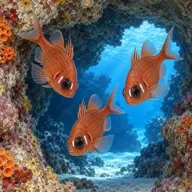
Cardinalfish
Almost always · Re tat-trilji
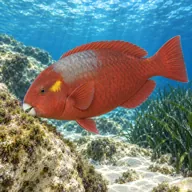
Mediterranean parrotfish
Almost always · Marzpan
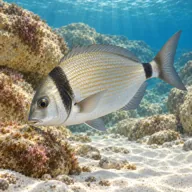
Two-banded bream
Almost always · Sargu
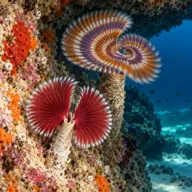
Tube worms
Almost always
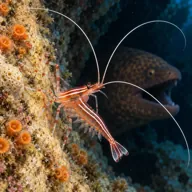
Anemones and shrimp
Almost always · Gamblu
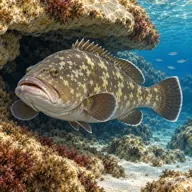
Dusky grouper
Often · Ċerna
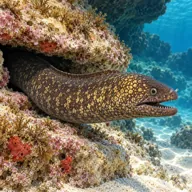
Mediterranean moray
Often · Morina
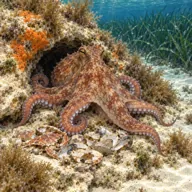
Common octopus
Often · Qarnit
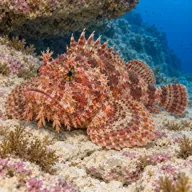
Red scorpionfish
Often · Ċippullazza
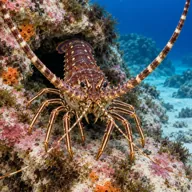
Spiny lobster
Sometimes · Awwista
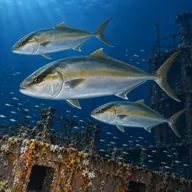
Amberjack
Sometimes · Aċċola · Late summer
Getting in and staying safe
Genuinely hard, and only sensible in near flat conditions. You drive to the end of the lane running out towards the Mtahleb cliffs, park on rough ground, and then carry kit down a long, steep and uneven scramble to the water. The climb back up afterwards is the real problem: hauling a full set up a few hundred metres of rough headland straight after a deep dive is a known route to exertion-related decompression illness, so sit, drink, and let twenty or thirty minutes pass before you start. Most divers who know the area simply take a boat from Golden Bay or Cirkewwa instead. Nothing on site: no toilets, no shade, no cafe, no easy exit if you get it wrong.
- Long steep scramble with kit, both ways, and a serious DCI risk on the climb out
- Entry and exit only workable in near perfect sea conditions
- Depth temptation, the wall runs far past recreational limits
- Slippery and unstable boulders at the waterline
- Remote location with poor phone coverage and no quick rescue
- Variable currents along the exposed west coast
- Loose rock and occasional falls from the cliff above
A bit of history
No wrecks or war stories attach to Mtahleb itself. The geology is the history here: hard Upper Coralline Limestone capping softer Blue Clay, which erodes out from underneath until whole slabs of cliff let go and slide into the sea. The boulder fields divers swim through are the debris of those collapses. As at Migra Ferha nearby, locals have used the cliff edge as an informal dumping ground over the years, so the odd car body has found its way down the slope and become artificial reef.
Divers say
Sign in to rate this site and leave a note for the next diver.
- No reviews yet. First one gets bragging rights.
Further reading: Malta Dive Sites: Mtahleb · Divers Guide: Mtahleb · Calypso Sub-Aqua Club: Mtahleb · Greatest Dive Sites: Migra Ferha and Mtahleb