🐙 Cephalopods · Octopus vulgaris
Common octopus
Qarnitin Maltese, also Qarnita
Eight arms, one very good brain
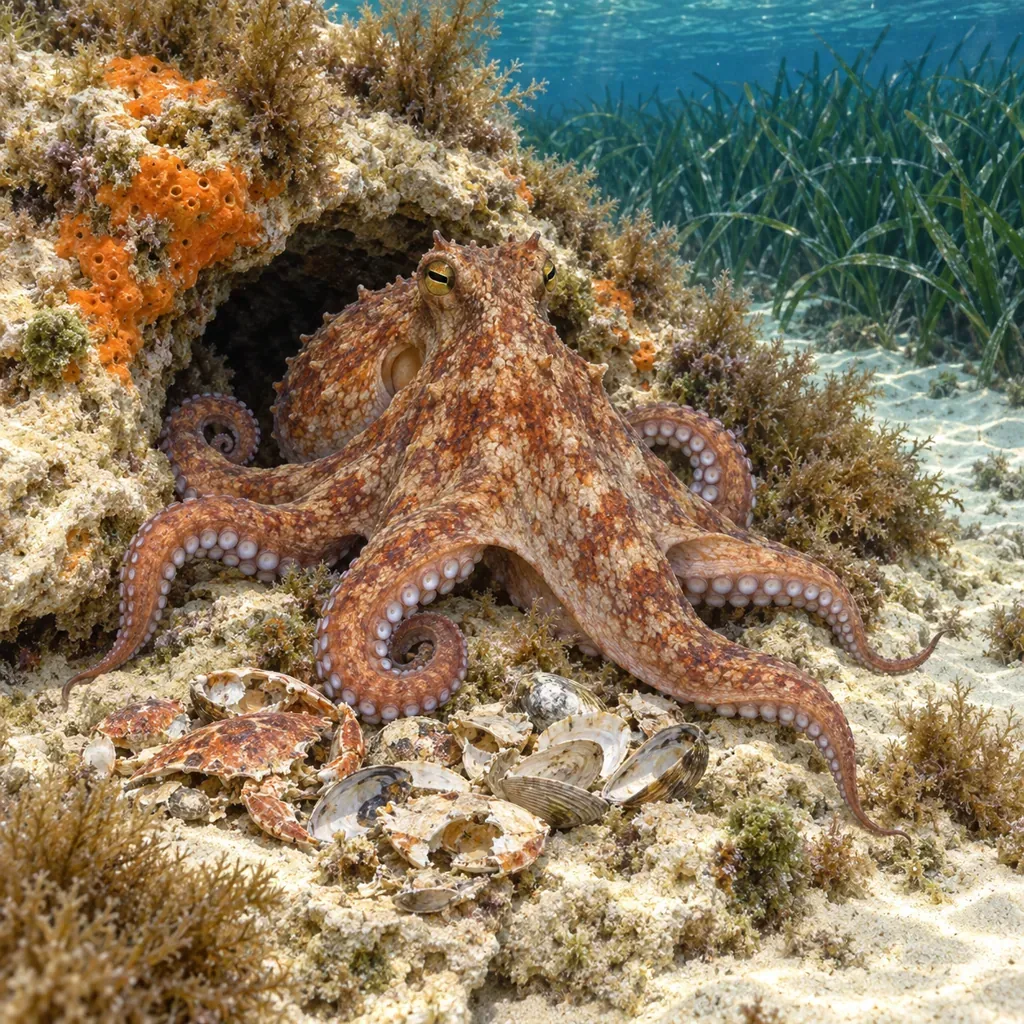
Meet the Common octopus
A soft, bag-bodied mollusc with eight arms, each carrying two rows of suckers, and a pair of large eyes with horizontal slit pupils set high on the head. Colour is not a useful identification feature, because it changes in under a second from sandy cream to brick red to near black, and the skin can raise itself into horns and warts to match weed or bare rock. What is reliable is the shape: a rounded mantle, no fins, and arms of roughly similar length, the longest three or four times the mantle. Around Malta most are 30 to 60 cm across the outstretched arms, with a mantle the size of a fist; big ones exceed a metre in total span.
It lives in a den - a crack in the reef, a hole under a boulder, a beer bottle, the inside of an old tyre - and gives itself away by the midden of picked-clean crab carapaces and bivalve shells heaped at the entrance. Hunting is mostly at dusk and at night, when it parachutes over rubble with the web between the arms spread and gropes blindly underneath for crabs. Corner it and it will jet away in a puff of ink, changing colour twice on the way.
Around the Maltese islands it is everywhere shallow and rocky: harbour walls, boulder slopes, the rubble at the foot of a wall, wrecks and the edges of Posidonia, from a metre down to 30 m and deeper. It is also the most Maltese animal in the sea in cultural terms - stuffat tal-qarnit, the slow-cooked octopus stew with tomato, wine, olives, capers and sometimes walnuts and raisins, is a genuine island classic, and the octopus you swim past is the same one the fishers take in pots.
When to look: All year, best at dusk and on night dives; numbers are highest in late summer and autumn.
Diving with them
- Find the den before you find the octopus: look for a small hole with a heap of broken crab shells and bivalves in front of it
- Once you have found one, stay put and stop moving your hands - a curious octopus will come back out and inspect you if you give it two or three minutes
- Do not feed one or pull it out of its hole, and never hand it your camera or gauge; stressed animals abandon the den
- Night dives are the best time, when they hunt out in the open with the arm web spread like a parachute
- For photographs, light it from the side rather than head-on - flat frontal light flattens the skin texture that makes the picture
- If it inks, hold your position and wait rather than chasing into the cloud; it will already be somewhere else
Can it hurt you?Handle with care
Not aggressive and no threat if you leave it alone, but every octopus has a parrot-like beak and venomous saliva, so a handled or cornered animal can deliver a bite that bleeds and aches. Suckers can also raise welts on bare skin.
First aid: Wash the bite with clean water, remove any tissue fragments, disinfect and cover it, and keep an eye on it - marine bites infect easily, so see a doctor if it becomes red, swollen or painful over the following days.
Easily confused with
- White-spotted octopus, which is reddish with clear white spots and much longer, more unequal arms, and is mostly seen at night
- Musky octopus, which has a single row of suckers on each arm instead of two and prefers muddy, silty ground
- Common cuttlefish, which hovers in mid-water with a fin skirt running around the mantle and has ten appendages, not eight
Where to meet them: 174 sites
Marsalforn Bay
Gozo
Newwiela Point
Gozo
Sirens
Malta
Submarine Pen
Malta
Further reading: Common octopus overview · SeaLifeBase: Octopus vulgaris · Guide Me Malta: stuffat tal-qarnit, Maltese octopus stew · Maltese seafood names in everyday and market use