Cominotto · Comino
Alex's Cave
A big, smooth-walled cavern with a sandy floor, a chimney at the back that opens to daylight, and a boulder-strewn tunnel that runs through the headland toward Crystal Lagoon.
Sea conditions
Excellent right now
Flat, sheltered and calm
Forecast for the site, updated 02:29 AM
- Waves
- n/a
- Wind
- 4 km/h
- S, gusts 8
- Swell
- n/a
- Sea temp
- n/a
- air 25 °C
Next 7 days
Sunrise 06:47, sunset 19:05
Exposed to wind and swell from: W (270°), SW (225°), S (180°), NW (315°). Faces the open western approaches, so anything from south through west puts swell into the mouth and surge into the chamber. Sources are blunt that a southerly storm makes it unsafe. Best in a settled northerly or easterly, and best again between mid-morning and early afternoon in summer when the sun angle lights the entrance. Best season: June to September, ideally between 10:00 and 14:00 for the light.
The dive
Alex's Cave is the crowd-pleaser of the shallow Comino caverns. Wave action has scoured the chamber into something almost architectural: smooth flanks, a broad floor of sand and shredded algae, and enough ambient light near the mouth that you can switch the torch off and still see your buddy's face. Average depth is about eight metres and the deepest corner is sixteen, so the limiting factor is gas and patience rather than nitrogen.
The back of the chamber is where it gets interesting. A chimney rises to the surface and, when the sea is properly flat, you can come up inside the rock and take your regulator out under a circle of sky. From the same area a tunnel floored with boulders runs on through the headland and eventually opens into Crystal Lagoon. Guides only take people through that when conditions are perfect and everyone's gas planning is honest, and rightly so: it is a genuine overhead traverse with no mid-route exit.
Outside the chamber the ground is Posidonia and sand, with saddled bream and two-banded bream patrolling the entrance and the usual crevice-dwellers tucked into the rock. Groupers, morays, octopus and wrasse all show up regularly, and the light beams through the entrance make it one of the easiest photo dives in the islands.
The warning that comes with every description of this site is worth repeating: a southerly blow turns the cavern from charming into dangerous. The chamber faces the wrong way, the surge has nowhere to dissipate, and the chimney stops being an exit and becomes a washing machine.
- Taking your regulator out inside the rock at the top of the chimney
- Light shafts cutting across a smooth, cathedral-ish chamber
- A genuine through-tunnel to Crystal Lagoon for teams who have earned it
- Shallow enough for a very long, very relaxed dive
Typical plan
Drop outside the mouth, cross the Posidonia at six metres, and enter the chamber staying off the floor. Work to the back, surface in the chimney if the sea allows, then either turn and come out the way you came or, with a guide and perfect conditions, commit to the tunnel through to Crystal Lagoon. Maximum sixteen metres. Fifty to sixty minutes on a single cylinder of air, thirds reserved before any overhead section, and a good torch each with a spare in the team.
What the bottom looks like
- 1Posidonia outside the cave mouth6 m deep · 20 m out
- 2Mouth of Alex's Cave8 m deep · 40 m out
- 3Sand and algae debris on the chamber floor11 m deep · 60 m out
- 4Chimney at the back of the chamber, surfaces in daylight6 m deep · 90 m out
- 5Boulder-floored tunnel through the headland toward Crystal Lagoon13 m deep · 140 m out
- 6Boulder garden along the outside of the headland6 m deep · 200 m out
Fine sand and broken algae on the cavern floor, Posidonia and low limestone rock outside the entrance.
Who you might meet
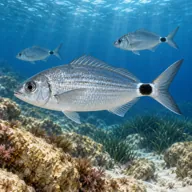
Saddled bream
Almost always · Kaħlija
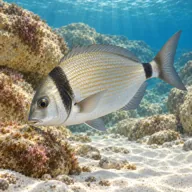
Two-banded seabream
Almost always · Ħaddiema

Cardinalfish
Almost always · Sultan iċ-ċawl
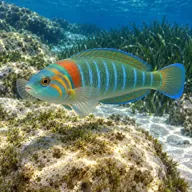
Ornate wrasse
Almost always · Tirda tal-passa
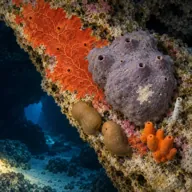
Encrusting sponges
Almost always · Sponża
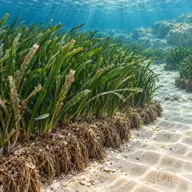
Posidonia meadow
Almost always · Ħaxix il-baħar
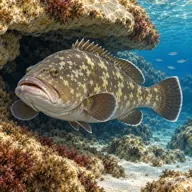
Dusky grouper
Often · Ċerna
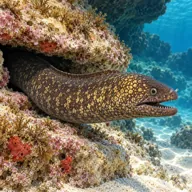
Mediterranean moray
Often · Morina
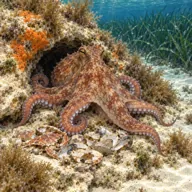
Common octopus
Often · Qarnita
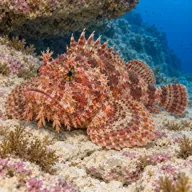
Scorpionfish
Sometimes · Skorfna
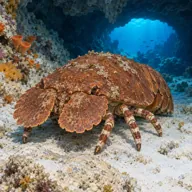
Slipper lobster
Lucky day · Ċikala
Getting in and staying safe
Boat only. Most operators run it as the second dive after Inner Lantern Point, mooring off the headland and dropping divers straight over the side. Ladder exit back onto the boat. Nothing ashore: no landing, no facilities. Boats out of Ċirkewwa reach it in roughly twenty minutes, Sliema day boats in about forty-five.
- Overhead environment: no direct ascent from inside the chamber or the tunnel
- Extremely dangerous in a southerly blow, surge inside the cave is violent
- The through-tunnel to Crystal Lagoon is a committed traverse needing strong gas management
- Silt: fine sand and algae debris on the floor, easily kicked into a whiteout
- Boulders on the tunnel floor, awkward in low visibility
- Chimney exit only usable in a flat calm
- Boat traffic above the exit points
A bit of history
The chamber is a wave-cut cavern in upper coralline limestone, opened up along the joint planes that run through Comino's western headlands. The same jointing produced the Crystal Lagoon tunnel and the Lantern Point chimney a few hundred metres south, which is why this stretch of coast has so many overhead features packed into so little water.
Divers say
Sign in to rate this site and leave a note for the next diver.
- No reviews yet. First one gets bragging rights.
Further reading: Calypso SAC, Cominotto Cave (Alex's Cave) · Private Scuba, Alex's Cave · Meandering Wild, diving Comino beyond the Blue Lagoon · Divers Guide, Crystal Lagoon tunnel