🧽 Sponges & bryozoans · Porifera: Crambe crambe, Ircinia spp., Petrosia ficiformis and others
Encrusting sponges
Sponżain Maltese
The paint layer on Malta's cave walls
Meet the Encrusting sponges
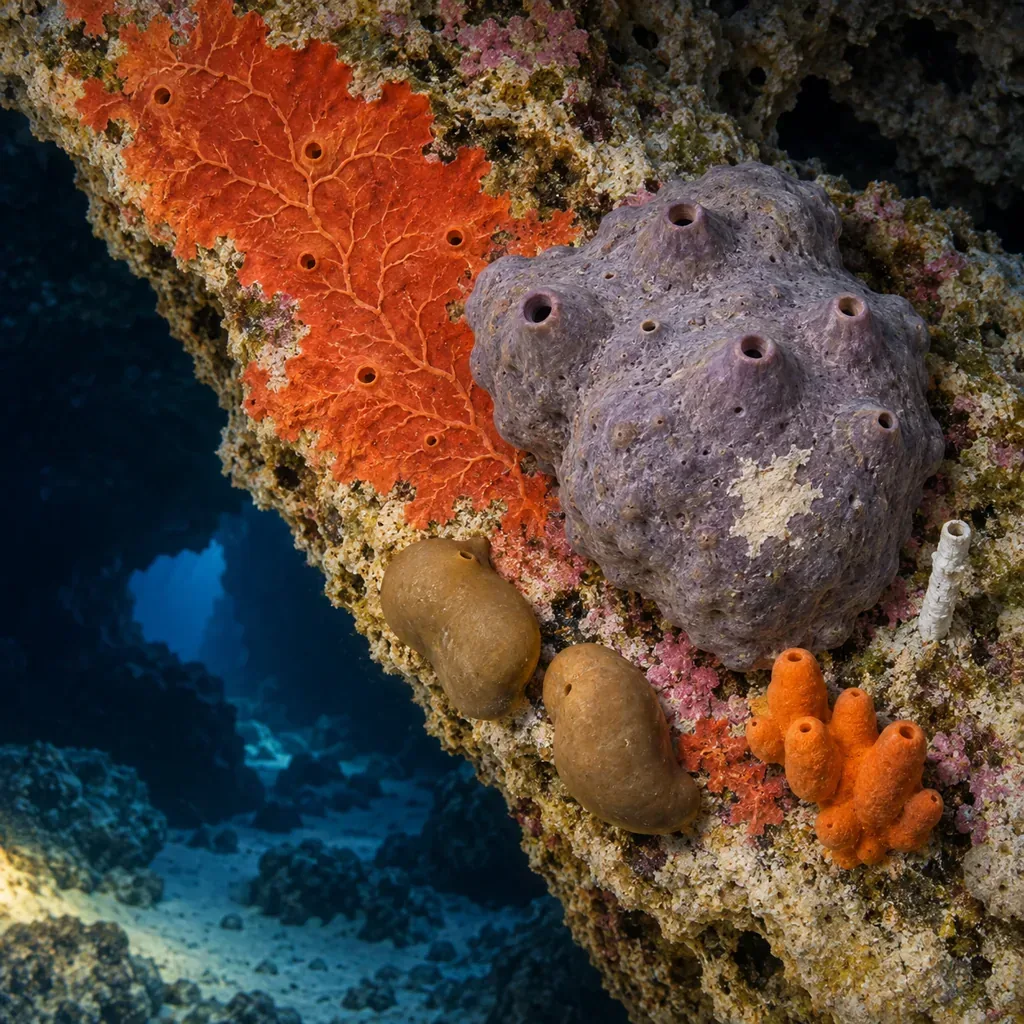
Sponges are the reason a Maltese cave wall looks like someone attacked it with poster paint. They are animals without organs: a skeleton of mineral spicules and protein fibres holding open a plumbing system that pumps water in through thousands of tiny pores and out through the larger, obvious craters called oscula. Look for those oscula; they are the surest sign that an orange smear on rock is a sponge rather than an alga. A handful of species do most of the colouring around Malta and Gozo. Crambe crambe is the flat scarlet-to-orange crust, only a few millimetres thick, spreading over shaded rock like spilled paint with a fine network of surface channels. Petrosia ficiformis is the hard, stony, grey-lilac 'fig sponge' of caves and overhangs, thick-walled and studded with volcano-like oscula. Chondrosia reniformis forms smooth, rubbery, kidney-shaped beige-brown lobes with no visible texture at all.
Add Ircinia variabilis, a tough dark grey-brown sponge with a surface of small conical points, and Agelas oroides, a vivid orange lobed sponge of dim water, and you have most of what coats the walls of Billinghurst, the Inland Sea tunnel, the Blue Hole chimney and the shaded plating of Maltese wrecks. In caves, the deeper you go from the entrance the more the community shifts, with pale yellow Aplysina finger clusters and delicate white mesh sponges taking over in permanent darkness.
They run from just under the surface down to well beyond diving depth, but the real displays are on vertical and overhanging surfaces between about five and sixty metres, wherever light is low and water moves. A patch may be a few centimetres across or spread over half a metre of rock, and it grows slowly, in millimetres per year.
When to look: All year; colours are unchanged by season, so the only variable is how much light you bring.
Diving with them
- Bring a torch even on a bright day. Past ten metres the reds and oranges are gone to the naked eye and a beam turns a grey wall into a mosaic.
- Look for the oscula, the small raised craters; they are what separates a sponge from an encrusting alga or a bryozoan.
- Trim and buoyancy matter more here than anywhere else in Malta. One dragged fin or steadying hand wipes out decades of growth on a cave wall.
- Do not use a wall of sponge as a handhold, and keep clips, gauges and torch lanyards tucked in when you enter a swim-through.
- Check the surface of the big grey fig sponges for white grazed scars and the white-and-black dotted sea slug that makes them.
- For photography, light at a shallow angle across the wall rather than straight on; it brings out the texture instead of flattening it.
Can it hurt you?Handle with care
Mediterranean sponges will not attack you, but handling some of them causes a delayed itchy rash or contact dermatitis, partly from chemical defences and partly from glassy spicules working into the skin. The greater risk in practice is the damage a hand does to the sponge.
First aid: Lift embedded spicules by pressing adhesive tape onto the skin and peeling it off, repeating as needed. Rinse the area with vinegar or dilute acetic acid, then wash with fresh water and dry. Do not scrub. A mild hydrocortisone cream and an oral antihistamine help the itching; see a doctor if a rash spreads, blisters or lasts more than a few days.
Easily confused with
- Encrusting bryozoans — flat and lace-like with a fine regular honeycomb texture and no oscula.
- Colonial sea squirts (ascidians) — often equally colourful but built from repeating units with visible paired siphons, and they twitch shut when touched.
- Encrusting red algae such as Peyssonnelia — smooth, dull maroon plates with no pores at all, and they need more light than most cave sponges.
- False coral (Myriapora truncata) — branched and rigid rather than a crust, and clearly a separate animal once you see the blunt tips.
Where to meet them: 121 sites
Anadrian
Malta
B-24 Liberator Bomber
Malta
Further reading: A preliminary survey of marine cave habitats in the Maltese Islands (sponge assemblages) · Wikipedia: Petrosia ficiformis · Marine Biology: diet of the dotted sea slug Peltodoris atromaculata on haplosclerid sponges · SPA/RAC: Annexes II and III of the Barcelona Convention SPA/BD Protocol · DiveWise Malta: Petrosia ficiformis on Maltese dive sites