Dwejra · Gozo
Blue Hole
A limestone sinkhole on the edge of the Dwejra headland, sheltered enough to step into and beautiful enough that it keeps winning best dive of the Mediterranean polls. An arch at nine metres lets you out into the open sea.
Sea conditions
Excellent right now
Flat, sheltered and calm
Forecast for the site, updated 01:33 AM
- Waves
- 0.3 m
- from SE
- Wind
- 8 km/h
- SSW, gusts 13
- Swell
- 0.2 m
- 5 s period
- Sea temp
- 28 °C
- air 27 °C
Next 7 days
Sunrise 06:47, sunset 19:06
Exposed to wind and swell from: W (270°), NW (315°), SW (225°). The rim shelters the pool so it stays diveable when nearby entries are already out, but once northwesterly swell gets much above a metre the entry and especially the exit stop being sensible. Foam lines, waves bouncing back off the rock and surge in the pool are the signals to go somewhere else. Locals often save this one for the afternoon. Best season: April to November, best from June to September when the sea is flattest and the water is warm.
The dive
From above it looks like someone dropped a well into the rock: a roughly circular pool about ten metres across, rimmed by a lip of limestone that takes the worst of the waves. Inside, the water is still and absurdly blue, the walls are furred with tube worms, sponges and small encrusting life, and the floor sits at about fifteen metres.
On the seaward side an archway opens at around nine metres and frames the deep water beyond. Swim through it and you are out among enormous fallen boulders, with the rock falling away below you. On the opposite wall, down at the bottom of the hole, there is a large cave that is worth a slow look with a torch on the way back in.
Almost nobody dives only the Blue Hole. It is the front door to the Azure Reef boulders to the north and to Coral Gardens, Coral Cave and Rogers Cave to the south, and plenty of divers enter at the Inland Sea and come out here, or the other way round. Because the rim shelters the pool, it is also the site guides keep in their pocket for the afternoon when the breeze has picked up and the rest of the coast has gone lumpy.
Snorkellers and freedivers love the place too, so expect company overhead in summer.
- A sheltered natural pool you can descend in before committing to the sea
- The window at nine metres, one of the most photographed arches in Malta
- Big cave on the far wall at the bottom of the hole
- Direct access to the Azure Reef boulders and to Coral Gardens
- Still diveable when the wind has closed most of the coast
Typical plan
Drop into the pool, check everyone in the calm, then out through the window at nine metres and north or south along the boulders to a maximum in the mid twenties or low thirties. Loop back at a shallower level, come in through the arch and finish inside the hole, where the safety stop is more interesting than usual. Fifty minutes on a single twelve litre is typical, and nitrox helps if you are repeating the site. Leave gas for a possible wait at the ladder.
What the bottom looks like
- 1Large cave at the bottom of the hole14 m deep · 12 m out
- 2The window, the archway out to open sea9 m deep · 20 m out
- 3Boulder field outside the arch22 m deep · 40 m out
- 4Slope steepening towards deep water28 m deep · 70 m out
- 5Chimney rising from the mid twenties towards Coral Gardens20 m deep · 100 m out
Solid limestone walls and a rubble floor inside the hole, then a chaos of fallen blocks outside with almost no sediment.
Who you might meet
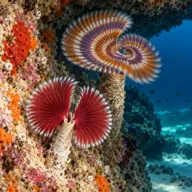
Tube worms
Almost always · Serpulid and sabellid fan worms

Damselfish
Almost always · Chromis chromis
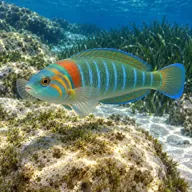
Ornate wrasse
Almost always · Thalassoma pavo · Summer
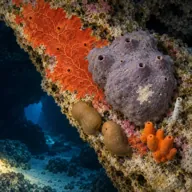
Encrusting sponges
Almost always · Various
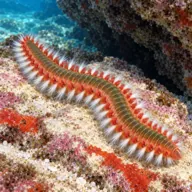
Fireworm
Almost always · Hermodice carunculata
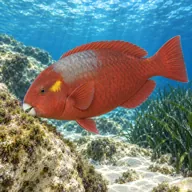
Mediterranean parrotfish
Often · Sparisoma cretense
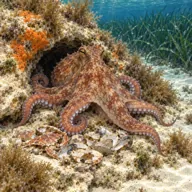
Octopus
Often · Qarnit
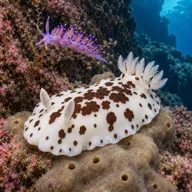
Nudibranchs
Often · Various doris species · Spring

Cardinalfish
Often · Apogon imberbis
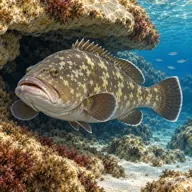
Dusky grouper
Sometimes · Ċerna
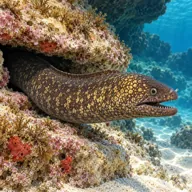
Moray eel
Sometimes · Morina
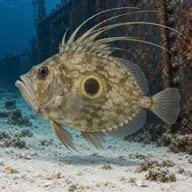
John Dory
Lucky day · Zeus faber · Winter and spring
Getting in and staying safe
Drive up past Dwejra Tower and park on the rocky ground at the end of the road, then carry your kit roughly two hundred metres over bare, uneven coralline limestone. It is a genuinely unpleasant walk with a twin set and it is worse coming back. Steps have been cut into the rock down to the pool, and there is a fixed ladder for the last bit. The exit is the crux: in any swell you want to time your grab on the ladder with the surge rather than fight it. Cafes, kiosks, toilets and showers are back down at the Inland Sea car park, not here.
- Awkward two hundred metre carry over rough, ankle turning rock
- Exit on the ladder becomes genuinely dangerous in swell, time it with the surge
- Surge through the arch on a westerly
- Sharp edges and urchins on the rim
- Snorkellers, freedivers and jumpers above you in summer
- Deep water immediately outside the arch, the boulder slope keeps going past forty metres
- Crowded pool with several dive groups kitting up at once
A bit of history
The hole is a small collapse in the Lower Coralline Limestone, a solution and erosion feature that the sea eventually broke into through the arch at nine metres. Until March 2017 the walk out to it passed under the Azure Window, and the shoreline around the pool is still littered with the fresh, pale scars of that collapse. Walking on the arch was outlawed and fined in late 2016 in an attempt to protect both the rock and the tourists, a few months before it came down of its own accord.
Divers say
Sign in to rate this site and leave a note for the next diver.
- No reviews yet. First one gets bragging rights.
Further reading: Atlantis Gozo, Blue Hole · PADI dive site, Blue Hole Dwejra · DiveWise Malta, the Blue Hole Gozo · Snorkeling Report, Blue Hole Gozo