Dwejra · Gozo
Rogers Cave
Two rocks poke out of the water about thirty metres off the Dwejra shore, and underneath the larger one sits a coral lined cavern with a proper drop-off falling away beside it.
Sea conditions
Excellent right now
Flat, sheltered and calm
Forecast for the site, updated 01:33 AM
- Waves
- 0.3 m
- from SE
- Wind
- 8 km/h
- SSW, gusts 14
- Swell
- 0.2 m
- 5 s period
- Sea temp
- 28 °C
- air 27 °C
Next 7 days
Sunrise 06:47, sunset 19:06
Exposed to wind and swell from: W (270°), NW (315°), SW (225°), S (180°). The rocks sit out in the open on an exposed western coast and there is no sheltered pool to hide in, so this one goes off the list earlier than the Blue Hole does. Pick a flat morning. Best season: May to October.
The dive
The locals call the pair Skuljetti, the little rocks, and divers long ago nicknamed them Big Bear and Little Bear. From the surface they look like nothing much. Underneath, the ground runs out at about five metres and then simply stops, and a vertical drop-off falls away directly below the rocks.
Rogers Cave is tucked beneath them. It is a cavern rather than a tunnel system, its sides and roof dressed in small corals and sponges, and it shelters the sort of residents that like a roof over their heads: slipper lobsters wedged into cracks, brown meagre hanging in the gloom, groupers that watch you from the back and then decide you are not interesting.
The standard route takes you into the cavern first, then out and right, following the wall around the bigger rock so you finish the circuit where you started. Boulders of every size are scattered across the seabed around the base, and the depths worth diving run from about twenty down to forty.
It sees fewer divers than the Blue Hole crowd a few hundred metres north, which is part of its charm, and it pairs naturally with Crocodile Rock if you have a boat.
- Cavern under Big Bear with corals and sponges on the roof
- Slipper lobsters, groupers and brown meagre sheltering inside
- Vertical drop-off starting almost under the shoreline rocks
- Quieter than the famous Dwejra entries just up the coast
- Pairs neatly with Crocodile Rock on a boat day
Typical plan
Drop in inshore of Big Bear, swim out over the five metre shelf and down the drop-off to the cavern in the low twenties. Look around inside with a torch, come out and turn right, then circle the larger rock along the wall at twenty five to thirty metres before spiralling up the boulders. Finish on the shallow shelf for your stop. Forty five minutes suits it, nitrox 32 is worth using, and keep a torch and a backup with you.
What the bottom looks like
- 1Big Bear and Little Bear at the surface6 m deep · 25 m out
- 2Vertical drop-off directly under the rocks14 m deep · 40 m out
- 3Rogers Cave, coral lined cavern beneath Big Bear22 m deep · 55 m out
- 4Scattered boulders around the base30 m deep · 85 m out
- 5Wall continuing towards Crocodile Rock38 m deep · 120 m out
Rocky shelf at five metres, then vertical limestone and a scatter of boulders of all sizes on the slope below.
Who you might meet
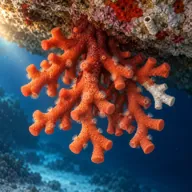
False coral
Almost always · Myriapora truncata
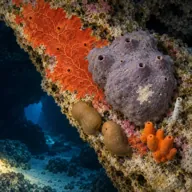
Encrusting sponges
Almost always · Various

Cardinalfish
Almost always · Apogon imberbis
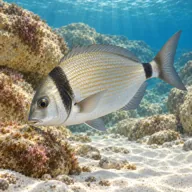
Two banded seabream
Almost always · Diplodus vulgaris
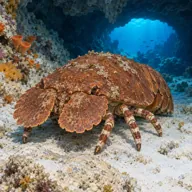
Slipper lobster
Often · Scyllarides latus
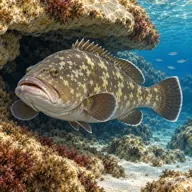
Dusky grouper
Often · Ċerna
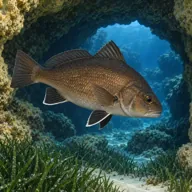
Brown meagre
Often · Sciaena umbra
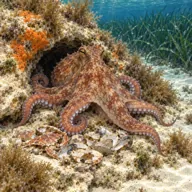
Octopus
Often · Qarnit
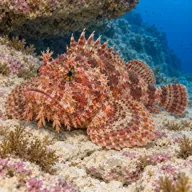
Scorpionfish
Often · Scorpaena species
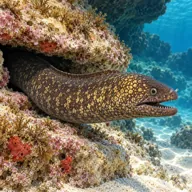
Moray eel
Sometimes · Morina
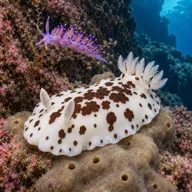
Nudibranchs
Sometimes · Various doris species · Spring
Getting in and staying safe
Shore access from the Dwejra headland, between Big Bear and Little Bear, which means parking on the rough ground near Dwejra Tower and walking your kit over bare limestone. Several groups prefer to enter at the Blue Hole or Coral Gardens and swim south, which is a longer fin but a much kinder carry. The rocks are only about thirty metres offshore, so the surface swim itself is short. No facilities at the entry, everything is back at the Inland Sea car park.
- Overhead environment inside the cavern, take a torch and stay near the light
- Awkward rocky entry and exit that becomes unsafe in swell
- Drop-off right beneath the rocks, easy to go deeper than intended
- Surge around the rocks in westerly weather
- Slippery, uneven limestone on the walk in
- Long swim back if you enter at the Blue Hole
- Fishing line snagged around the rocks
A bit of history
The rocks are erosion remnants of the same Lower Coralline Limestone headland, left standing offshore as the cliff line retreated, and the cavern beneath them was cut along weaknesses in that rock. The Maltese name Skuljetti simply describes what they are, small rocky islets, and the diving names Big Bear and Little Bear came from their silhouettes.
Divers say
Sign in to rate this site and leave a note for the next diver.
- No reviews yet. First one gets bragging rights.
Further reading: Atlantis Gozo, Skuljetti and Rogers Cave · Dive Systems Malta, Coral Gardens and Big Bear · Visit Gozo, diving in Gozo