Dwejra · Gozo
Crocodile Rock
A low, crocodile shaped rock sitting offshore between Dwejra Point and Fungus Rock, with a shallow plateau on top, a natural amphitheatre carved into one side and a sheer wall that keeps going well past forty metres.
Sea conditions
Excellent right now
Flat, sheltered and calm
Forecast for the site, updated 01:33 AM
- Waves
- 0.3 m
- from SE
- Wind
- 8 km/h
- SSW, gusts 14
- Swell
- 0.2 m
- 5 s period
- Sea temp
- 28 °C
- air 27 °C
Next 7 days
Sunrise 06:47, sunset 19:06
Exposed to wind and swell from: W (270°), NW (315°), SW (225°), S (180°), N (0°). An offshore rock on the open western side of Gozo, so it is a settled weather dive only and the outer face can be lumpy even on a decent day. Best in the morning before the sea breeze fills in. Clear water is almost guaranteed, which is both the attraction and the trap. Best season: June to October.
The dive
It earns its name from the profile above water, a long flat snout lying in the sea about a hundred and fifty metres off the headland. The boat anchors on a shallow plateau that sits between roughly four and twelve metres, which is where the dive starts and where it finishes.
On the southern side the rock is cut into what divers call the amphitheatre, a square notch with near vertical sides dropping to about eighteen metres and stuffed with life. That is the easy way down. On the seaward side the ground simply falls off a cliff, a sheer drop from around eight metres to forty and then deeper still, past fifty and on towards sixty five in places.
Because the rock stands out in open water, it sees pelagic traffic that the sheltered inshore sites do not. Amberjack, bonito, dentex and barracuda come through, tuna are possible, and the wall itself carries groupers, eels and octopus in the cracks with sponges and coralites over everything. The usual route is a lap of the rock, anticlockwise, with the depth chosen to suit training and gas.
The visibility works against you here. It is so good that forty metres does not look like forty metres, and people quietly run up decompression they did not plan for.
- Sheer wall from eight metres down past forty on the seaward side
- The amphitheatre notch, a gentler eighteen metre descent packed with life
- Best chance on this coast of running into amberjack, bonito and barracuda
- Shallow plateau on top for a relaxed, colourful decompression
- Offshore setting between Dwejra Point and Fungus Rock
Typical plan
Off the boat onto the plateau, drop through the amphitheatre or over the eastern edge, then circle the rock anticlockwise at a depth matched to your training, typically thirty to forty metres for advanced divers and eighteen to twenty five for everyone else. Keep an eye out into the blue, turn on gas rather than on time, and come back up onto the plateau to finish shallow. Nitrox or trimix depending on the plan, a torch for the wall cracks, and a delayed surface marker is not optional out here.
What the bottom looks like
- 1Shallow plateau where the boat anchors7 m deep · 15 m out
- 2The amphitheatre, a notch cut into the southern side18 m deep · 45 m out
- 3Edge of the sheer drop on the seaward face24 m deep · 60 m out
- 4Vertical wall with sponges and false coral36 m deep · 85 m out
- 5Small coral filled cave sections in the wall44 m deep · 110 m out
- 6Deep ground towards Fungus Rock62 m deep · 195 m out
Bare limestone plateau on top, sheer rock faces below, with boulders and coarse debris collecting at the foot of the wall.
Who you might meet
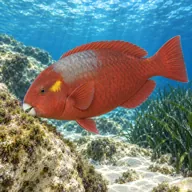
Mediterranean parrotfish
Almost always · Sparisoma cretense
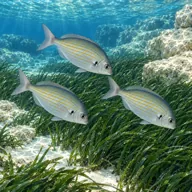
Salema
Almost always · Sarpa salpa
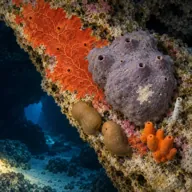
Lace corals and sponges
Almost always · Myriapora and encrusting species
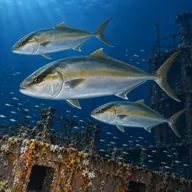
Amberjack
Often · Aċċola · Late summer and autumn
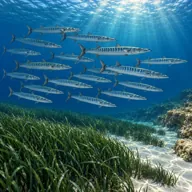
Barracuda
Often · Lizz · Late summer
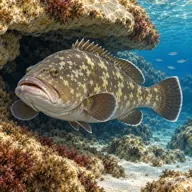
Dusky grouper
Often · Ċerna
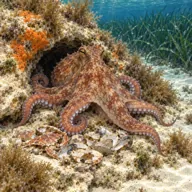
Octopus
Often · Qarnit
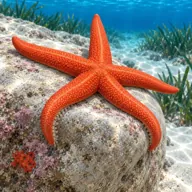
Starfish
Often · Hacelia attenuata
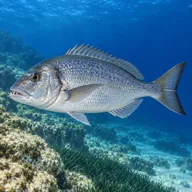
Common dentex
Sometimes · Dentex dentex
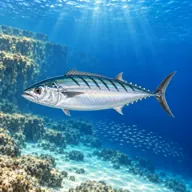
Atlantic bonito
Sometimes · Sarda sarda · Autumn
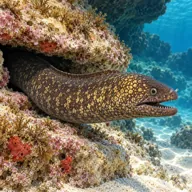
Moray and conger eel
Sometimes · Morina
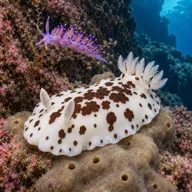
Nudibranchs
Sometimes · Various doris and flabellina · Spring
Getting in and staying safe
Realistically a boat dive, about ten minutes in a fast boat from Xlendi Bay, with the skipper anchoring on the shallow plateau. A handful of very fit, very committed divers do it as a shore dive from Dwejra with a long surface swim, but that leaves you a very long way from an exit if anything goes wrong. There is nothing at the rock itself, so eat, drink and use the toilet before you leave the harbour.
- Genuinely deep, the wall passes forty metres and keeps going
- Exceptional visibility makes depth hard to judge, watch the computer not the view
- Choppy water, surge and slight currents along the outer wall
- Exposed offshore position with no shelter and no shore exit
- Boat traffic and other dive boats around the plateau
- Narrow passages in the small cave sections can get tight
- Decompression obligation and gas planning on a site with a surface swim to nowhere
A bit of history
The rock stands between Dwejra Point and Fungus Rock, the sea stack the Knights of St John called Il-Ġebla tal-Ġeneral and guarded fiercely, because the rare parasitic plant growing on its top was believed to be a powerful medicine. Dwejra Tower, the 17th century watchtower built by the Order, overlooks the whole scene from the shore. Like everything else here, the rock is a remnant of Lower Coralline Limestone left behind as the cliff line retreated.
Divers say
Sign in to rate this site and leave a note for the next diver.
- No reviews yet. First one gets bragging rights.
Further reading: Gozo Dive, Crocodile Rock · Calypso Sub Aqua Club, Crocodile Rock · Atlantis Gozo, Crocodile Rock · Wikipedia, Dwejra Bay and Fungus Rock