🐟 Fish · Sarda sarda
Atlantic bonito
Plamtuin Maltese, also Palamit, Palamita, Plamitu
A striped torpedo, gone before you focus
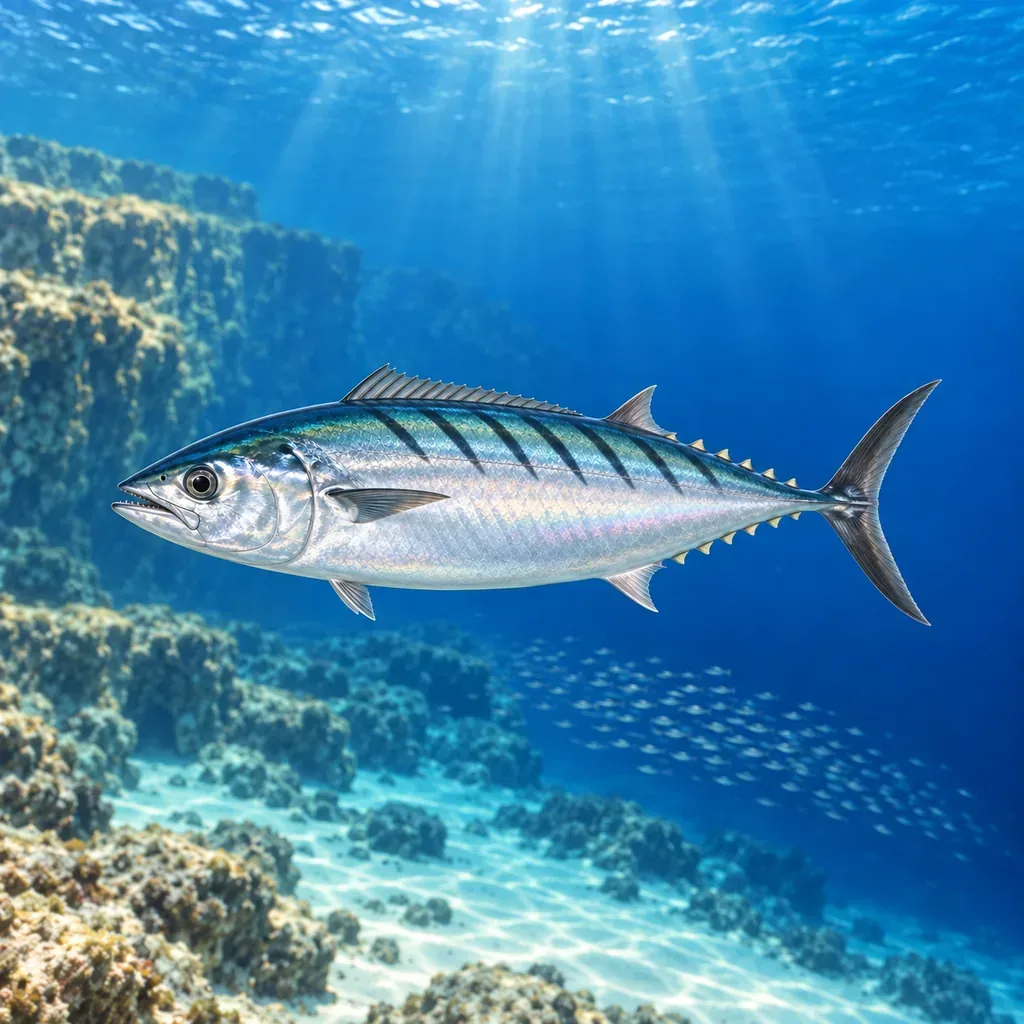
Meet the Atlantic bonito
The Atlantic bonito is a small, muscular member of the tuna and mackerel family, built like a polished metal spindle. The back is steel blue-green and carries somewhere between five and eleven dark stripes that run obliquely forward and downward, a pattern no other local tuna shows on its upper body. The flanks and belly are bright silver, the first dorsal fin is long and low, and a row of small separate finlets runs from the second dorsal and anal fins to the stiff, crescent tail. The mouth is full of small conical teeth. Divers in Malta usually meet fish of 40 to 55 cm, though the species can reach roughly 90 cm.
Bonito are open-water hunters that travel in fast, tight schools and follow shoals of sand smelt, picarel, sardine and bogue. Around the Maltese islands they show up where deep water comes close to the rock: the drop-offs at Ċirkewwa and Aħrax, the outer reefs of Comino, the walls at Dwejra and Xlendi, and along the Delimara and Munxar cliffs. They come in from the blue, sweep once or twice through the bait, and leave. Most sightings happen in the top 25 metres, often while you are still hanging in open water at the start or end of a dive.
They are a warm-season fish here. Numbers build from late spring, peak through late summer and autumn when the water sits in the mid twenties, and thin out again in winter. Maltese fishermen troll for plamtu along the same headlands, and it is a familiar, cheap, strongly flavoured fish on the market slab in autumn.
When to look: Late spring to autumn, when warm water pulls baitfish inshore, and usually in the first or last minutes of a dive while you are still in the blue.
Diving with them
- Look outward, not down: bonito appear against the blue at mid-water, often above or beyond a reef edge rather than on it.
- They are drawn to bait, so watch the far side of a sand smelt or picarel shoal for the flash of a fast silver body.
- Do not chase them; hang still and let the school swing back past you, which it often does two or three times.
- For photographs, pre-set a fast shutter and a tight focus point and shoot as they turn side-on, because their backs read as dark and featureless from above.
- They are a daytime, open-water fish and are almost never seen on a night dive.
Can it hurt you?Harmless
Harmless to divers. Bonito are fast fish-eaters with small teeth that have no interest in people and will not let you close enough to touch them.
Easily confused with
- Little tunny (Euthynnus alletteratus), which has wavy scribble marks only on the rear of the back and dark spots below the pectoral fin, never straight oblique stripes running the whole back
- Juvenile Atlantic bluefin tuna, which are deeper-bodied, plain-backed and have longer pectoral fins
- Chub mackerel, much smaller and slimmer with wavy vertical bars rather than slanting stripes
Where to meet them: 1 sites
Further reading: FishBase: Sarda sarda (size, depth, biology) · GBIF vernacular names for Sarda sarda, Maltese entries (Plamtu, Palamit, Pelamit)