🐟 Fish · Sardina pilchardus
Sardine
Sardinin Maltese, also Sardina, Sardina kaħla, Nemusa
Silver rivers moving through the open blue
Meet the Sardine
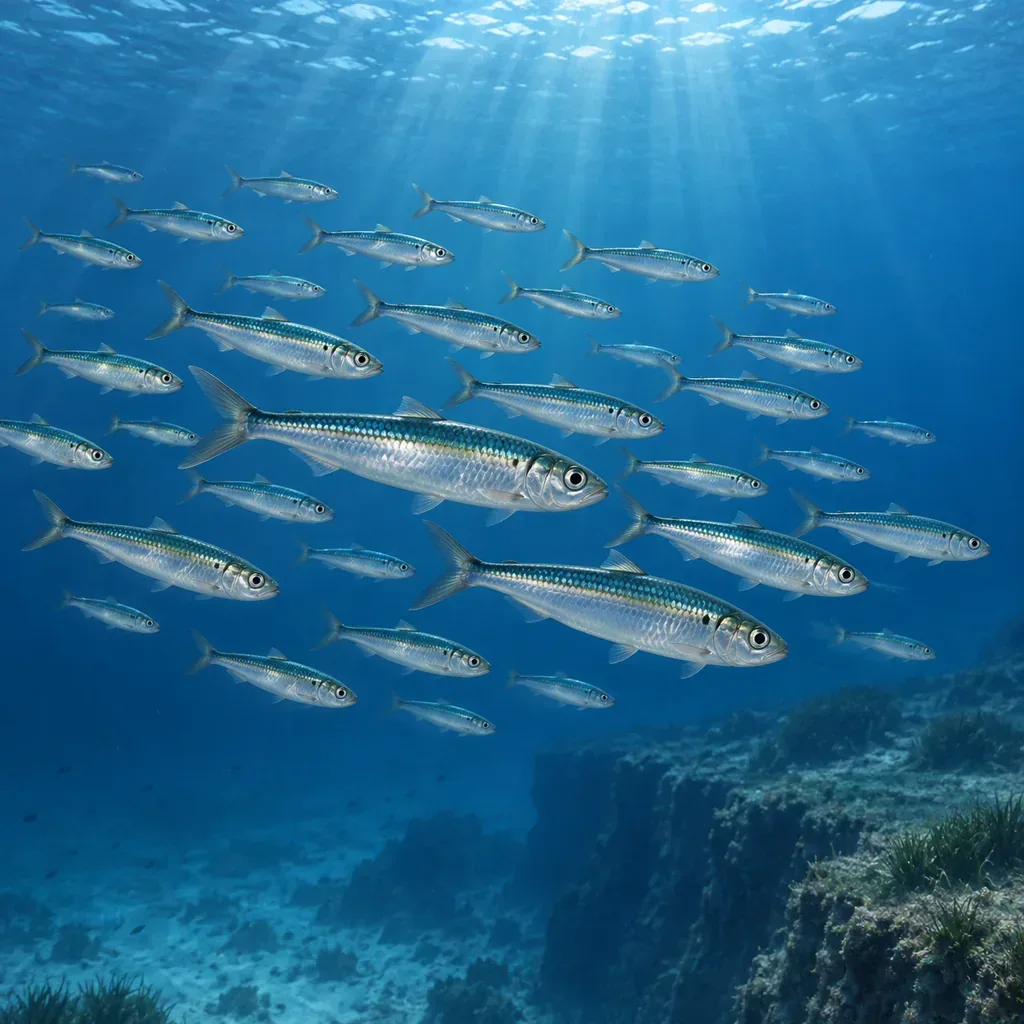
A small, streamlined, round-bellied fish with a deep blue-green back, brilliant mirror-silver flanks and a white belly, usually with a faint row of dark spots just behind the gill cover. The scales are large and come away easily, the single dorsal fin sits forward on the back and the tail is deeply forked. Maltese fish are typically 12 to 18 cm, with about 27 cm as the recorded maximum.
Sardines live in the open water, not on the reef, and they live as a crowd. A shoal is a single shifting sheet of silver that flashes and darkens as the fish turn together, and a diver's first sign is usually a change in the light rather than a fish. They spend the day deeper and rise towards the surface at night to feed on plankton, which they strain through fine gill rakers. Around Malta and Gozo you meet them in open blue water off headlands and over deep drop-offs, and in winter and spring they come closer inshore and into the harbours.
They matter enormously as food. Almost everything larger in Maltese waters, from amberjack and bonito to tuna, barracuda and terns, feeds on small shoaling fish, so where the sardines are, the predators are not far away. A shoal being hit from below is one of the best things you can see in the blue here.
When to look: Mostly autumn through spring in cooler inshore water, and any time of year out in the blue off headlands and drop-offs.
Diving with them
- Watch the blue, not the reef, and look up as well, shoals often pass between you and the surface
- Do not chase, hold still with slow breathing and the shoal will often open and re-form around you
- Look for the shoal shape changing suddenly, a tightening ball or a flashing scatter means a predator is working underneath
- Exhale less on approach if you can manage it safely, bubble bursts push a shoal away faster than movement does
- For photography, shoot upwards into the light with the strobe off, the flank silver does the work
- In harbours and marinas at night, dive lights pull plankton and small shoals right into the beam
Can it hurt you?Harmless
Entirely harmless. Sardines have no venom, no teeth of any consequence and no interest in divers.
Easily confused with
- Round sardinella (Sardinella aurita), the Maltese laċċa, which is slimmer, more cylindrical and has a faint golden line along the flank
- European anchovy (Engraulis encrasicolus), which has a pointed snout overhanging a very large mouth that opens back beyond the eye
- Bogue and picarel, which hang in looser shoals near the reef rather than in tight open-water sheets
- Sand smelt, which are smaller, more transparent and stay in the top metre or two close inshore
Where to meet them: 2 sites
Further reading: FishBase: Sardina pilchardus, Malta country page with Maltese names · FishBase: Sardina pilchardus common names list · IUCN Red List: Sardina pilchardus · Fish for Tomorrow: sardine, Mediterranean stock and gear notes