🐟 Fish · Thunnus thynnus
Atlantic bluefin tuna
Tonnin Maltese
A living torpedo that arrives out of the blue
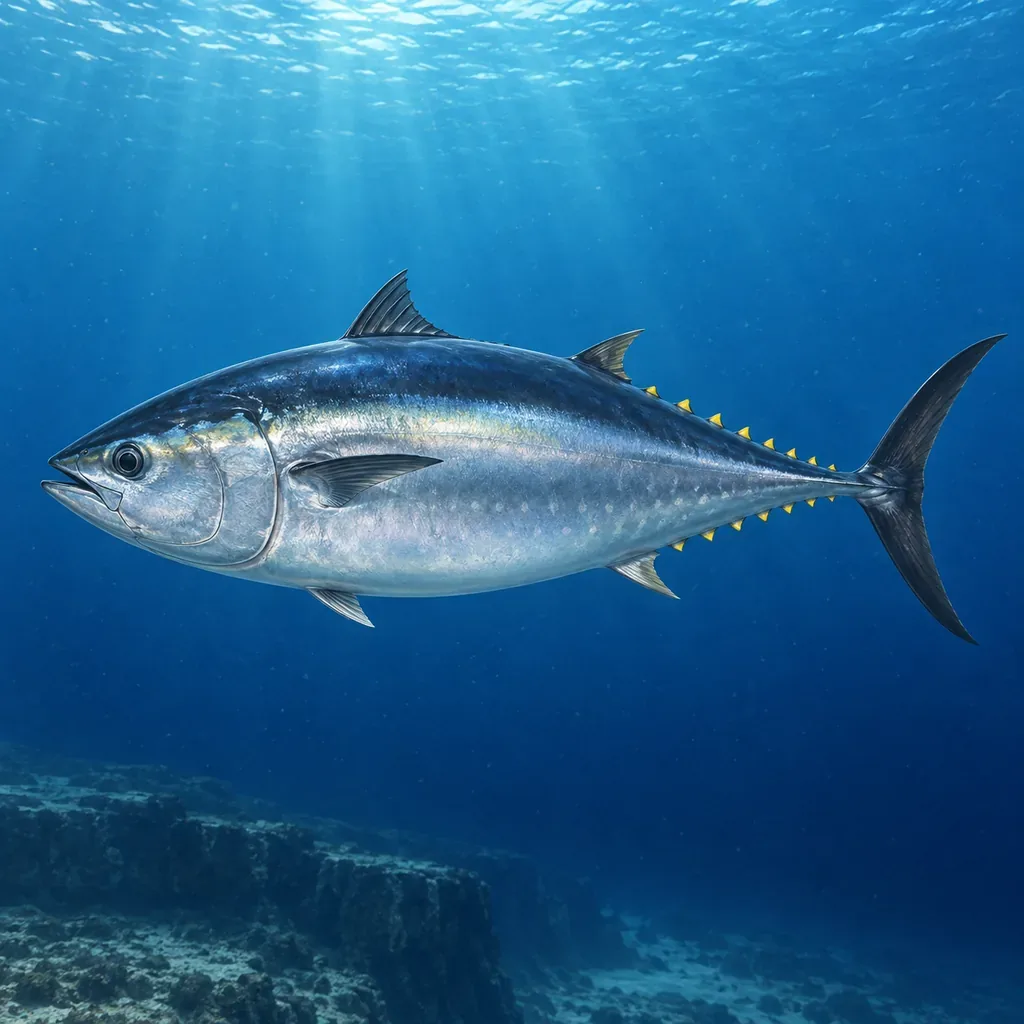
Meet the Atlantic bluefin tuna
The biggest bony fish most divers will ever meet in the Mediterranean, and the fastest. The body is a perfect metal-bright spindle: deep blue-black across the back, polished silver on the flanks with faint pale spots and bars in live fish, and a white belly. The pectoral fins are short, the tail is a stiff crescent, and a row of small yellow finlets runs along the top and bottom of the tail stock. Everything about it is built to shed drag, right down to fins that fold into slots.
Mediterranean fish you might see are commonly 150 to 250 cm and a few hundred kilos, with the species reaching three metres and well over 400 kg. They travel in small groups or singly, cruising fast through open blue, and an encounter is usually over in seconds: a shape hardens out of the haze, passes, and is gone.
Around the Maltese islands divers meet them off the deeper drop-offs and open-water sites around Gozo and Comino, most often in the warmer half of the year when bluefin come into the Mediterranean to spawn. Malta also has a large tuna ranching industry, and pens off the coast hold thousands of fish; a handful of operators run dives inside those pens, which is one of the very few places in the world you can do it.
When to look: May to October, when bluefin are in the Mediterranean to spawn and the tuna pens are stocked; encounters are luck, not schedule.
Diving with them
- Look outwards into the blue, not at the reef - almost every sighting in Malta happens at the edge of visibility
- Do not chase or swim at it; stay still, stay horizontal and it may make a second pass
- Bubbles turn them away, so if you are on open circuit expect one look and no more
- A sudden hard ball-up in a bogue or sand smelt shoal is often the first sign one is working the area
- Hold the camera still and pan rather than tracking; at their speed autofocus will not keep up
Can it hurt you?Harmless
No threat to divers. It is a fast-moving open-water predator with no interest in people, and the only sensible caution is not to put yourself in its path or try to touch one.
Easily confused with
- Atlantic bonito (Sarda sarda) - much smaller with dark oblique stripes along the back
- Albacore (Thunnus alalunga) - very long sabre-like pectoral fins reaching past the middle of the body
- Greater amberjack (Seriola dumerili) - slimmer, bronze-tinted, with a dark bar through the eye and no finlets
Where to meet them: 26 sites
Small World
Malta
Further reading: IUCN - 2021 Red List update downlisting Atlantic bluefin tuna · Wikipedia - Atlantic bluefin tuna · Bluefin tuna fishery policy in Malta (tunnara, ranching, ICCAT quota) · Lovin Malta - inside Malta's bluefin tuna pens