🐟 Fish · Seriola dumerili
Greater amberjack
Aċċolain Maltese, also Ċervjola
Muscle and chrome, cruising past the wreck
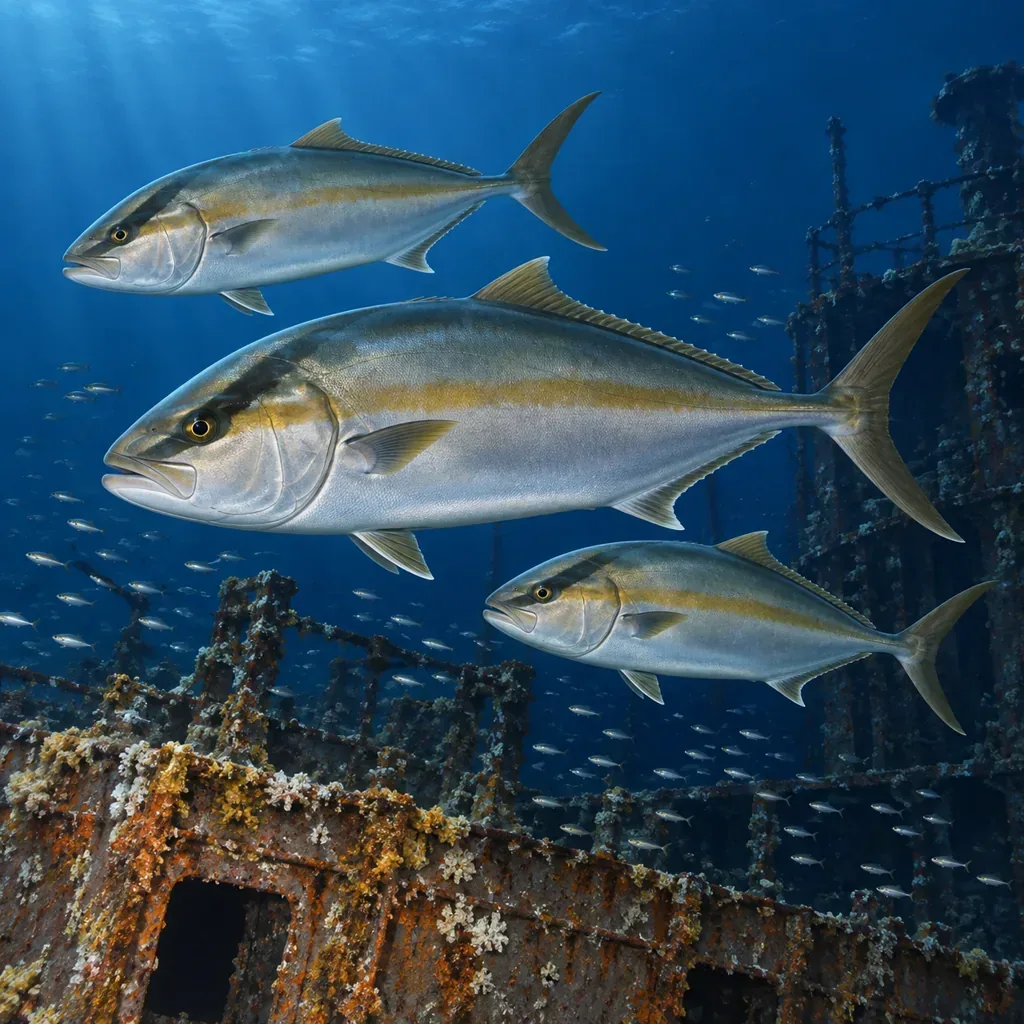
Meet the Greater amberjack
A powerful, streamlined fish with a smoothly tapered body, a small pointed head and a stiff, deeply forked tail built for speed. The back is steel blue to olive-bronze, the flanks are silver, and a soft amber or brassy band runs from the gill cover along the middle of the body, brightening when the fish is excited. A dark diagonal stripe runs from the snout through the eye up to the front of the dorsal fin, which is the quickest way to name it. Juveniles are boldly barred with five or six dark vertical bands.
Amberjacks are open-water hunters that come in to structure. Around Malta and Gozo they are best known from the scuttled wrecks and the deeper reef points, where groups of a few to a few dozen sweep past, often circling divers once out of plain curiosity before accelerating away. They also drive shoals of bogue and sand smelt up against walls, and a sudden silver panic overhead usually means aċċola. Divers meet them mostly between 10 and 70 m.
The name aċċola is familiar in Maltese fish markets and to sport fishermen; Il-Miklem also records ċervjola for the same fish, a name shared with the leerfish.
When to look: Late spring to autumn is best, with the biggest groups over wrecks and deep points in warm water; single large fish turn up all year.
Diving with them
- Look up and out into the blue, not at the reef, especially on the first few minutes of a wreck dive before the noise of the group spreads
- Stay level and calm; a diver who stops and hangs still is often circled, while a diver who swims at them is left behind instantly
- Watch for bait shoals suddenly balling or flashing, which is the tell that amberjacks are hunting
- Available-light wide angle beats strobes; aim to shoot upward so the amber flank band catches the surface light
- They are fast, so pre-focus on the blue at a fixed distance and let them swim into it
Can it hurt you?Harmless
Harmless to divers. They are big and fast and can come close, but they have no interest in you beyond curiosity.
Easily confused with
- Leerfish (Lichia amia, Ċervjola) has a strongly wavy lateral line and a more compressed, slab-sided body
- Almaco and Mediterranean amberjack (Seriola species) are very similar but have a steeper head profile and a higher front dorsal lobe
- Common dentex (Dentex dentex) is a similar size in the blue but is a deeper-bodied, blunt-headed seabream with visible canine teeth
Where to meet them: 86 sites
Further reading: Dive Shack Malta marine life guide – greater amberjack · Il-Miklem – Aċċola (Seriola dumerili) · FishBase – Seriola dumerili · Wikipedia – Greater amberjack