Xwejni Bay · Gozo
Double Arch
Two enormous natural arches stacked one above the other on an offshore reef north of Xwejni, with barracuda hanging over the top and the ground falling away to 45 metres and beyond. The best-looking deep reef dive on Gozo's north coast.
Sea conditions
Excellent right now
Flat, sheltered and calm
Forecast for the site, updated 01:33 AM
- Waves
- 0.4 m
- from ESE
- Wind
- 6 km/h
- SSW, gusts 15
- Swell
- 0.3 m
- 5 s period
- Sea temp
- 28 °C
- air 27 °C
Next 7 days
Sunrise 06:47, sunset 19:06
Exposed to wind and swell from: NW (315°), N (0°), NE (45°). Offshore on the north coast, so any northerly component rules it out for shore access and makes the boat drop uncomfortable. Current is often noticeable on the reef top even when the surface looks flat. Best in a settled southerly. Best season: May to October, with the cleanest water and calmest north coast in September and October..
The dive
Double Arch is the postcard. A T-shaped reef sits about 200 metres off Xwejni with its crown at 15 to 18 metres, and around the corner the rock has been hollowed twice, one arch sitting directly on top of the other like a window and a doorway cut in the same wall. Swim through the lower opening and the floor beneath you is at 34 metres.
The approach matters. Some divers swim it from the slipway, which is honest work and a big chunk of gas; plenty use a scooter, and most centres simply drop you on it from a boat. However you arrive, drop onto the reef top first, get your bearings, then descend the flank to the arches rather than plunging straight to the sand.
The reef top usually has something moving over it. Big shoals of barracuda are common, dentex and amberjack cruise past, and the deeper ledges at 40 metres hold grouper that have clearly been there a while. Small caves pit the rock near the arches, with a larger cavern around 35 metres a little further out for divers with the training to use it.
Past the arches the outer wall keeps going beyond 50 metres. That is technical ground. For a recreational diver, the arch at 20 to 34 metres is already the whole point of the trip.
- Two natural arches stacked vertically, unusual anywhere in the Med
- Barracuda shoals over the reef top most of the season
- Grouper on the ledges at 40 metres
- A 35 metre cavern nearby for suitably trained divers
- Wall continuing past 50 metres for technical teams
Typical plan
Boat drop or a ten minute swim from Xwejni. Descend onto the reef top at 16 metres, head around the corner and drop through the upper arch, spending a few minutes at 30 to 34 metres beneath the spans. Work back up the flank, tour the reef top at 16 to 18 metres and keep a decent shallow phase before ascending. Nitrox 28 to 32 suits it well; keep it inside no-decompression limits at around 35 to 40 minutes, or plan it properly with staged deco if you want the 45 metre end of the reef. Carry an SMB and a torch for the small caves.
What the bottom looks like
- 1T-shaped reef top16 m deep · 220 m out
- 2Upper arch, springing from about 20 metres20 m deep · 300 m out
- 3Lower arch directly beneath the upper one28 m deep · 315 m out
- 4Floor under the arches34 m deep · 322 m out
- 5Small caves pitting the rock near the arches30 m deep · 345 m out
- 6Larger cavern further out along the wall35 m deep · 380 m out
- 7End of the reef, wall dropping past 50 metres45 m deep · 420 m out
Hard limestone reef and rubble slopes, with coarse sand collecting in the gullies and beneath the arches.
Who you might meet
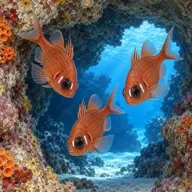
Cardinalfish in the small caves
Almost always · Sultan iċ-ċawl
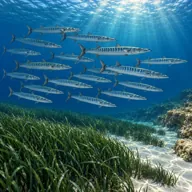
Barracuda
Often · Lizz · Summer and autumn
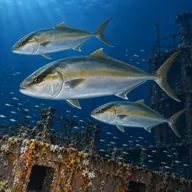
Amberjack
Often · Aċċola · Summer
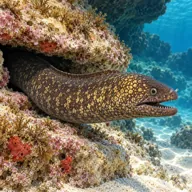
Mediterranean moray
Often · Morina
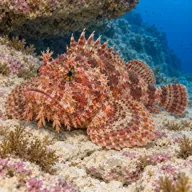
Scorpionfish
Often · Skorfna
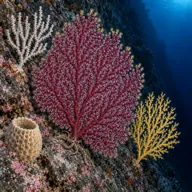
Encrusting sponges and gorgonians on the deeper wall
Often
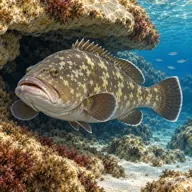
Dusky grouper
Sometimes · Ċerna
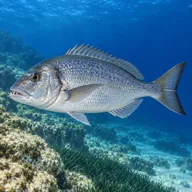
Dentex
Sometimes · Dentiċi
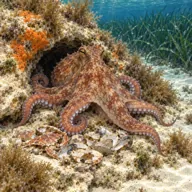
Common octopus
Sometimes · Qarnita
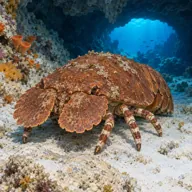
Slipper lobster
Lucky day · Ċkala
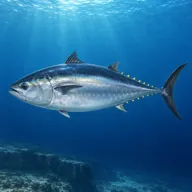
Tuna passing in the blue
Lucky day · Tonn · Summer
Getting in and staying safe
Shore divers park on the coast road at Xwejni, enter at the slipway, and swim roughly ten minutes northwest on the surface or on a compass bearing underwater. It is a genuinely long haul with twin sets and a reason many people use a scooter or book a boat. Boat drops are straightforward and are the usual way dive centres run it. Facilities are the Xwejni kiosk and, a few minutes away, Marsalforn.
- Depth: easy to end up in the high 30s or 40s without noticing
- Long surface swim from shore, with fatigue on the return
- Current over the reef top and around the arches
- Offshore position with boat traffic overhead; carry an SMB
- Narcosis in the arch and at the deeper cavern
- Getting separated in low light under the arches
A bit of history
The arches are erosional, formed where the sea exploited bedding planes and joints in the Upper Coralline limestone of this offshore reef, cutting through and leaving two spans of rock stacked vertically. Gozo lost its most famous rock arch when the Azure Window at Dwejra collapsed in March 2017, which sharpened local appreciation for the ones that remain underwater and out of the weather.
Divers say
Sign in to rate this site and leave a note for the next diver.
- No reviews yet. First one gets bragging rights.
Further reading: Malta Dives, Double Arch · Dive Systems Malta, Double Arch Marsalforn · Gozo Dive, Double Arch Reef · Blue Waters Dive Cove, Double Arch · Blue Hole Diving Gozo, Double Arch