🦞 Crustaceans · Scyllarides latus
Mediterranean slipper lobster
Ċkalain Maltese, also Ċikala, Ċkala ħamra, Xkall
A flat armoured tank wedged in the dark
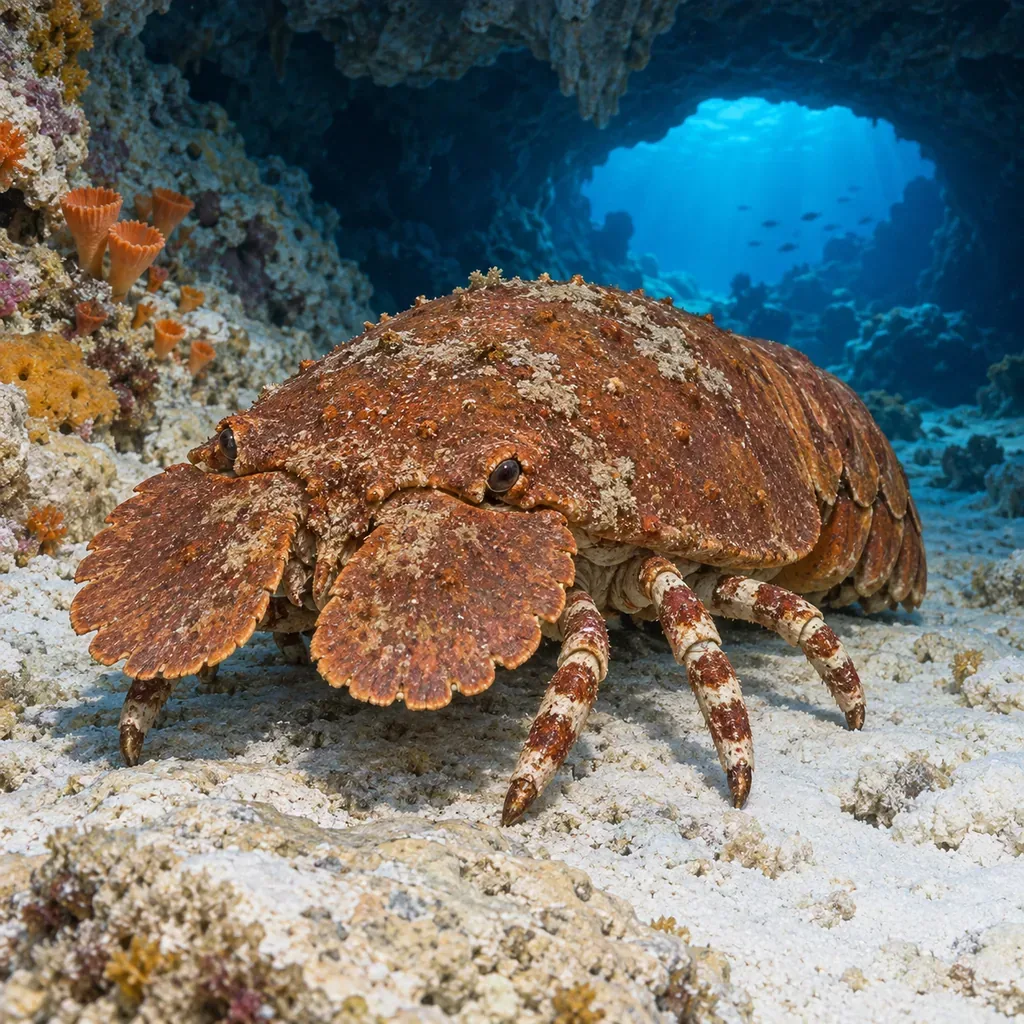
Meet the Mediterranean slipper lobster
This is the odd one out among Mediterranean lobsters: a broad, flattened animal the colour of wet terracotta, reddish brown to orange, with no claws at all and no long whip antennae. Instead it carries two stubby, flattened antennal plates at the front that look like shovels or bulldozer blades, and its back is studded with hard tubercles that often carry a fur of bryozoans and algae. Adults are usually around 30 cm long, with big ones reaching 45 cm and roughly 2 kg.
Around Malta and Gozo it lives on rocky reef and in the caves and deep crevices that riddle the limestone, from about 5 m down to well past 100 m. Divers most often meet it between 15 and 50 m, tucked head-first into a hole with only the front plates showing, or clinging upside down on a cave ceiling. It is nocturnal and solitary, coming out after dark to crunch mussels and other shelled molluscs with powerful mouthparts.
It is one of the animals Maltese and Gozitan cave dives are known for. Billinghurst Cave off Reqqa Point in Gozo has a long association with them, and they also turn up in the overhangs at Ċirkewwa and in the darker recesses of wreck superstructure. Heavy collection has made large animals scarce, so a good one is a genuine find rather than an everyday sighting.
When to look: All year, best on night dives or deep inside caves where it sits out the daylight.
Diving with them
- Look for the pair of flat front plates and a faint gleam of eyes at the back of a hole rather than for a whole animal.
- Sweep cave ceilings and the underside of overhangs with your torch; they cling upside down as readily as they sit on the floor.
- Keep the beam off it for more than a few seconds and it will start backing away, so frame the shot first and light it last.
- It grips rock so hard that people have injured animals trying to pull them off; photograph it where it sits and leave it there.
- On night dives look on open reef between 10 and 30 m, where it walks slowly over the rock hunting shellfish.
Can it hurt you?Harmless
Harmless. It has no claws and no venom, and its only defence is to grip the rock or flip backwards with its tail.
Easily confused with
- Small European locust lobster (Scyllarus arctus), the same shape but only about 10 cm long and marked with dark bands
- Common spiny lobster, which shares the caves but has very long whip antennae and a spiny, non-flattened body
Where to meet them: 70 sites
Further reading: Wikipedia: Scyllarides latus · SeaLifeBase common names, including Maltese · Diveshack Malta marine life guide · Barcelona Convention SPA/BD Protocol annexes