Malta
HM Drifter Eddy
A small steel minesweeping drifter sitting upright and lonely on sand at 56 m, a mile and a half off Fort St Elmo. She was hunting mines when one found her in May 1942, and the hole it made is still the way in.
Sea conditions
Good right now
Some chop (0.5 m E)
Forecast for the site, updated 01:45 AM
- Waves
- 0.5 m
- from E
- Wind
- n/a
- Swell
- 0.5 m
- 5 s period
- Sea temp
- 29 °C
Next 7 days
Exposed to wind and swell from: N (0°), NE (45°), E (90°), SE (135°). The site sits off a north east facing coast, so any northerly or easterly wind builds a lumpy surface over the shot and makes deco hanging miserable. Southerly and westerly winds give the calmest days. Visibility on the wreck is often good, but harbour traffic and weather windows decide the dive as much as the swell does. Best season: May to October, on days with a southerly or westerly airflow.
The dive
Eddy is a compact wreck with an outsized story. Twenty seven metres of Aberdeen built steel, launched at the tail end of the First World War, sent to the Mediterranean and quietly put on the reserve list in Malta until the Second World War came looking for anything that floated. She was pressed back into service as a minesweeping drifter, given a gun forward and another over the wheelhouse, and wrapped in a degaussing cable in the hope that would keep the magnetic mines off her steel hull.
Today she stands upright on a sand plain, bows more or less proud, the wooden upper structure long since collapsed into a low tangle across the deck. The obvious feature is the wound: a large opening in the starboard side aft, big enough to swim through into the hold, which is precisely where the mine caught her. Inside is soft silt that will erase the visibility in a couple of careless fin strokes, so penetration is a slow, trim conscious business or no business at all.
This is not a wreck anybody dives casually. Fifty six metres puts it firmly in technical territory, and the site lies squarely in the approaches to one of the busiest harbour mouths in the central Mediterranean, so shipping movements dictate the day as much as the weather does. When it all lines up, though, you get a genuinely intact little warship that very few divers have ever laid eyes on.
- Small, upright and remarkably complete for an eighty year old war loss
- Swim through sized mine damage in the starboard quarter
- A genuine wartime minesweeper rather than a scuttled tourist wreck
- Rarely dived because of depth and harbour traffic, so it feels untouched
- Sand plain around the hull that draws in conger, octopus and forkbeard
Typical plan
Trimix, twin set or rebreather, shot line descent, boat cover throughout. A typical run is twenty to twenty five minutes of bottom time at 52 to 56 m, circling the hull once, looking into the mine damage and along the deck, with any penetration kept short, direct and reeled. That buys roughly sixty to ninety minutes of decompression depending on your mix and gradient factors, so plan for a long, exposed hang and carry a delayed marker plus a backup. Surface support that can move you off the shipping lane matters more than any of the kit.
What the bottom looks like
- 1Shot line touchdown on the sand56 m deep · 30 m out
- 2Mine damage, starboard side aft54 m deep · 42 m out
- 3Collapsed wheelhouse and superstructure52 m deep · 55 m out
- 4Open hold and deck fittings52 m deep · 70 m out
- 5Bow section55 m deep · 88 m out
- 6Open sand plain beyond the wreck56 m deep · 115 m out
Flat sand and light silt at 56 m, with the hull standing four or five metres proud of it.
Who you might meet

Cardinalfish
Almost always · Re tat-trilja
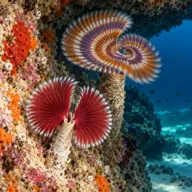
Tube worms
Almost always
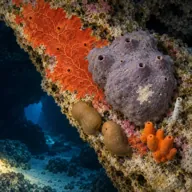
Encrusting sponges
Almost always · Sponża
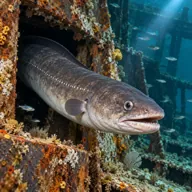
Conger eel
Often · Gringu
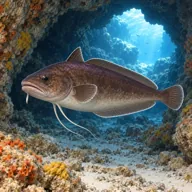
Forkbeard
Often · Lipp
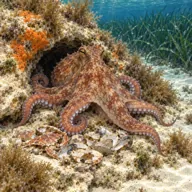
Common octopus
Often · Qarnit
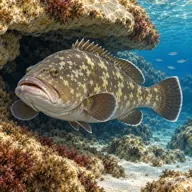
Dusky grouper
Sometimes · Cerna

Amberjack
Sometimes · Accola · Autumn
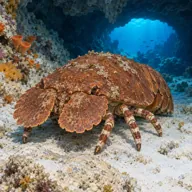
Slipper lobster
Sometimes · Cikala
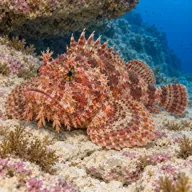
Red scorpionfish
Sometimes · Cippullazza
Getting in and staying safe
Boat only, out of Valletta, Sliema or the Marsamxett side. The run is short but the site sits in the shipping approach to Grand Harbour, so the skipper needs to be watching traffic and the team needs to be surfacing with big, visible markers and a boat that is genuinely on station. A shot line is standard practice. As a wreck more than fifty years old she falls under Malta's underwater cultural heritage protection, so book through a dive centre registered for these sites rather than turning up on a private boat and hoping.
- 56 m depth with a mandatory decompression obligation
- Heavy commercial and cruise shipping in and out of Grand Harbour
- Fine silt inside the hull that can black out the interior instantly
- Narcosis and gas density at depth on anything but trimix
- Limited natural light on the wreck
- Current across the site at times
- Permit and registered operator requirements for historic wrecks
A bit of history
HM Drifter Eddy, pennant FY12, was built by Alexander Hall in Aberdeen and launched on 6 August 1918. The steel vessel measured about 27 m by 6 m. She finished the First World War clearing mines off the south coast of England, then transferred to the Mediterranean Fleet and spent most of her career based in Malta, going onto the reserve list there in 1936. Recommissioned as a minesweeping drifter at the outbreak of the Second World War, she joined the 403rd Minesweeping Group in Malta in 1942, an odd one out in a flotilla of wooden hulled sweepers. On 26 May 1942, returning from clearing a channel that Italian E boats had mined the previous night, she struck a mine herself and sank quickly about 1.5 km off the Grand Harbour entrance. Eight of her crew were lost. Divers relocated the wreck on 26 October 1995.
Divers say
Sign in to rate this site and leave a note for the next diver.
- No reviews yet. First one gets bragging rights.
Further reading: Techwise Malta, HMS Drifter Eddy · Calypso Sub-Aqua Club, HMS Drifter Eddy · Wrecksite, HM Drifter Eddy · X-Ray Mag, Malta's deep wrecks · PADI dive site, HMS Drifter Eddy