Malta
HMS Hellespont
A Robust class paddle tug, bombed in Grand Harbour in April 1942, later filled with rubble and scuttled off Fort Rinella. She sits upright on sand with her deck at 35 m and the seabed at 41, minus the first fifteen metres of her bow.
Sea conditions
Good right now
Some chop (0.5 m E)
Forecast for the site, updated 01:45 AM
- Waves
- 0.5 m
- from E
- Wind
- n/a
- Swell
- 0.5 m
- 5 s period
- Sea temp
- 29 °C
Next 7 days
Exposed to wind and swell from: N (0°), NE (45°), E (90°), SE (135°). Sits off the north east facing Rinella shore, so northerly and easterly winds put a swell over the site and make deco stops unpleasant. Southerly and westerly airflow gives the flat, clear days you want. Visibility on the wreck is typically good, often 20 m or more. Best season: May to October, best on southerly or westerly wind days.
The dive
Hellespont is the most approachable of the deep Valletta wrecks and probably the most characterful. She was a paddle tug, a side wheeler built in 1910 with wheels in sponsons on either beam, and although the paddle boxes are long gone the outer edges of the wheel shafts are still there on both sides, which is the detail every diver goes down for. There is nothing else quite like it in Maltese waters.
She sits upright on clean sand with the deck around thirty five metres and the sand at forty one, which makes her a manageable dive for an experienced sport diver on nitrox with deco training, rather than a technical project. The hull is broadly intact aft of the break, with the machinery spaces, deck fittings and the massive towing arrangement all legible. Forward of that, roughly fifteen metres of bow is simply absent, torn away either by the bomb damage or by the postwar salvage and scuttling.
Because she was filled with rubble from bombed Valletta before being towed out and sunk, Hellespont carries a strange double cargo of history: a ship destroyed by the siege, stuffed with the wreckage of the city the siege destroyed. Divers get a tidy, photogenic wreck at a sensible depth. Historians get something a good deal more poignant.
- Paddle wheel shafts still visible on both beams, unique among Malta's wrecks
- Upright, largely intact and only 35 m to the deck
- The missing bow section makes a dramatic, obvious landmark
- Filled with rubble from bombed Valletta before being scuttled
- A deep wreck that experienced sport divers can realistically reach
Typical plan
Twin set or a large single with a stage, 28 to 32 percent bottom mix and 50 percent or oxygen for deco. Shot descent to the deck at 35 m, one circuit of the hull taking in the bow break, a paddle wheel shaft and the stern gear, dropping to the sand at 41 briefly for the profile shot. Twenty to twenty five minutes of bottom time for an average around 37 m, followed by fifteen to twenty five minutes of staged decompression, ideally on a deployed marker with the boat following. Keep off the rubble fill and you will keep the visibility.
What the bottom looks like
- 1Shot line onto the deck35 m deep · 26 m out
- 2Bow break where 15 m of hull is missing37 m deep · 34 m out
- 3Paddle wheel shaft, starboard side37 m deep · 50 m out
- 4Boiler and machinery space36 m deep · 58 m out
- 5Stern and towing gear40 m deep · 80 m out
- 6Sand plain around the hull41 m deep · 115 m out
Clean sand at 41 m with the hull standing five to six metres above it.
Who you might meet

Cardinalfish
Almost always · Re tat-trilja
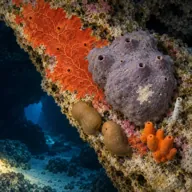
Encrusting sponges
Almost always · Sponża
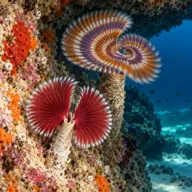
Tube worms
Almost always
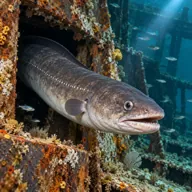
Conger eel
Often · Gringu
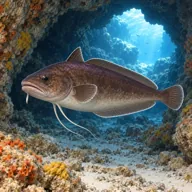
Forkbeard
Often · Lipp
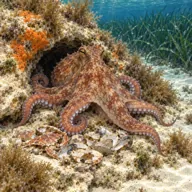
Common octopus
Often · Qarnit
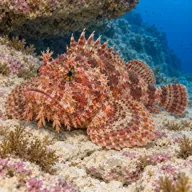
Red scorpionfish
Often · Cippullazza
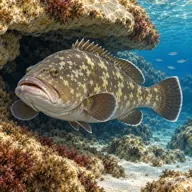
Dusky grouper
Sometimes · Cerna

Amberjack
Sometimes · Accola · Autumn

Barracuda
Sometimes · Lizz · Autumn
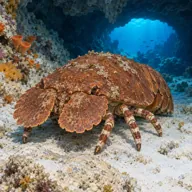
Slipper lobster
Sometimes · Cikala
Getting in and staying safe
Boat only, a short run out of Valletta, Sliema or the Three Cities. Operators normally shot the wreck and dive it on a live boat with a surface marker on ascent, since the site sits in open water near the harbour approaches. Being a wreck over fifty years old she is protected under Malta's cultural heritage rules, so dive her with a centre registered for historic wrecks. There is no shore option and nothing to swim to.
- 41 m maximum depth with decompression likely on any real bottom time
- Shipping traffic in and out of Grand Harbour on the surface
- Silt inside the hull and over the rubble fill
- Current across the site, particularly on the ascent
- Sharp corroded plating and collapsed structure at the bow break
- Snagged fishing line around the wreck
- Low light in the machinery spaces, carry a backup torch
A bit of history
Hellespont was a Robust class paddle tug built by Earle's Shipbuilding and Engineering at Hull and launched on 10 May 1910, about 46 m long. She spent the First World War at Haulbowline in Ireland and moved to Malta in 1922 as a dockyard and harbour tug. During the air raids of 6 and 7 April 1942 she was hit and sank in Grand Harbour. After the war, as the harbour was being cleared, her hull was raised, packed with rubble from the bombed shoreline, towed outside and scuttled off Fort Rinella, about 1.5 km beyond the harbour entrance, where she lies today. Divers relocated her on 15 May 1999.
Divers say
Sign in to rate this site and leave a note for the next diver.
- No reviews yet. First one gets bragging rights.
Further reading: Underwater Malta Virtual Museum, HMS Hellespont · Divewise Malta, HMS Hellespont wreck · Wrecksite, HMAV Hellespont · PADI dive site, HMS Hellespont