Malta
Schnellboot S-31
A German fast torpedo boat that struck a drifting mine off Valletta in May 1942 and went down with half her crew. She lies upright at 65 m with her torpedo tubes, engines and triple screws still in place.
Sea conditions
Good right now
Some chop (0.5 m E)
Forecast for the site, updated 01:45 AM
- Waves
- 0.5 m
- from E
- Wind
- n/a
- Swell
- 0.5 m
- 5 s period
- Sea temp
- 29 °C
Next 7 days
Exposed to wind and swell from: N (0°), NE (45°), E (90°), SE (135°). Open water off the harbour entrance with no shelter from the northern and eastern sectors. A technical dive here needs a flat surface for the shot, the descent and a long hang, so the weather window is narrower than the depth alone would suggest. Best season: June to October, when the sea is settled enough for a long decompression in open water.
The dive
The S-31 is one of the most striking technical dives in Malta precisely because there is so little of her left and yet so much to see. The mahogany planking that covered her aluminium frame rotted away decades ago, so what you find on the sand is a skeleton: ribs, frames and bulkheads with the machinery sitting inside like an exploded diagram of a 1939 torpedo boat.
She sits upright on fine silt at around 65 to 67 m, in two pieces where the mine tore her open, but otherwise remarkably complete. The bow carries twin 21 inch torpedo tubes, one of them still loaded. Aft you get three Daimler-Benz diesels, three propellers and three rudders lined up as they were built. The anti-aircraft mounting is still standing, and there is ammunition scattered around that nobody has any business touching.
At this depth the dive is short and the planning is everything. Bottom time is measured in minutes, the silt will cloud the moment somebody gets careless, and the descent is into open water without a shore to fall back on. Done properly, though, it is one of the clearest windows into the war around Malta that you can swim through.
- Twin torpedo tubes at the bow with a torpedo still aboard
- Three engines, three propellers and three rudders laid bare
- A skeletal aluminium frame with the wooden skin long gone
- A dated, documented war grave from the height of the Malta siege
- Sixty five metres of very clear blue water on the way down
Typical plan
Shot line straight down to about 65 m, twenty to twenty five minutes of bottom time working bow to stern and back, then a staged ascent with decompression stops that will run considerably longer than the bottom phase. Trimix in the 18/45 region for the back gas with a 50 percent and an oxygen deco cylinder is the conventional set-up, twin cylinders or a rebreather, and a full redundant light and lift bag. Everyone on the team needs the same plan and the same gas switches agreed in advance, and nobody touches the ordnance.
What the bottom looks like
- 1Bow with twin 21 inch torpedo tubes65 m deep · 20 m out
- 2Break in the hull where the mine struck65 m deep · 34 m out
- 3Three Daimler-Benz diesel engines66 m deep · 44 m out
- 4Anti-aircraft gun mounting66 m deep · 52 m out
- 5Triple propellers and rudders at the stern66 m deep · 62 m out
- 6Fine silt seabed around the hull67 m deep · 75 m out
Fine sand and silt, easily disturbed, with the aluminium frame of the boat sitting upright on top of it.
Who you might meet

Cardinalfish
Almost always · Re tat-trilji

Encrusting sponges
Almost always · Sponoż

Dusky grouper
Often · Ċerna

Common spiny lobster
Often · Awwista

Forkbeard
Sometimes · Lipp
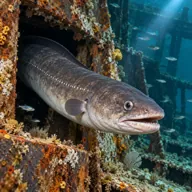
Conger eel
Sometimes · Gringu

Amberjack
Sometimes · Aċċola · Summer

Rays in the sand
Lucky day · Rajja
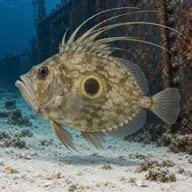
John Dory
Lucky day · Pixxi San Pietru · Winter and spring
Getting in and staying safe
Boat only, and normally through a Maltese technical diving centre rather than independently. Heritage Malta administers the historic wrecks in this depth band and diving the Schnellboot is done under permit with an authorised operator, so the practical route is to book it rather than to plan it yourself. The run out from Valletta or Sliema is short, but the site is open water with no shelter and the boat has to be able to hold a shot in a breeze. Confirm the permit situation with the operator when you book, because the arrangements have changed more than once.
- 65 m plus depth: full technical training, gas planning and decompression
- Narcosis and gas density if you turn up on air
- Silty seabed that clouds instantly and will not clear
- Unexploded ordnance on and around the wreck, including a loaded torpedo tube
- Entanglement in the exposed metal frames
- Current at depth and a long decompression hanging in open water
- War grave: nothing may be moved or taken
A bit of history
S-31 was a Lürssen-built Schnellboot, the German fast motor torpedo boat the Royal Navy called an E-boat, about 33 m long and 5 m in the beam. She reached Sicily on 3 December 1941 with the 3rd Flotilla and was in action against Malta within days. Early on 9 May 1942, running a minelaying operation off the entrance to the Grand Harbour alongside her sisters S-34 and S-61, she detonated a drifting mine next to her engine room and sank almost at once. Around half her complement died, the survivors were picked up by S-61, and the wreck is therefore a war grave. She was located by technical divers in September 2000 and has been under Heritage Malta's protection since 1 May 2019, which is why access is controlled.
Divers say
Sign in to rate this site and leave a note for the next diver.
- No reviews yet. First one gets bragging rights.
Further reading: Underwater Malta Virtual Museum: Schnellboot S-31 · Wrecksite.eu: S-31 Schnellboot · Divernet: Malta's S-31 Schnellboot · Battlefront Malta: Schnellboot operations and losses · Heritage Malta: Schnellboot