🐟 Fish · Conger conger
Conger eel
Gringuin Maltese
The grey giant that lives under the wreck
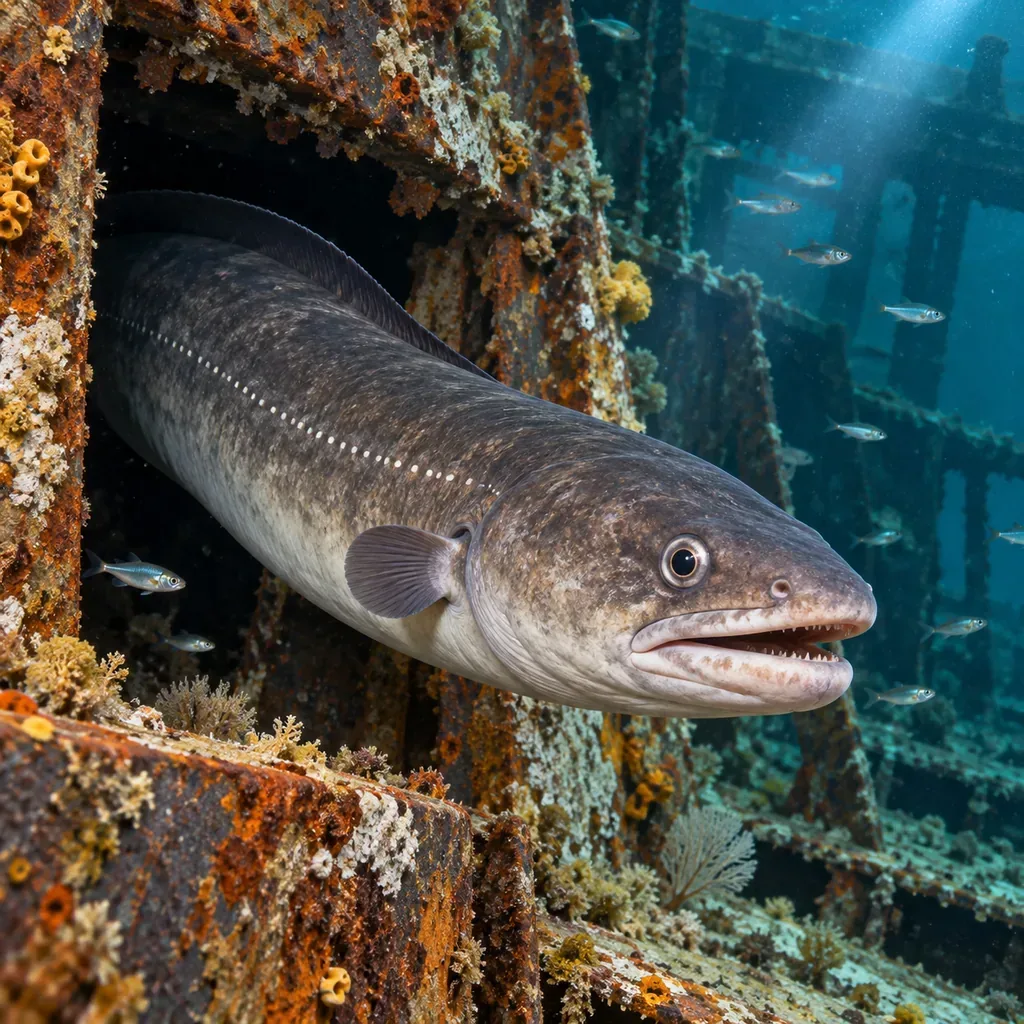
Meet the Conger eel
A very large, heavy-bodied eel, grey to slate-brown on the back and dirty white underneath, with a pale line running along each flank where the lateral-line pores show as a row of white dots. Unlike a moray it has clear pectoral fins just behind the gill openings, a broad flat-topped snout, thick fleshy lips and a wide mouth lined with small close-set teeth. The dorsal fin starts above the pectorals and runs the whole length of the body, joining the tail in a continuous black-edged fringe.
Congers hide by day, wedged deep in wreck plating, under concrete blocks, in the back of caves and in silty crevices, and they hunt at night for fish, octopus and crustaceans. Big ones are genuinely big: the head alone can be the size of a diver's forearm. Around Malta and Gozo they are a wreck speciality, and are regularly seen on the sunken patrol boats and ferries as well as in deeper natural caves, mostly between 10 and 60 m.
They are much shyer than their size suggests. Most of what you will see is a grey head and one eye in a dark hole, and any strong torch beam held on it will usually make the animal ease back out of sight.
When to look: All year, best on night dives and on wreck dives where a torch into the plating often finds one at home.
Diving with them
- Look into the deepest, darkest gaps of a wreck rather than the open holds, and check under concrete blocks and rubble at the base of walls
- Use the edge of your torch beam rather than the hot centre; a full beam in the eye makes it withdraw immediately
- Keep hands out of holes on wrecks, which is where conger bites happen
- Hold position and stay quiet instead of pushing closer, as a settled conger will often slide further out on its own after a minute or two
- On a night dive keep an eye on open sand next to wrecks, where a hunting conger can be surprisingly bold
Can it hurt you?Can hurt you
No threat to a diver who leaves it alone, but it has extremely powerful jaws and a determined grip. Bites come from reaching into holes or handling a hooked fish, and the damage is from crushing pressure and the eel's violent twisting rather than from cutting teeth.
First aid: Stop the bleeding with direct pressure, rinse the wound well with clean water and do not seal it. Seek medical attention the same day for wound cleaning, antibiotic cover and a tetanus check, since crush and puncture wounds from marine animals infect readily.
Easily confused with
- Mediterranean moray (Muraena helena) has no pectoral fins and a dark skin finely marbled with pale yellow
- Serpent eel (Ophisurus serpens) is far more slender, pale sandy and lives head-up in sand rather than in rock
- European eel (Sallura) is much smaller, browner and turns up in brackish and harbour water rather than on open reef
Where to meet them: 49 sites
Further reading: Sammut, Dangerous creatures of the Maltese sea Part 2 (Gringu, bite injuries) · Il-Miklem – Gringu (Conger conger) · Wikipedia – European conger · FishBase – Conger conger