Malta
HMS Russell
A hundred and thirty two metre pre-dreadnought battleship lying completely upside down at around a hundred and ten to a hundred and fifteen metres, with her stern torn away and her guns scattered on the sand. The biggest thing on the Maltese seabed by a wide margin.
Sea conditions
Good right now
Some chop (0.5 m E)
Forecast for the site, updated 01:45 AM
- Waves
- 0.5 m
- from E
- Wind
- n/a
- Swell
- 0.5 m
- 5 s period
- Sea temp
- 28 °C
Next 7 days
Exposed to wind and swell from: N (0°), NE (45°), E (90°), SE (135°), S (180°). Fully exposed offshore ground east of Valletta. Any northeasterly puts the dive away, and even moderate swell makes shotting a target this deep unpleasant. Wait for the flat glassy days. Visibility on the wreck is usually thirty metres or better, and the sheer bulk of the inverted hull is visible from the shot in good water. Best season: June to September for the calm windows, with the clearest water often in September..
The dive
Russell is a monster. She is a Duncan-class battleship, one of the Admirals, a hundred and thirty two metres long with a twenty three metre beam, and she went over on the surface before sinking, which means she is now lying fully inverted. At a hundred and ten metres plus you arrive on what used to be her bottom and work your way along an enormous, smooth, alien expanse of hull with the bilge keels running away into the blue.
The interesting stuff is at the edges and on the sand. Her stern section is gone, blown off by the mines, leaving a torn and complicated break. The area around her is littered with gun cases, and some of the big guns that were sitting on deck fell clear as she capsized and are lying out on the bottom, with more of them still unaccounted for. Finding one of those is a genuine moment.
Scale is the problem and the point. You cannot see anything like all of her in a single bottom time at this depth, so pick a section before you get wet. Most teams work one end or one flank and accept that Russell is a wreck you visit repeatedly rather than one you tick off.
- The largest wreck in Maltese waters, a full pre-dreadnought battleship
- Completely inverted, which makes for a genuinely strange dive
- Main guns lying loose on the sand where they fell during the capsize
- The centrepiece of the U-73 minefield story of April 1916
- Only found in 2003, and still yielding new detail
Typical plan
Hypoxic trimix or closed circuit. Twelve to eighteen minutes at a hundred and ten metres, working one chosen section of the hull rather than trying to cover ground, with a look at the gun debris if the shot is well placed. Two hours or more of staged decompression on intermediate trimix, fifty percent nitrox and oxygen. Team of three or four, full bail-out, and a briefed plan for which end of her you are diving.
What the bottom looks like
- 1Inverted hull bottom and bilge keel104 m deep · 24 m out
- 2Gun cases scattered across the seabed109 m deep · 60 m out
- 3Torn break where the stern was blown away112 m deep · 105 m out
- 4Fallen main guns lying on the sand115 m deep · 140 m out
- 5Open sand beyond the debris field115 m deep · 155 m out
Flat offshore sand, littered close in with shell cases, plating and fallen ordnance from the capsize.
Who you might meet
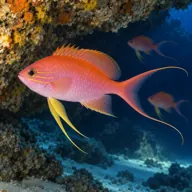
Swallowtail sea perch
Almost always · Pixxiroża
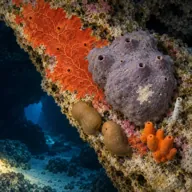
Encrusting sponges
Almost always · Sponża
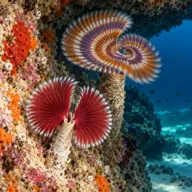
Tube worms
Almost always
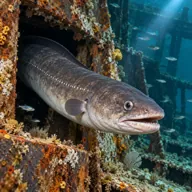
Conger eel
Often · Gringu
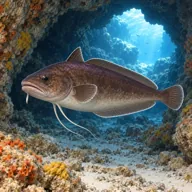
Greater forkbeard
Often · Lipp tal-qawwi
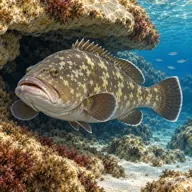
Dusky grouper
Sometimes · Ċerna

False black coral
Sometimes
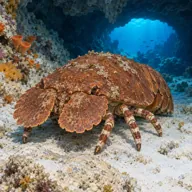
Slipper lobster
Sometimes · Ċikala
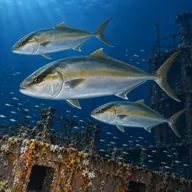
Greater amberjack
Sometimes · Aċċola · Late summer
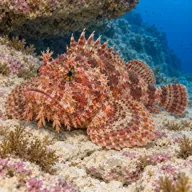
Red scorpionfish
Sometimes · Ċipullazza
Getting in and staying safe
Boat only, through a Heritage Malta registered centre or club with a licensed vessel, booked via the Underwater Cultural Heritage Unit system. You sign the standard conditions first: no penetration, no touching, respect the war grave, respect the marine life. Shot line, live boat and a full surface team are standard. There is no shore alternative and no informal way onto this site.
- A hundred and ten metres plus, requiring hypoxic trimix and hours of decompression
- War grave holding a hundred and twenty five men
- Live ordnance: the seabed around her is scattered with gun cases and shells
- Inverted hull with few reference points, so it is easy to get disoriented
- The torn stern break is unstable and full of snag points
- Fishing gear and long lines on an offshore mark like this
- Current across the site and a long open water ascent
A bit of history
Russell was a Duncan-class pre-dreadnought battleship built by Palmers Shipbuilding and Iron Company at Jarrow and launched in February 1901, one of six ships named for admirals, hers being Admiral Edward Russell, first Earl of Orford. At nineteen knots she was among the faster capital ships of her day. She served with the Grand Fleet before being sent to the eastern Mediterranean. She reached Malta on the night of 26 April 1916 and had to wait outside because Grand Harbour was closed by its boom defence. Early on 27 April, manoeuvring off Valletta, she ran into the minefield laid two days earlier by the German submarine U-73 and struck two mines. Fire broke out aft, an explosion followed near one of the turrets, and she listed badly. She stayed afloat for about twenty minutes, long enough for most of her people to get off, before capsizing and going down. Twenty seven officers and ninety eight ratings were lost. The same field claimed HMS Nasturtium and HMY Aegusa within about thirty six hours. Her wreck was located in July 2003 and first dived by a British technical team. She was opened to permitted diving on 1 May 2019 alongside seven other historic wrecks.
Divers say
Sign in to rate this site and leave a note for the next diver.
- No reviews yet. First one gets bragging rights.
Further reading: Heritage Malta: HMS Russell · Wikipedia: HMS Russell (1901) · Wrecksite entry for HMS Russell · Heritage Malta Underwater Cultural Heritage Unit, permit and booking rules