🪸 Corals & anemones · Savalia savaglia
False black coral
Gold polyps on a tree it stole and rebuilt
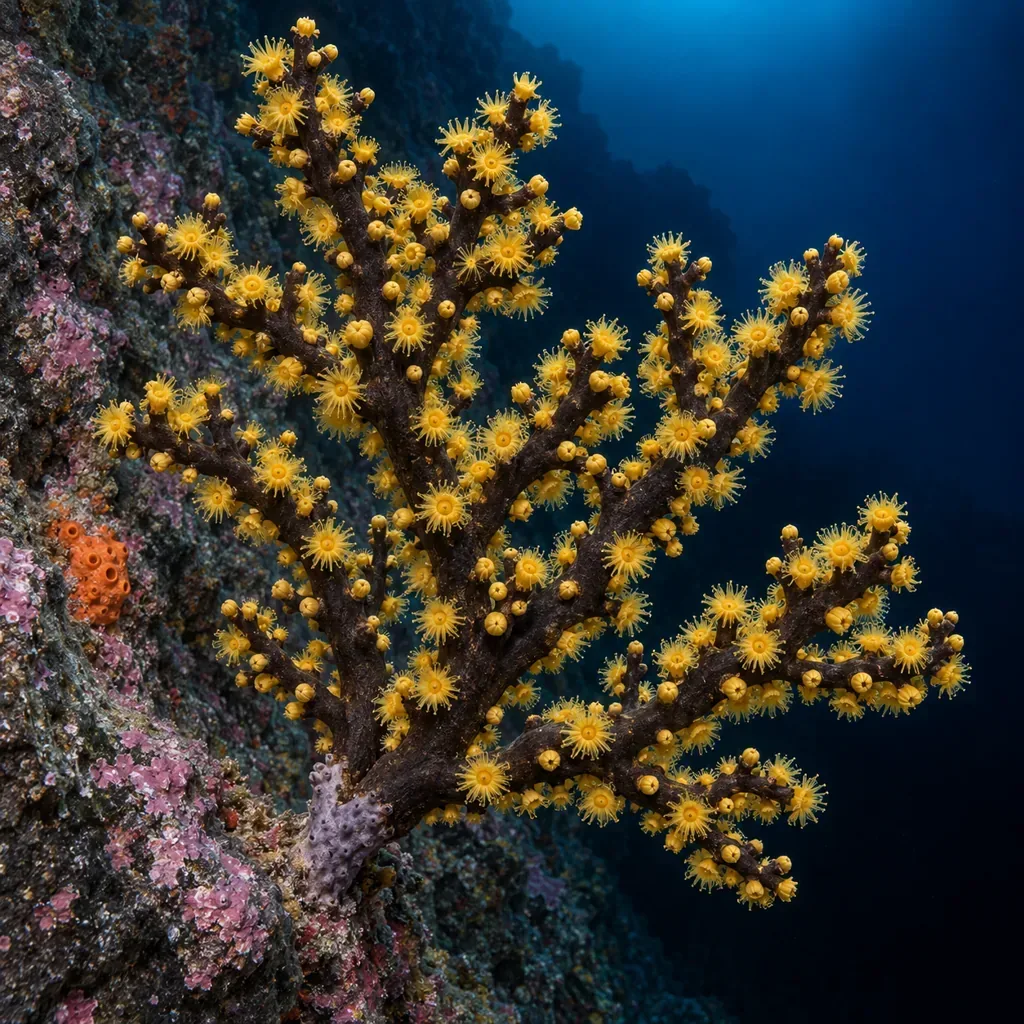
Meet the False black coral
Also called the gold coral, this is a zoanthid living a very odd life. It starts as polyps settling on a living gorgonian, kills the host tissue back branch by branch, then coats the bare skeleton and thickens it with a hard, dark, horn-like material of its own. What you end up with is a stiff, tree-like colony, dark brown to near black at the core, covered in fat golden-yellow polyps each ringed with short tentacles. Colonies commonly reach half a metre and the big ones are well over a metre across.
In the Mediterranean it is a rare, patchy species of dim circalittoral rock, typically from about 30 m down to a couple of hundred metres, and it has been recorded from Maltese waters. Realistically it is a deep-wall and technical-depth find here rather than something on a standard recreational profile: think the shaded faces below 40 m on the offshore pinnacles and drop-offs.
It is also one of the longest-lived animals in the sea. Growth-band work on Mediterranean colonies has put ages in the thousands of years, which makes any encounter with a large specimen a genuinely unusual moment and any damage to one effectively permanent.
When to look: All year; it lives too deep for light or season to make much difference.
Diving with them
- A deep-wall and technical-depth species; do not extend a dive chasing one
- Tell it from a true black coral by the thick, stiff branches and the big yellow polyps rather than fine wiry stems with pale polyps
- Look for colonies with a dead gorgonian stub still visible at the base, which is the classic signature of how it started
- Photograph with a wide beam: the dark skeleton eats light and the yellow polyps blow out easily on a narrow spot
- Report sightings with depth and site to a local marine NGO, since Maltese records for it are sparse
Can it hurt you?Harmless
Harmless to divers. It does not sting through skin and poses no hazard beyond being fragile.
Easily confused with
- True black corals (Antipathella subpinnata, Antipathes spp.) - fine, feathery, flexible colonies with small whitish six-tentacled polyps
- Violescent sea fan (Paramuricea clavata) - soft flexible branches and tiny polyps, sometimes with yellow tips that fool the eye at depth
- Yellow cluster anemone (Parazoanthus axinellae) - the same golden polyps but as a flat mat on rock or sponge, with no branching skeleton
Where to meet them: 3 sites
Further reading: Wikipedia - Savalia savaglia · Reef Check Med - True and false black corals of the Mediterranean · Scientific Reports - A large non-parasitic population of Savalia savaglia · SPA/RAC - Barcelona Convention SPA/BD Protocol Annex II