A U-class submarine bombed at her berth in Sliema in 1942, salvaged sixteen years later and dumped in deep water north of Malta. At around a hundred and forty metres she is the deepest divable wreck on the island, and barely anyone has been.
 Wreck
Divers rarely, if ever, come here.
We found no record of anyone diving this site. It is charted so the picture of what lies under the water is complete, not because it is a place to go: there is no set route, no local briefing to lean on, and nothing on this page has been proven in the water.
Sea conditions
Reading the sea…
Exposed to wind and swell from: N (0°), NE (45°), E (90°), SE (135°), S (180°), SW (225°), W (270°), NW (315°). Roughly ten to twelve kilometres north of Malta in open sea, exposed from every direction. You need a genuinely flat forecast holding for the better part of a day. Visibility at depth should be exceptional, but ambient light is nearly gone and the water is cold year round down there. Best season: July to early September, the only period that reliably offers calm enough weather for a dive of this length..
The dive
P36 has an unusual double life. She was sunk once by the Luftwaffe while tied up in Marsamxett, sat on the harbour bottom for sixteen years, and was then raised in 1958 and towed out to be disposed of in deep water. So she is not a war grave in the conventional sense and she is not sitting where she died. She is simply a small British submarine lying a long way down on the sand north of Malta.
That depth is the whole story. A hundred and forty metres is the outer edge of what gets dived in Maltese waters at all, and the site has effectively no visitor traffic. Whatever is down there is untouched. The trade is brutal: something like ten minutes of bottom time for two and a half to three hours of decompression, plus the logistics of getting a boat and a team out to a mark that few people have ever put a shot on.
If you are reading this and thinking about it, you already know the standard required. If you are reading it out of curiosity, enjoy the fact that Malta still has a corner nobody has worn out.
- The deepest divable wreck in Maltese waters
- A submarine sunk twice: once by bombs in Sliema, once deliberately in 1958
- Direct link to the HMS Olympus tragedy through her surviving crew
- Effectively untouched, with almost no recorded visits
Typical plan
Closed circuit or open circuit hypoxic trimix with a full staged bail-out. Eight to twelve minutes at a hundred and forty metres, one careful look along the hull, then a controlled ascent of two and a half to three hours on multiple gases. Support divers meeting you in the shallows, oxygen on the boat, chamber notified. This is expedition diving, not a dive.
What the bottom looks like
- 1Conning tower and upper casing134 m deep · under the boat
- 2Pressure hull, salvage damaged138 m deep · 19 m from the boat
- 3Bow or stern section on the sand140 m deep · 44 m from the boat
- 4Flat deep sand140 m deep · 64 m from the boat

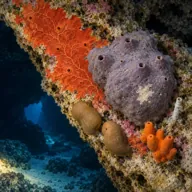
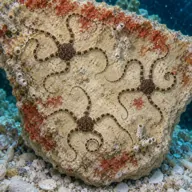
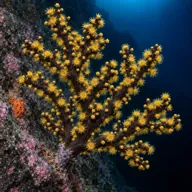
Deep, cold, fine sand and silt off the edge of the shelf, with nothing around the wreck to break the flatness.
Who you might meet
Almost always
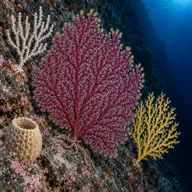
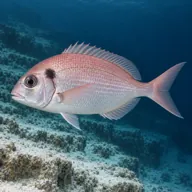
Lucky day
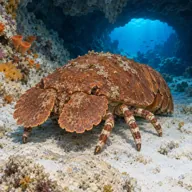
Marked ones can hurt you. What they do and what to do about it is under Getting in and staying safe.
Getting in and staying safe
Only for serious professionals who know exactly what they are doing. With no record of anyone diving here there is no one to ask and no set route, so treat every line below as the start of your own planning, not a briefing. Plan it as an expedition, not a dive.
Boat only, and only as a planned deep expedition with a technical operator who knows the ground north of the island. There is no mooring and no casual approach. Surface support, oxygen, a chase boat and a chamber plan are the minimum. Confirm the current permitting position with your centre, because although she is a disposal site rather than a grave, protected wreck rules in Maltese waters are a moving target.
- A hundred and forty metres: extreme depth, hypoxic trimix, decompression measured in hours
- High pressure nervous syndrome and gas density issues at the bottom
- Very poorly documented position, so expect searching and possible aborted days
- Far offshore with no shelter and a long run home
- Snagged fishing gear and deep-set long lines
- Total commitment: no realistic bail-out to the surface once on schedule
- Salvage damage means unstable and torn structure
Marine life to respect
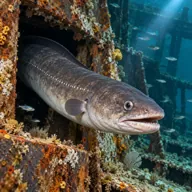
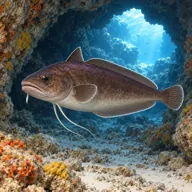
Conger eel · Gringu Can hurt you
Crushing bite if a hand goes into its hole. Look in from a distance and keep fingers out.
A bit of history
P36 was a third group British U-class submarine, roughly sixty metres long and displacing five hundred and forty tons surfaced, commissioned in September 1941. She operated in the Mediterranean and off the Bay of Biscay, and on 15 February 1942 she damaged the Italian destroyer Carabiniere. On 1 April 1942, during the height of the air assault on Malta, she was lying alongside a jetty in Sliema when Luftwaffe dive-bombers hit the harbour. A near miss holed her, she rolled over and sank at her berth. Her surviving crew were among those embarked in HMS Olympus five weeks later, when that submarine was mined with terrible loss of life. P36 was finally raised on 7 August 1958 and scuttled in deep water off Malta on 22 August 1958.
Divers say
Sign in to rate this site and leave a note for the next diver.
- No reviews yet. First one gets bragging rights.
Further reading: Wikipedia: HMS P36 (1941) · uboat.net: HMS P36 · Wrecksite entry for HMS P36 · Malta Dive Sites: HMS P36