Malta
Junkers Ju 88 (North)
A German twin engine bomber from the siege of Malta lying on sand at about 55 metres, three kilometres off the north coast. Well preserved, tail broken off nearby, and divable only with a Heritage Malta permit through a registered centre.
Sea conditions
Excellent right now
Flat, sheltered and calm
Forecast for the site, updated 01:45 AM
- Waves
- 0.4 m
- from ESE
- Wind
- n/a
- Swell
- 0.4 m
- 5 s period
- Sea temp
- 29 °C
Next 7 days
Exposed to wind and swell from: NW (315°), N (0°), NE (45°), E (90°). Squarely on the north coast approaches, which means the northwesterly majjistral kills it and a northeasterly grigal makes for a horrible surface interval. Trips run on light southerly or windless days. Deep visibility here is generally very good, twenty five metres and better, and the aircraft shows up well against pale sand. Best season: June to September, with a settled southerly forecast.
The dive
The Ju 88 was the aircraft that did most of the damage to Malta between 1940 and 1942, so finding one of them on the seabed off the north coast has a particular weight to it. It is not a big machine by modern standards, roughly fifteen metres nose to tail with a twenty metre wingspan, and at fifty five metres on clean sand it stands out beautifully against the pale bottom.
The airframe is in good order for something that has been down there for eighty years. The tail section broke away and lies a short swim from the main fuselage, trawl gear has done some damage over the decades, and the forward machine gun is still in its mounting in the cockpit, which is the detail everyone remembers. Reported depths vary a little between sources, generally between fifty five and fifty seven metres, so plan for the deeper figure.
The important practical point: this is a protected site. It was found in a remote sensing survey in 2009, opened to divers on 1 May 2019, and is managed by Heritage Malta, which means you dive it through a registered dive centre or club with a permit, you do not touch, and you do not take. That regime is exactly why it is still worth diving.
- The forward machine gun still sitting in its cockpit mount
- Tail section lying clear of the fuselage for a second look
- A genuinely well preserved airframe on clean white sand
- Protected and permitted, so it has not been picked over
Typical plan
Descend the shot to around fifty six metres, twenty to twenty five minutes of bottom time on trimix, then thirty to forty five minutes of decompression on nitrox and oxygen. Circle the fuselage first while the light and the gas are best, run out to the tail, then back to the line. Twin set or rebreather, two torches, and hands off everything.
What the bottom looks like
- 1Main fuselage and cockpit with mounted machine gun55 m deep · 16 m out
- 2Wings and engine nacelles56 m deep · 28 m out
- 3Detached tail section, about 50 m from the fuselage56 m deep · 70 m out
- 4Open sand around the debris57 m deep · 95 m out
Flat, pale sand with only light silt, which is why the aircraft reads so clearly.
Who you might meet

Cardinalfish sheltering in the fuselage
Almost always · Sultan iċ-ċawl
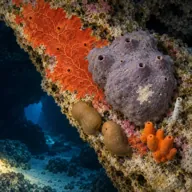
Encrusting sponges on the airframe
Almost always · Sponża

Tube worms
Almost always
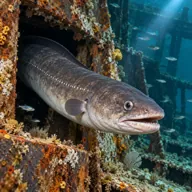
Conger eel
Often · Gringu

Common octopus
Often · Qarnita
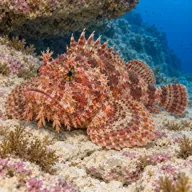
Scorpionfish
Often · Skorfna

Common stingray
Sometimes · Rajja
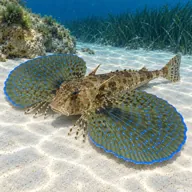
Flying gurnard
Sometimes · Bies · Summer

Dusky grouper
Sometimes · Cerna

Greater amberjack
Sometimes · Accola · Summer
Getting in and staying safe
Boat only, roughly three kilometres offshore from the Bahar ic-Caghaq and Salina coastline, usually run out of the northeast harbours. A permit obtained through a registered dive centre or club is required, and the rules that come with it are simple: look, photograph, touch nothing. Full technical surface support, a shot on the aircraft and hung decompression gas are the norm.
- 55 to 57 metres, mixed gas and mandatory decompression
- Entanglement in trawl netting draped over the airframe
- Thin corroded aluminium that collapses if you grab it
- Offshore position with no shelter and real boat traffic
- Silt clouds off the sand if you fin carelessly
- Protected site, so any disturbance carries legal consequences
- Narcosis and gas management at working depth
A bit of history
The Junkers Ju 88 was a German twin engine, all metal bomber used heavily against Malta during the island's second great siege between 1940 and 1943, when the Luftwaffe flew sustained raids against the harbours and airfields. This particular aircraft may have been hit by anti aircraft fire over its target or shot down in combat, possibly during the period in 1942 when Allied fighters were regaining control of the air over Malta, though no confirmed identification of the aircraft or its crew has been published. It was located during an offshore remote sensing survey in 2009 and opened as a permitted dive site on 1 May 2019 under Heritage Malta's management, which also produced a virtual model of the site for the public.
Divers say
Sign in to rate this site and leave a note for the next diver.
- No reviews yet. First one gets bragging rights.
Further reading: Underwater Malta: Ju 88 · Heritage Malta: JU88 · Malta Dive Sites: Junkers Ju 88 (North) · DIVE Magazine: Malta's deep wrecks, Junkers Ju 88