Malta
HMS Stubborn
A sixty six metre S-class submarine sitting upright and beautifully intact on sand northeast of Qawra, top of the conning tower around forty five metres and the sand at fifty six. The best submarine dive in Malta and a rite of passage for local tech divers.
Sea conditions
Excellent right now
Flat, sheltered and calm
Forecast for the site, updated 01:48 AM
- Waves
- 0.4 m
- from ESE
- Wind
- n/a
- Swell
- 0.4 m
- 5 s period
- Sea temp
- 28 °C
Next 7 days
Exposed to wind and swell from: N (0°), NE (45°), E (90°), NW (315°). Sitting off the exposed north coast, so the gregale from the northeast and any northwesterly swell will put it out of reach. Southwesterly and westerly winds are your friends and flatten this ground nicely. Visibility is often twenty five to thirty five metres on the wreck, and on a bright day you can pick out the conning tower from surprisingly far up the line. Best season: May to October, with September and early October usually offering the warmest water and the longest calm spells..
The dive
Stubborn is the one everybody wants. She sits upright with a gentle lean to starboard, complete and coherent, on flat sand three kilometres off Qawra Point. The conning tower comes up to around forty five metres, so you meet her early in the descent, and the casing runs away forward and aft into the blue. Sixty six metres of submarine is a lot of boat to swim, and doing the whole length and back is a satisfying way to spend a bottom time.
The detail is what makes her. The torpedo tube doors forward, the open escape hatches, the periscope standards, the shape of the pressure hull under its coat of growth. She was stripped of her armament and useful gear before being put down, so this is a hull rather than a fitted out warship, but the form is all there.
Do not think about going inside. The largest hatch is only around sixty centimetres across and the interior is heavily silted, so penetration would be a very effective way of ending badly. Outside, at these depths, she is one of the most rewarding wrecks in the central Mediterranean.
- An almost complete S-class submarine, upright and easy to read
- Conning tower at around forty five metres, so the wreck greets you early
- Scuttled rather than sunk in action, which means no war grave restrictions
- A submarine that survived being driven to a hundred and sixty six metres and lived to tell it
- Reliably good visibility and heavy fish life on the casing
Typical plan
Normoxic trimix, about twenty to twenty five minutes on the bottom. Down the shot to the conning tower at forty five metres, forward along the casing to the bow and the tube doors, drop to the sand for a look at the hull form, then back aft to the stern before returning to the line. Forty five to sixty minutes of decompression on fifty percent nitrox and oxygen. Torch, reel, big marker, and no thoughts about those hatches.
What the bottom looks like
- 1Top of the conning tower, shallowest point45 m deep · 12 m out
- 2Casing and open escape hatches51 m deep · 25 m out
- 3Bow and torpedo tube doors55 m deep · 55 m out
- 4Stern and propeller shafts56 m deep · 70 m out
- 5Clean sand off the stern57 m deep · 85 m out
Flat, clean sand with a light silt cover, the submarine resting on it with a slight list to starboard.
Who you might meet
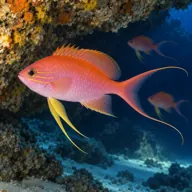
Swallowtail sea perch
Almost always · Pixxiroża
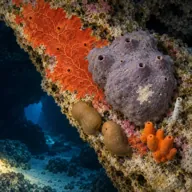
Encrusting sponges
Almost always · Sponża
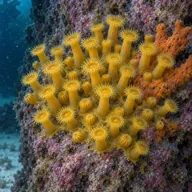
Yellow cluster anemone
Almost always
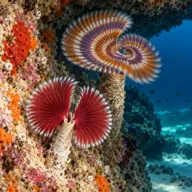
Tube worms
Almost always
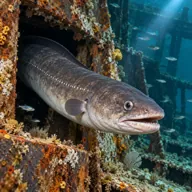
Conger eel
Often · Gringu
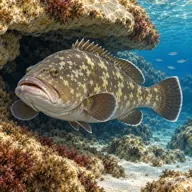
Dusky grouper
Often · Ċerna
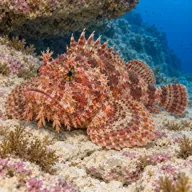
Red scorpionfish
Often · Ċipullazza
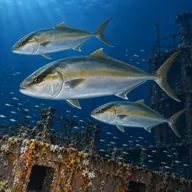
Greater amberjack
Sometimes · Aċċola · Late summer

Barracuda
Sometimes · Lizz · Summer
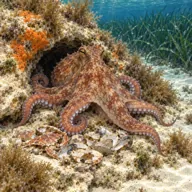
Common octopus
Sometimes · Qarnit
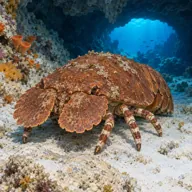
Slipper lobster
Sometimes · Ċikala
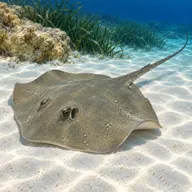
Common stingray
Sometimes · Boll
Getting in and staying safe
Boat only, roughly a fifteen to twenty minute run from Qawra, Buġibba or St Paul's Bay with any of the technical centres on that coast. Most operators drop a shot on the conning tower and run a live boat. There is no mooring, so plan to ascend the line or shoot a bag and drift. The north coast harbours have plenty of parking, cafes and facilities, so the logistics of the day are easy. Check current site rules with your centre, since the management status of Maltese wrecks has been tightened in recent years.
- Fifty six metres maximum with the top of the wreck at forty five, so a genuine trimix decompression dive
- Penetration is effectively impossible and would be lethal: narrow hatches and heavy silt inside
- Current runs across the site and can make the return swim to the shot hard
- Snagged fishing line and nets on the conning tower and periscope standards
- The shot line is your lifeline here, with no shallow reference nearby
- Silt on and inside the casing clouds quickly
- Offshore position with boat traffic in summer
A bit of history
Stubborn was an S-class submarine, sixty six metres long on a seven metre beam, built by Cammell Laird at Birkenhead and launched on 11 November 1942. She worked off Scandinavia and later in the Far East, and she had a famously rough war: depth charged severely, she was driven far below her design depth, reportedly touching the seabed at around a hundred and sixty six metres against a rated limit of roughly ninety. She survived and got home, but the hull was never right again. After the war the Royal Navy stripped her of anything useful and scuttled her deliberately on 30 April 1946, off the north of Malta, to serve as a sonar training target. That is why she sits so squarely and so intact: she was put down on purpose, not blown apart. She is not a war grave, which is one reason she is dived far more than the permitted historic wrecks.
Divers say
Sign in to rate this site and leave a note for the next diver.
- No reviews yet. First one gets bragging rights.
Further reading: Underwater Malta virtual museum: HMS Stubborn · Calypso Sub Aqua Club dive notes and coordinates for HMS Stubborn · Wikipedia: HMS Stubborn (P238) · uboat.net: HMS Stubborn