🪸 Corals & anemones · Parazoanthus axinellae
Yellow cluster anemone
Buttercup polyps carpeting the shaded rock
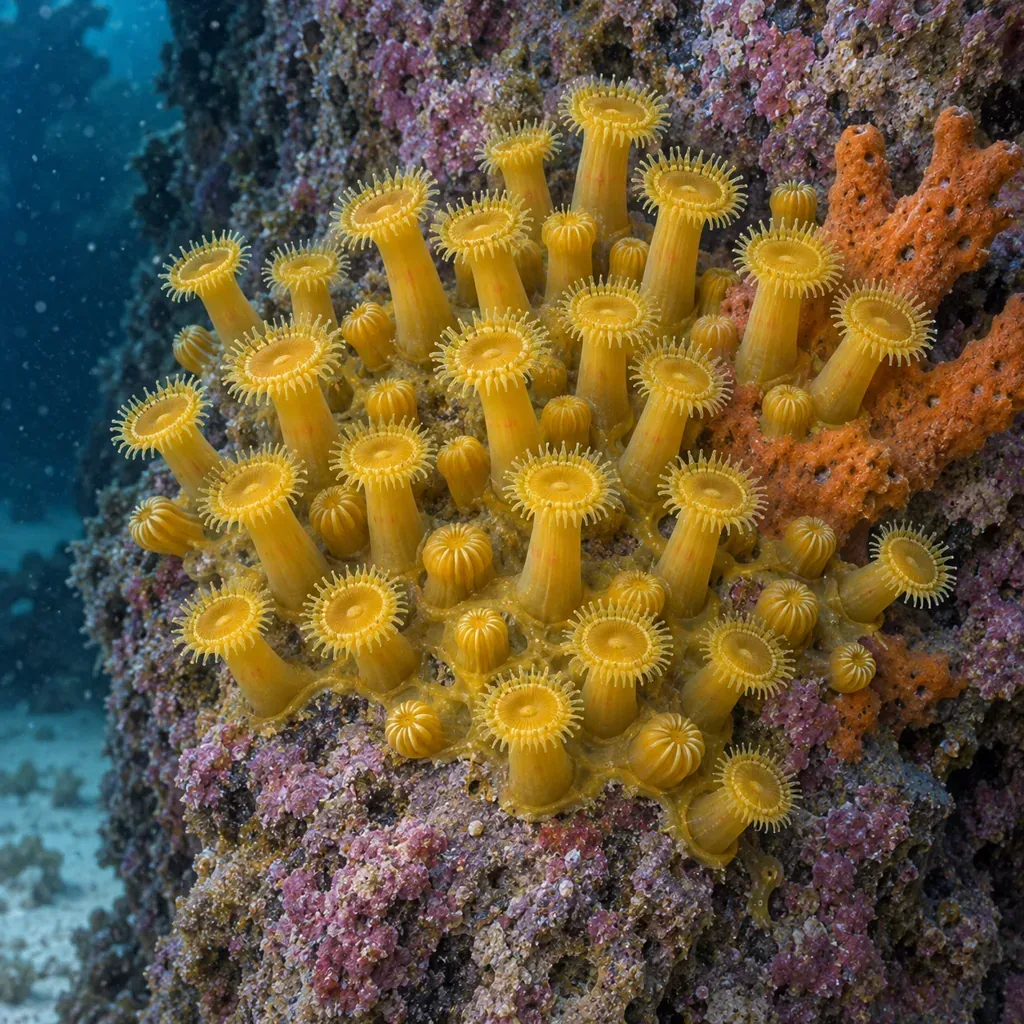
Meet the Yellow cluster anemone
Not really an anemone at all but a zoanthid, a colonial relative that spreads as a mat of small polyps joined by a thin creeping base. Each polyp is a slim yellow or orange column about 5 mm wide and up to 2 cm tall, crowned with two rings of fine tentacles, usually twenty-four to thirty-six of them. A colony can be a scatter of a dozen polyps or a dense patch the size of a dinner plate, and on a good wall the effect is a spill of bright yellow paint across the grey rock.
It likes shade and moving water. Look for it on vertical and overhanging rock, in the entrance zones of caves and caverns, on the shaded plating and ribs of Malta's scuttled wrecks, and very often growing directly on sponges of the genus Axinella, which is where its Latin name comes from. Divers meet it from about 5 m down to well past sport-diving depth; in Malta and Gozo the reliable spots are the shaded walls at Reqqa Point, Fungus Rock and the deeper parts of Ras il-Ħobż.
The polyps are open most of the time, day and night, because the colony feeds on plankton carried past on the current rather than relying on sunlight. Touch or a passing shadow makes them shrink to squat yellow buttons within seconds, then slowly bloom again once things settle.
When to look: All year, day or night; polyps stay open wherever there is shade and a little current.
Diving with them
- Search shaded vertical rock and cavern entrances rather than sunlit reef tops
- Check the flanks of orange and yellow Axinella sponges, which it frequently grows straight onto
- Approach slowly with your light off-axis; a bright beam straight on makes the polyps contract
- Macro-friendly subject: fill the frame with twenty or thirty polyps rather than shooting the whole patch
- On Malta's wrecks it colonises shaded overhangs and undersides within a few years, a useful cue to how long a structure has been down
Can it hurt you?Harmless
Completely harmless. The stinging cells are far too weak to affect human skin.
Easily confused with
- Golden cup coral (Astroides calycularis) - a hard, cup-shaped stony skeleton under each polyp instead of soft joined bases
- Sunset cup coral (Leptopsammia pruvoti) - larger solitary polyps, each in its own stony cup, never forming a joined mat
- False black coral (Savalia savaglia) - similar yellow polyps but sitting on a thick dark branching skeleton
Where to meet them: 18 sites
HMS Nasturtium
Malta
HMS Southwold
Malta
HMS St. Angelo
Malta
HMS Stubborn
Malta
HMY Aegusa
Malta
Il-Qaws
Malta
Newwiela Point
Gozo
Further reading: MarLIN - Yellow cluster anemone (Parazoanthus axinellae) · Wikipedia - Parazoanthus axinellae · Institut oceanographique Paul Ricard - Yellow cluster anemone · Phys.org - One species or two? The case of the cluster anemones