🪸 Corals & anemones · Astroides calycularis
Golden cup coral
Qroll tad-dellin Maltese
Orange fire burning at every cave mouth
Meet the Golden cup coral
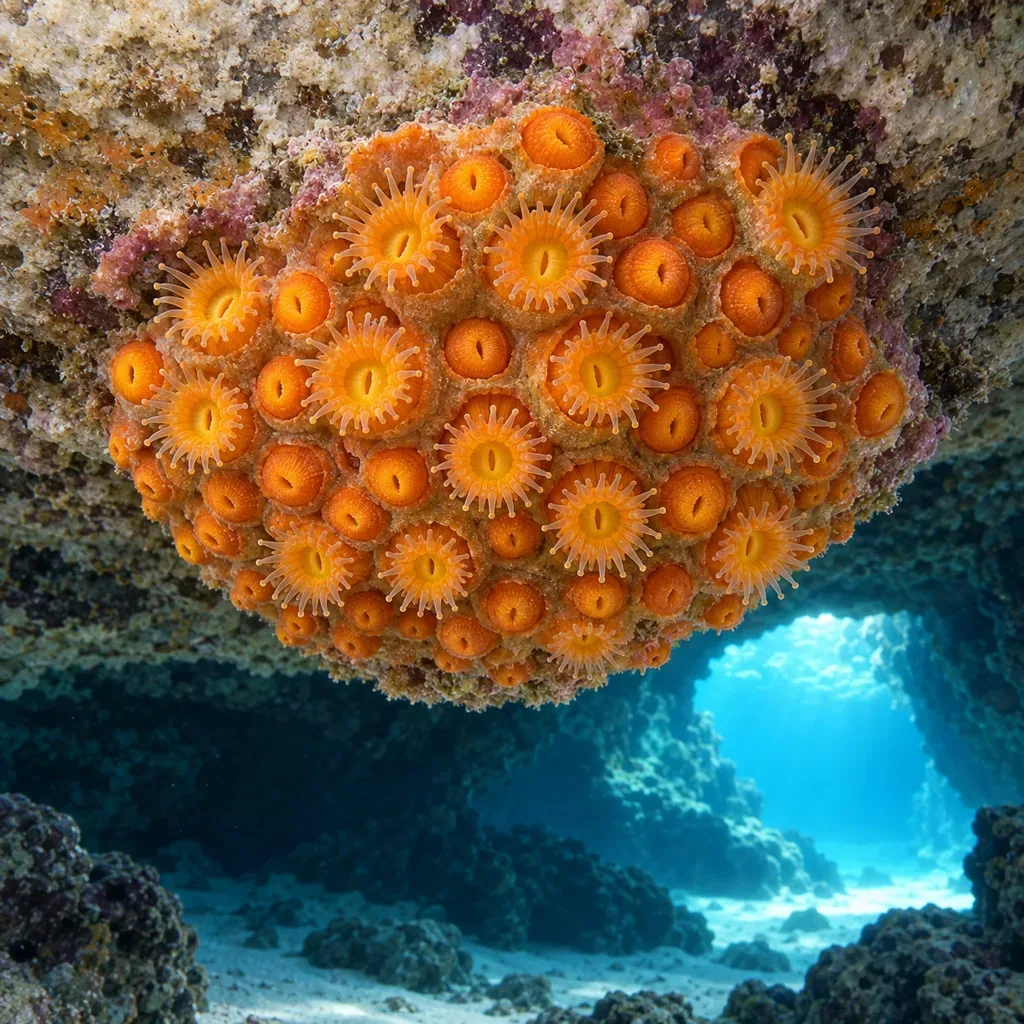
This is the coral that makes Maltese cave diving look the way it does. Colonies form low, rounded crusts of stony cups packed tightly together, each cup a few millimetres across, the whole patch usually 10 to 30 cm wide and only a few centimetres thick. The living tissue is a hot orange-to-egg-yolk yellow, and when the polyps are open each one puts out a short ring of translucent tentacles around a slit-shaped mouth. Closed up in daylight the colony looks like a sheet of orange honeycomb glued to the rock.
It carries no symbiotic algae, so it has no reason to seek the sun. Instead it takes the shaded places: the roof and entrance of every cavern, the underside of overhangs, the dark side of boulders and the inner walls of swim-throughs, anywhere from a metre below the surface down to about 50 m. Around the Maltese islands it is one of the first things a torch beam picks out at Reqqa Point, in the Dwejra caves and along the shaded ledges of Comino's caverns, often sharing the rock with yellow cluster anemones and encrusting sponges.
The polyps feed at night on zooplankton drifting past, so a night dive or a deep cave shows the colony fully open and furry-looking rather than shut tight. It grows very slowly, which is exactly why a fin kick that snaps a crust off the rock is worse than it looks.
When to look: All year; polyps open at night and inside dark caves at any hour.
Diving with them
- Look up, not down: the best colonies are on cave ceilings, arch undersides and the shaded lips of overhangs
- A torch or video light is essential; without one the orange reads as dull brown at depth
- Photograph at night or deep inside a cavern to catch the polyps expanded, which is a completely different picture
- Keep fins and console clear of the rock, as the crusts are brittle and grow back over decades
- It is a good marker species: where you find it you are usually in the shaded, current-fed spots where sponges, cup corals and blennies gather
Can it hurt you?Harmless
Harmless to divers. It cannot sting through skin and there is nothing sharp about it beyond the usual rough limestone it grows on.
Easily confused with
- Sunset cup coral (Leptopsammia pruvoti) - single yellow polyps scattered on the rock rather than a joined orange crust
- Yellow cluster anemone (Parazoanthus axinellae) - soft polyps with long tentacles and no stony cup underneath
- Orange encrusting sponges - smooth or holey sheets with no ring of tentacles and no cup structure
Where to meet them: 16 sites
B-24 Liberator Bomber
Malta
Devil's Reef
Malta
Fungus Rock
Gozo
Għar id-Dar
Gozo
Further reading: Atlantis Gozo - Orange star coral in Maltese waters · Wikipedia - Astroides calycularis · SPA/RAC - Barcelona Convention SPA/BD Protocol Annex II · Marine Biodiversity - Polyp bail-out in Astroides calycularis · OBIS - Astroides calycularis occurrence records