Cominotto · Comino
Cominotto Rock
Cominotto's serious dive: a vertical wall that runs past forty metres onto white sand, with boulder caverns, swim-throughs, a four-pointed anchor and clouds of chromis over the top.
Sea conditions
Excellent right now
Flat, sheltered and calm
Forecast for the site, updated 01:45 AM
- Waves
- 0.3 m
- from SE
- Wind
- n/a
- Swell
- 0.2 m
- 5 s period
- Sea temp
- 29 °C
Next 7 days
Exposed to wind and swell from: S (180°), SW (225°), W (270°), NW (315°), N (0°). Very exposed, which is the single most repeated line about this site. Calypso link the exposure directly to strong currents. It needs light winds and a small sea: anything meaningful from west through south, or a northerly rolling down the channel, and the point is off. Check it visually from the boat before committing. Best season: June to early October, with the settled high-summer spells giving the best shot at calm water.
The dive
Round the south-western corner of Cominotto and the friendly shallow shelf simply stops. What replaces it is a proper wall, vertical for most of its height, dropping past thirty-nine metres and, depending on where you go over the edge, continuing on to fifty and beyond. The base is clean white sand, which reflects light upward and makes the whole face glow when the sun is high.
The shallower part of the site is a boulder landscape. House-sized blocks lean against each other and against the reef, and the spaces between them form swim-throughs and dim caverns lined with coloured sponges and golden cup corals. It is easy to spend twenty minutes here alone. An old four-pointed Admiralty-pattern anchor sits on the route, usually visited on the way back up, and it has become the obligatory photograph of the site.
Fish life reflects the depth profile. Over the top of the reef, chromis in absurd numbers. In the cracks and along the wall, grouper that get noticeably larger the deeper you go, plus moray, octopus and nudibranchs for anyone diving slowly enough to notice them. In late summer, amberjack and barracuda occasionally show up off the face.
The catch is exposure. This corner sticks out into the channel and sources are consistent that it should be dived by experienced people only, because it is open to weather from several directions and can run current. It is a lovely dive when it is on, and a bad idea when it is not.
- A clean vertical drop to white sand at around forty metres
- Swim-throughs and sponge-lined caverns in the boulder field
- The four-pointed anchor on the shallow reef
- Twenty-five to thirty-five metres of visibility when the weather plays along
Typical plan
Straight down the face to a planned maximum in the thirty-five to forty metre band, ten to fifteen minutes along the wall, then a slow staged return through the boulder caverns at twenty and the anchor at ten. Nitrox 28 is the sensible mix if you are staying inside no-stop limits, and a computer plus a reel and DSMB are not optional. Keep an eye on current from the moment you leave the boat and abort early if it turns.
What the bottom looks like
- 1Old four-pointed anchor on the shallow reef10 m deep · 30 m out
- 2Boulder stacks with swim-throughs13 m deep · 50 m out
- 3Caverns under the leaning blocks15 m deep · 65 m out
- 4Lip of the drop-off19 m deep · 80 m out
- 5Vertical wall face29 m deep · 110 m out
- 6White sand at the wall base42 m deep · 180 m out
Vertical coralline limestone wall with angular collapsed blocks at its foot, meeting clean white sand at around forty metres.
Who you might meet

Damselfish
Almost always · Kaħlija

Golden cup coral
Almost always · Qroll tad-dell
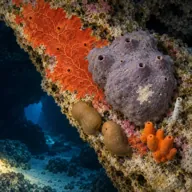
Encrusting and cave sponges
Almost always · Sponża
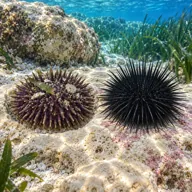
Sea urchins
Almost always · Rizzi
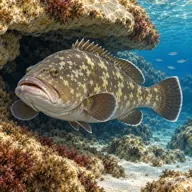
Dusky grouper
Often · Ċerna
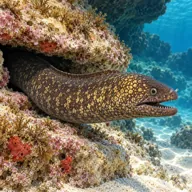
Mediterranean moray
Often · Morina
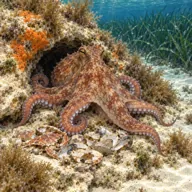
Common octopus
Often · Qarnita
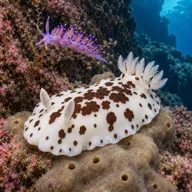
Nudibranchs
Often · Spring

Greater amberjack
Sometimes · Aċċola · Late summer

Barracuda
Sometimes · Lizz · Summer
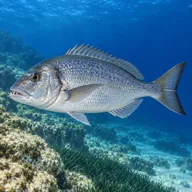
Dentex
Sometimes · Dentiċi
Getting in and staying safe
Boat only, and only in settled weather. Boats run from Ċirkewwa in about fifteen to twenty minutes and moor or live-drop off the point. Entry is a giant stride from the boat, exit is up a ladder, and there is no shore alternative if the plan goes wrong. Most operators pair it with a shallow second dive in the lagoon while the surface interval runs.
- Strong and variable current on the exposed point
- Depth: the wall runs well past recreational limits with no natural stop
- Nitrogen narcosis and rapid gas consumption at the base of the face
- Swim-throughs and caverns among the boulders, some with restricted exits
- Choppy surface and difficult boat pick-up if the wind builds
- Thermocline and noticeably colder water below thirty metres
- Boat traffic in the channel above
A bit of history
The wall is a fault-and-joint face in upper coralline limestone, the hard cap rock that forms Comino, Cominotto and the cliffs along Malta's northern coast. Its vertical jointing is why the face is a clean drop rather than a slope, and why the collapsed blocks at its foot are so angular. The four-pointed anchor on the route is a relic of the era when sailing craft sheltered in the lee of the islets.
Divers say
Sign in to rate this site and leave a note for the next diver.
- No reviews yet. First one gets bragging rights.
Further reading: Calypso SAC, Cominotto Rock · Seashell Dive Centre, Outer Cominotto Reef · Dive Shack Malta, Cominotto Reef · Paradise Diving, Comino dive sites