🐌 Molluscs & sea slugs · Nudibranchia spp.
Nudibranchs
Small, slow and absurdly colourful
Meet the Nudibranchs
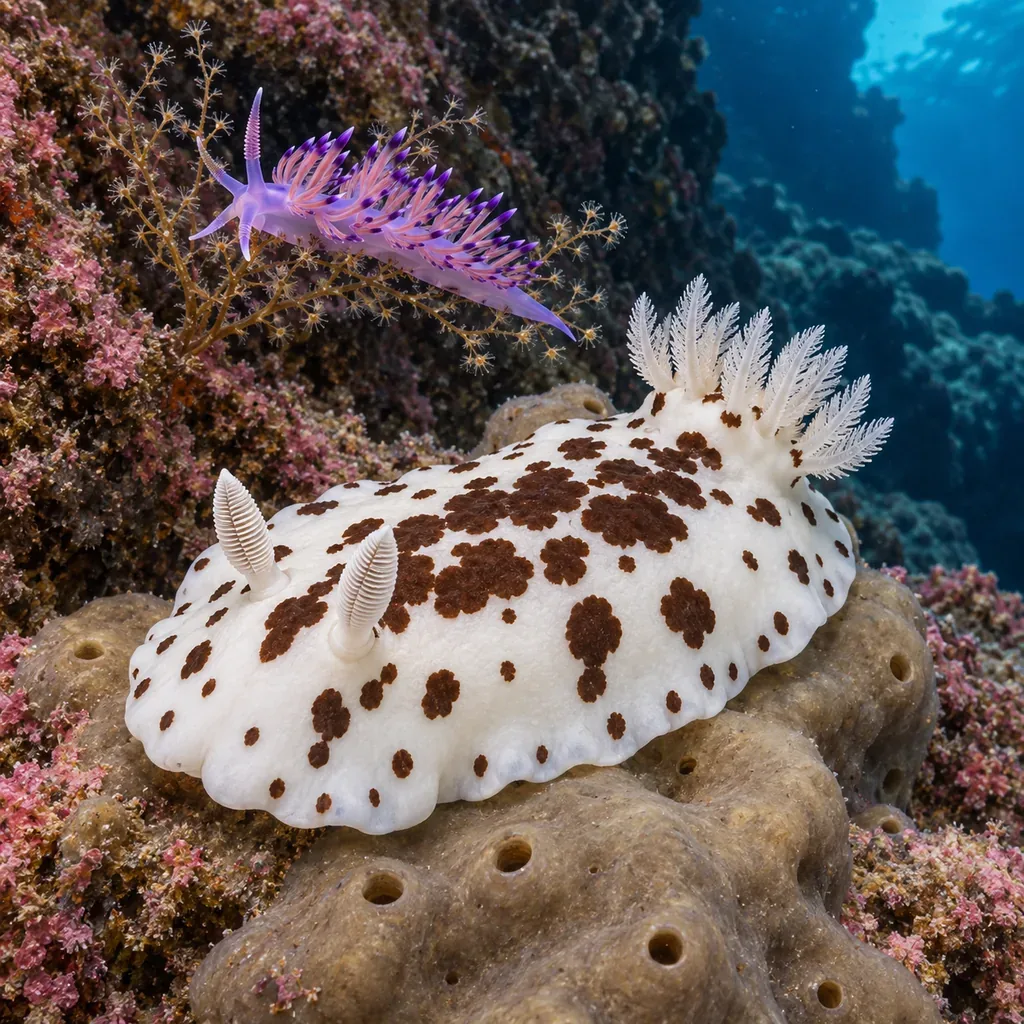
Nudibranchs are sea slugs that have given up their shell and advertise instead, using colour as a warning that they taste appalling. Four species make up most of what Maltese divers photograph. The dotted sea slug, Peltodoris atromaculata, is a firm white oval 5 to 7 cm long with irregular dark brown blotches, almost always sitting on the pale brown stony sponge Petrosia ficiformis, which is the only thing it eats. The regal doris, Felimare picta, is the showpiece: up to 13 cm, deep blue-black with bright yellow lines and elongated rings, feeding on Dysidea sponges.
The other two are aeolids, slimmer slugs whose backs are covered in finger-like cerata rather than a flat mantle. Flabellina affinis is translucent violet-pink with purple-tipped cerata and grows to about 5 cm. Cratena peregrina is smaller, three or four centimetres, white and blue-tinged with two orange patches on the head and orange-tipped rhinophores. Both graze the polyps of Eudendrium hydroids and are frequently found on the same colony, often in the top 5 to 20 m on dim, shaded walls.
Around the Maltese islands the reliable places are shaded rock and cave mouths: Reqqa Point, the Blue Hole and Anchor Reef in Gozo, the overhangs at Ċirkewwa, and anywhere a good Petrosia sponge or a healthy clump of Eudendrium is growing.
When to look: All year, with aeolids most abundant in spring and early summer when their hydroid food is growing fastest.
Diving with them
- Hunt the food, not the slug: find a Petrosia sponge for the dotted sea slug and a clump of Eudendrium hydroids for the aeolids.
- Search the shaded side of walls and the first few metres inside overhangs, where all four species prefer to sit.
- Both gills and rhinophores retract when startled, so frame and focus before you push the light in.
- Look for the white spiral or ribbon egg coils on the rock nearby; where there are eggs there are usually adults.
- Never move one for a better background; they are soft, slow and easily damaged, and they will not go back to the right food.
Can it hurt you?Harmless
Harmless to divers. Their chemical defences are aimed at fish that try to eat them, not at hands, though it is still good practice not to touch.
Easily confused with
- Sea hares (Aplysia), which are far bigger, softer and have two ear-like flaps rather than exposed gills or cerata
- Flatworms, which are thinner, glide smoothly and have no rhinophores or gill plume
- Other Felimare species, separated by the exact arrangement of yellow lines and spots
Where to meet them: 92 sites
Tug 2
Exiles, Malta
Further reading: Atlantis Gozo: Peltodoris atromaculata in Gozo · Atlantis Gozo: Felimare picta · OPK Opistobranquis: Flabellina affinis · OPK Opistobranquis: Cratena peregrina