🐌 Molluscs & sea slugs · Aplysia spp.
Sea hare
Serduq il-baħarin Maltese, also Bebbux il-baħar
A soft grazer that answers trouble with ink
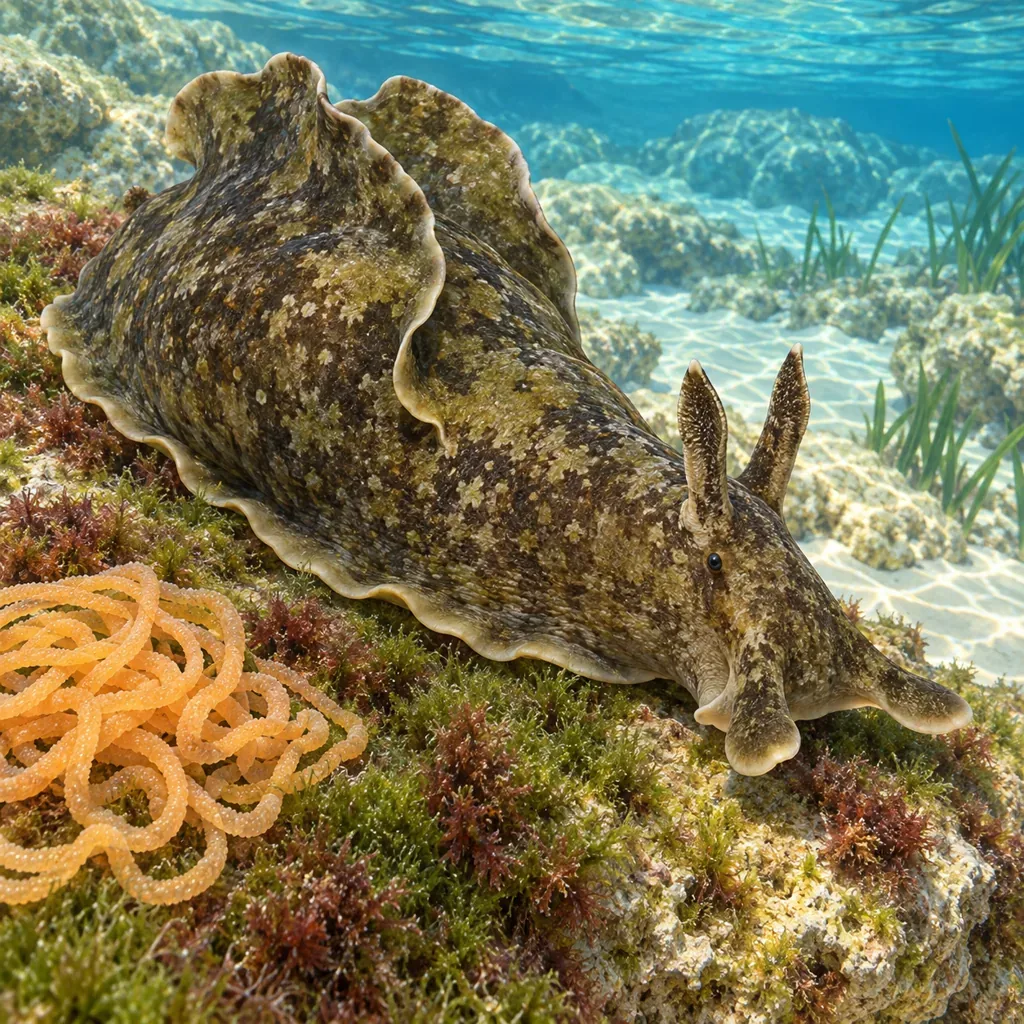
Meet the Sea hare
Sea hares are big, soft, shell-less molluscs that look rather like a wet slug with rabbit ears, which is where the name comes from: the two "ears" are rhinophores, chemical sensors, and a second pair of tentacles sits lower on the head. Along the back are two large fleshy flaps, the parapodia, which some species flap to swim in a clumsy, undulating way. Colour ranges from olive and brown to almost black, usually mottled and often edged in a paler line, and the animal takes its shade from the algae it eats. Common Maltese species include Aplysia depilans, Aplysia fasciata and Aplysia punctata; the spotted sea hare Aplysia dactylomela, an Indo-Pacific arrival that reached the Mediterranean in 2002 and Malta by 2008, is marked with black-ringed spots on a paler ground.
They are grazers, working through green and red algae in very shallow water, and around Malta and Gozo you meet them from the surface down to about 10 m, on algae-covered rock, on sand between weed and along the shallow edges of Posidonia meadows. Big Aplysia depilans can reach 40 cm and a solid weight, which is a surprise the first time you find one.
The defence is the memorable part. Handled or attacked, a sea hare releases a cloud of purple ink from one gland and a sticky white opaline secretion from another. The purple comes from pigments in the red algae it has eaten, and the mixture works by jamming a predator's sense of taste and smell rather than by poisoning it.
When to look: Best in spring and early summer, when adults gather in the shallows to mate and lay tangled ribbons of eggs.
Diving with them
- Look in the first few metres on algae-covered rock and in the sandy gaps between weed; this is a snorkel-depth animal more than a deep one.
- In spring look for the egg masses, tangled ropes of yellow, pink or orange spaghetti draped over weed, then look nearby for the adults.
- Chains and clusters of several animals mating are common in season and are worth photographing whole rather than one at a time.
- Do not provoke the ink for a photograph; it costs the animal a resource it needs against real predators.
- Let it crawl rather than lifting it, as the body is soft and tears easily and the flaps are thin.
Can it hurt you?Harmless
Harmless. It has no bite, no sting and no spines, and the purple ink is a chemical smokescreen rather than a toxin, though as with anything on a dive it is best not to handle it.
Easily confused with
- Nudibranchs, which are far smaller and carry an exposed gill plume or rows of cerata rather than two big body flaps
- Octopus at rest, occasionally confused at a glance in weed, but an octopus has eight arms and suckers
- Other Aplysia species, separated by the pattern: plain olive-brown in A. depilans, dark with a pale edge in A. fasciata, black rings in the introduced A. dactylomela
Where to meet them: 1 sites
Further reading: Il-Miklem: Serduq il-baħar (Aplysia depilans) · Wikipedia: Aplysia depilans · GuideMeMalta: the spotted sea hare in Malta · Occurrence of the alien sea hare Aplysia dactylomela in Malta