🌿 Plants & algae · Posidonia oceanica
Neptune grass
Alkain Maltese, also Posidonja, Ħaxix il-baħar
Not seaweed - a meadow of flowering plants
Meet the Neptune grass
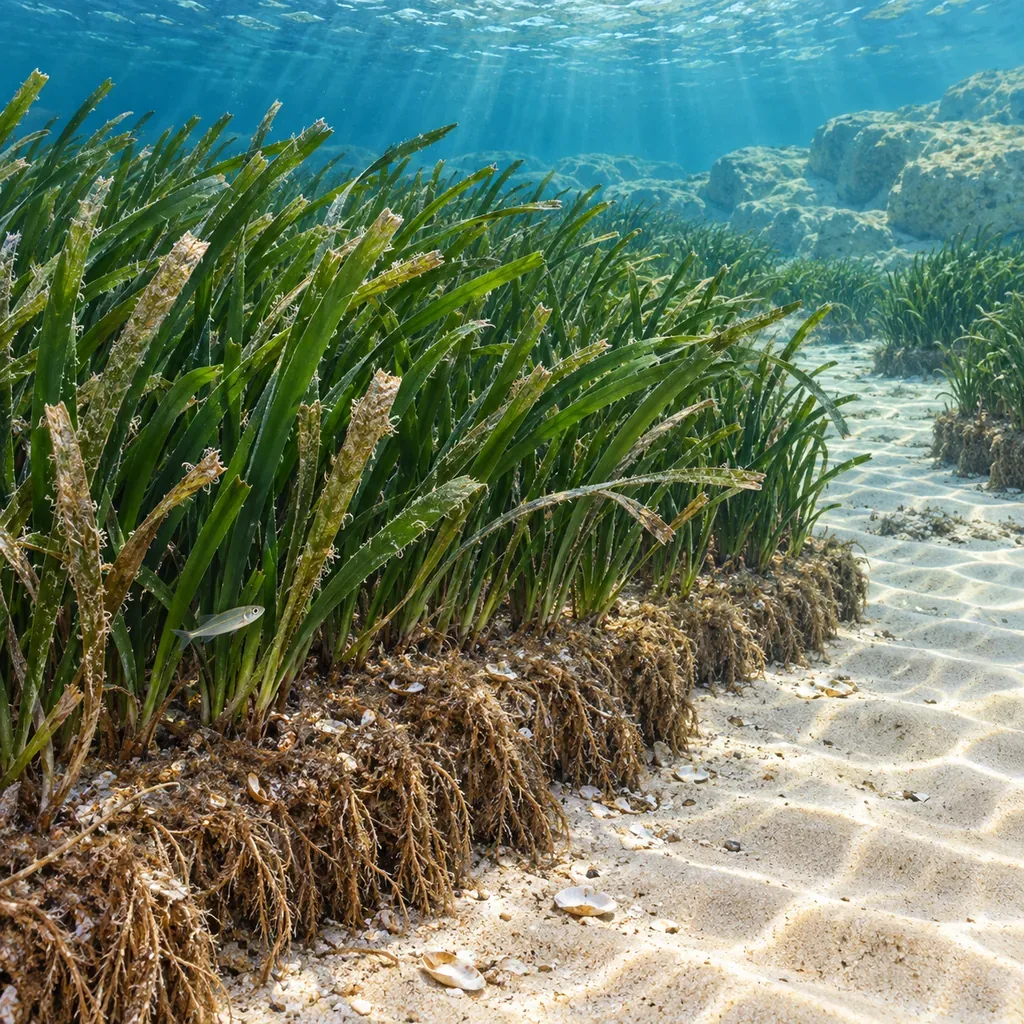
This is not an alga but a true flowering plant that returned to the sea, endemic to the Mediterranean and found nowhere else on earth. It grows in tufts of five to eight flat ribbon leaves, about one centimetre wide and commonly 30 to 80 cm long, bright green when young and darkening with a fur of epiphytes as the season goes on. The tufts sit on woody rhizomes that creep sideways and pile slowly upwards, and over centuries the dead rhizomes, roots and trapped sediment build a raised terrace called matte, which is why a meadow often sits noticeably higher than the sand beside it.
A Posidonia meadow is the nursery and pantry of the Maltese inshore sea. Seahorses, pipefish, juvenile bream and wrasse, cuttlefish eggs, the noble pen shell and an enormous cast of small invertebrates depend on it, and it releases oxygen and locks away carbon at a rate no other Mediterranean habitat matches. In autumn it flowers and later drops olive-shaped floating fruits that Maltese beachgoers find washed up and mistake for real olives.
Around the Maltese islands it forms extensive meadows from around a metre down to about 40 m wherever the water is clear and the bottom is sand or matte, and it is the habitat you swim over on the way to most shore-dive reefs. In winter, storms strip old leaves and pile them on beaches in springy brown banks called banquettes - these look like rubbish but are the beach's own defence against erosion and a habitat in their own right, and clearing them accelerates sand loss.
When to look: All year; greenest in late spring and early summer, flowering in autumn, with leaf litter and beach banquettes after the first winter storms.
Diving with them
- Swim over a meadow, never through it on your knees - fin tips and dragged gauges snap rhizomes that take decades to regrow
- Trim for good horizontal buoyancy before you cross one; it is the single most useful thing a diver can do for this habitat
- Hover still at the meadow edge and scan the leaf bases rather than the tips; seahorses, pipefish and juvenile fish hide low down
- In spring, look along the rhizomes for black grape-like cuttlefish egg clusters
- On a night dive the meadow is a different place, with octopus, cuttlefish and sleeping fish out among the blades
- If you dive from a boat, insist on a mooring or a sand patch - an anchor dropped into a meadow leaves a bare scar for years
Can it hurt you?Harmless
Completely harmless. The plant cannot hurt you in any way; the only thing to watch is your own buoyancy, and the risk runs entirely in the other direction.
Easily confused with
- Cymodocea nodosa, a much finer, shorter seagrass with narrow leaves a few millimetres wide growing on sand rather than on raised matte
- Halophila stipulacea, an alien Red Sea seagrass recorded in Maltese waters with small paired oval leaves, nothing like Posidonia's long ribbons
- Caulerpa and other green algae, which are true seaweeds with feather-like or bead-like fronds rather than flat-bladed leaf tufts on rhizomes
Where to meet them: 21 sites
Armier Bay
Malta
Benghisa Point
Malta
Crystal Lagoon
Comino
Lockheed P2V Neptune
Malta
Merkanti Reef
Malta
Further reading: MaltaWildPlants: Posidonia oceanica, Maltese name and legal protection · Friends of the Earth Malta: Neptune seagrass, banquettes and protection · ERA Malta: marine habitats and Posidonia meadows · Cirkewwa Marine Park: Posidonia oceanica and anchoring damage · Nature Trust Malta: marine habitats