🐟 Fish · Syngnathus spp.
Pipefish
Gremxula tal-baħarin Maltese, also Gremxula, Gremxula tal-baħar ħoxna
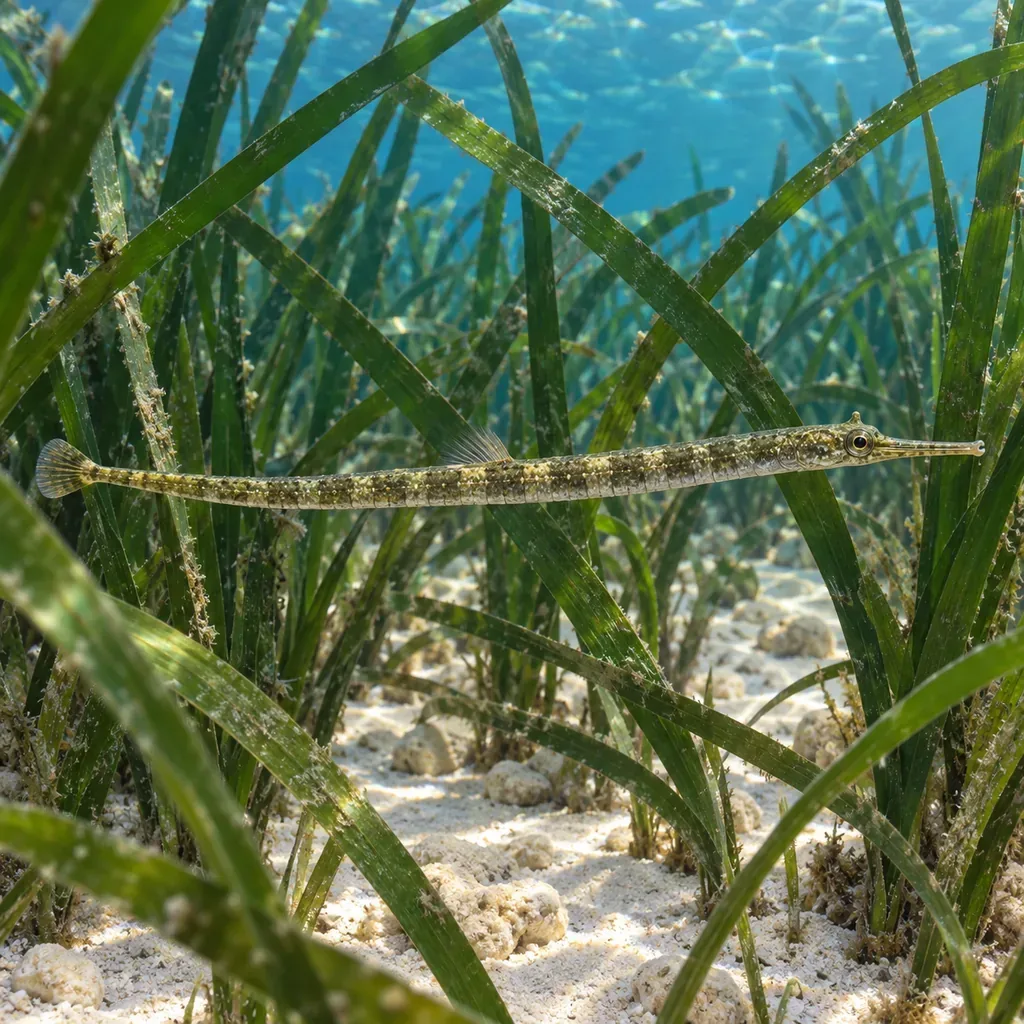
A straightened-out seahorse in the seagrass
Meet the Pipefish
Pipefish are seahorses that never sat up. The body is a long, stiff, pencil-thin tube of bony rings, the snout is a fused tube with a tiny mouth at the tip, and propulsion comes almost entirely from a small transparent dorsal fin rippling in the middle of the back. Colours are camouflage colours: olive, brown, grey-green, sometimes with pale saddles or fine bars, matching seagrass blades and drift algae almost exactly. Three species account for most Maltese sightings. The broadnosed pipefish, Syngnathus typhle, is the seagrass specialist and holds itself vertically among blades with a deep, flattened snout. The greater pipefish, Syngnathus acus, is the largest, up to about 45 to 50 cm, with a distinct bump on the head in front of the eyes. The black-striped pipefish, Syngnathus abaster, is a small, slim species of sheltered shallow water. The worm pipefishes of the genus Nerophis also occur.
Around Malta, Gozo and Comino they live in the top 20 metres over Posidonia meadows, mixed algae, dead seagrass matte and quiet rubble bottoms in sheltered bays. They are far commoner than seahorses but almost invisible because they lie parallel to the blades and drift with the surge. The broadnosed pipefish was once very common in Maltese coastal bays and has declined noticeably in the last decade, enough that the Malta Aquaculture Research Centre bred it in captivity between 2011 and 2015 and released young into quiet local bays.
Like seahorses, the males do the carrying: eggs are held in a pouch or a glued strip on the underside of the tail until the young hatch out as miniature versions of the adults.
When to look: All year in sheltered bays, with the best searching in calm summer conditions and the most obvious animals in late spring and early summer when brooding males are on the seagrass.
Diving with them
- Look for a straight line among curved blades, or for a shadow that does not move with the surge the way the weed does.
- Hold position with your hands off the bottom and watch a single square metre of meadow for a minute rather than sweeping a whole bay.
- Check the underside of the tail: a swollen pouch or a visible line of eggs means a brooding male, and worth leaving undisturbed.
- They tolerate a slow close approach, so macro photography works, but avoid repeatedly flashing the same animal.
- Night dives over shallow seagrass in summer often produce pipefish resting in the open on sand at the meadow edge.
Can it hurt you?Harmless
Harmless. Pipefish have no teeth, spines or venom, and their tiny tube mouths are built for plankton, not for anything a diver would notice.
Easily confused with
- Seahorses, which share the tube snout and ringed body but hold the head at right angles and curl the tail around a holdfast
- Snake pipefishes of the genus Nerophis, which are rounder in section, smoother and lack a tail fin
- A blade of Posidonia or a stem of drift algae, which is what most pipefish are mistaken for
Where to meet them: 9 sites
Further reading: FishBase: Syngnathus acus (size, depth, brooding, IUCN status) · Aquatic Resources Malta: broadnosed pipefish (Gremxula), local decline and captive breeding 2011-2015 · GBIF vernacular names for Syngnathus acus, Maltese entries (Gremxula tal-baħar) · Diversity: A Critical Checklist of the Marine Fishes of Malta and Surrounding Waters (pipefish species recorded in Malta)