🐙 Cephalopods · Sepia officinalis
Common cuttlefish
Siċċin Maltese, also Siċċa
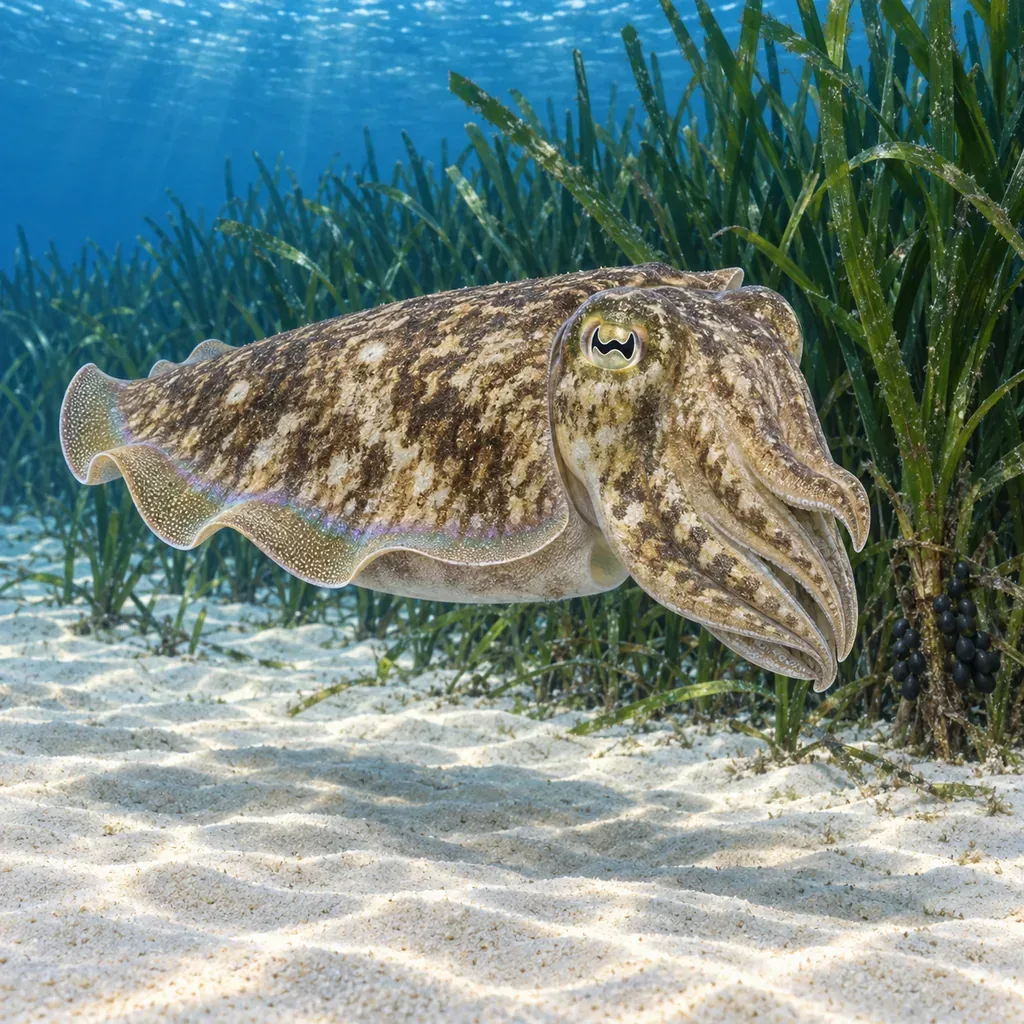
A hovering hologram with a W in each eye
Meet the Common cuttlefish
A broad, flattened oval body with a continuous frill of fin running all the way around the mantle like a skirt, eight short arms and two long feeding tentacles kept folded away in pockets under the eyes. The eyes are the giveaway: the pupil is a distinct W shape. Skin colour runs through sand, marble, chocolate and, in excited males, a pulsing black-and-white zebra pattern that rolls across the body in waves. Inside is the cuttlebone, the white oval float that washes up on Maltese beaches by the thousand. Mantle length is usually 15 to 30 cm here, with the largest animals reaching about 45 cm.
It hovers rather than swims, rippling the fin skirt so it hangs motionless in mid-water, then shoots the two tentacles out in a fraction of a second to snatch a shrimp or small fish. On sand it will settle and flick sediment over itself with the arms until only the eyes show. Faced with a diver it does not usually flee: it turns to face you, raises the first pair of arms and flashes, which is a display rather than a threat.
Around Malta it is most reliably seen in spring, when adults move into shallow sandy and seagrass bottoms between about 3 and 20 m to breed and lay clusters of black, grape-like eggs on Posidonia rhizomes, gorgonians, ropes and anything else with a stem. Outside the breeding season it moves deeper. It is common on the market as siċċ, usually cooked in its own ink.
When to look: Best from March to June when adults come into shallow water to breed and lay eggs; scarcer and deeper in high summer and winter.
Diving with them
- Look for a hovering oval with a rippling fin skirt just above the sand-seagrass boundary, not down in the weed
- It will usually hold its ground; move in slowly, keep your hands still and it will often stay and study you
- Watch for the colour show - a stationary cuttlefish facing you is talking, and the rolling zebra bands are worth waiting for
- In spring, search Posidonia rhizomes, gorgonians and mooring ropes for clusters of black grape-like eggs, and do not touch them
- Photograph at eye level so the W-shaped pupil is in the frame; that one detail identifies the animal
- Empty cuttlebones on the sand are a good sign the area holds them
Can it hurt you?Handle with care
Harmless in practice - it has no interest in biting a diver and its display is bluff. A handled animal can bite with its beak and can release a cloud of ink that stings the eyes if your mask floods.
First aid: Clean and disinfect a bite, cover it and watch for infection over the following days; rinse ink from the eyes with clean water.
Easily confused with
- European squid, which is torpedo-shaped with two triangular fins at the rear only, not a skirt running all round the body
- Elegant and pink cuttlefish, smaller relatives found deeper on soft bottoms, under about 12 cm mantle
- Common octopus, which has eight arms, no fins and no internal cuttlebone, and sits on the bottom rather than hovering
Where to meet them: 61 sites
Further reading: Common cuttlefish overview · SeaLifeBase: Sepia officinalis · English-Maltese terminology for cuttlefish and squid · Telling squid and cuttlefish apart