Malta
HMS Kingston
A shallow scatter of steel in the channel between Selmun and St Paul's Island, all that is left of a K-class destroyer that survived a battleship's shell and then died in dry dock. Think easy scenic dive with a very good story rather than a wreck dive.
Sea conditions
Excellent right now
Flat, sheltered and calm
Forecast for the site, updated 01:47 AM
- Waves
- 0.3 m
- from SE
- Wind
- n/a
- Swell
- 0.3 m
- 5 s period
- Sea temp
- 29 °C
Next 7 days
Exposed to wind and swell from: N (0°), NE (45°), E (90°). The channel is open to the northeast, so a gregale shuts it down completely and turns the gap into a washing machine. In a southwesterly or a westerly the island itself gives useful shelter and the water stays clear. Visibility is usually good, around fifteen to twenty five metres, but a blow will stir the sand and knock it back for a day or two. Best season: May to November, with September and October giving the warmest water and the clearest channel..
The dive
Manage your expectations and you will enjoy this one. Kingston was cut up where she lay in the early nineteen fifties, so what remains is a low, broken trail of plate and frames lying in three to twelve metres of water in the middle of the hundred metre gap between the Selmun headland and St Paul's Island. Some days you swim over it and barely notice. Other days the light hits a run of ribs half buried in sand and the shape of a ship suddenly reads.
The diving around it is genuinely lovely, which is the real reason to come. The channel bottom is a mosaic of clean sand, seagrass patches and low rock, and it tips gently deeper towards the bay side until you are at around twenty five metres. That mix is octopus and cuttlefish country, with bream shoaling over the grass and the occasional ray tucked into the sand.
Because it is shallow, the gas planning is trivial and the limiting factor is simply how long you can stay warm. Most groups drop on the debris, poke around the metal for twenty minutes, then wander down the slope towards the bay in search of life before working back up along the island side. It makes a very relaxed second dive of the day.
- A Second Battle of Sirte veteran, reduced to ribs in twelve metres of water
- Shallow and forgiving, so bottom time is limited by your suit and not your gas
- Seagrass and sand mosaic that holds octopus, cuttlefish and the odd ray
- Pretty channel setting between Selmun and St Paul's Island
Typical plan
An easy single tank dive on air or thirty two percent nitrox. Drop on the debris at around ten metres, spend twenty minutes reading the wreckage and photographing the frames, then ease down the slope towards the bay to eighteen or twenty metres hunting for life on the grass edge before drifting back shallow along the island side. Sixty minutes is comfortable, and nobody needs a decompression stop.
What the bottom looks like
- 1Rock and rubble off the island shore7 m deep · 15 m out
- 2Scrapped plate and frames of HMS Kingston10 m deep · 45 m out
- 3Outlying debris in the channel12 m deep · 95 m out
- 4Posidonia patches on the slope17 m deep · 160 m out
- 5Open sand towards the bay24 m deep · 250 m out
Clean sand broken by patches of Posidonia seagrass and low limestone outcrop, with the odd rusted fragment sticking out of it.
Who you might meet
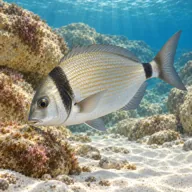
Two-banded bream
Almost always · Sargu
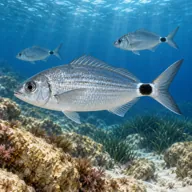
Saddled bream
Almost always · Xilpa
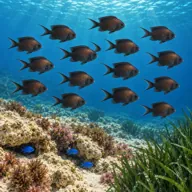
Damselfish
Almost always · Ċawl · Summer
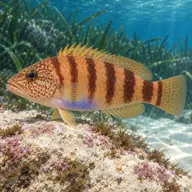
Painted comber
Almost always · Burqax
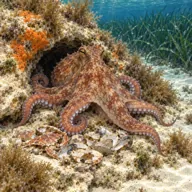
Common octopus
Often · Qarnit
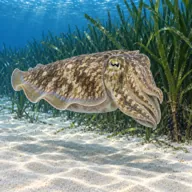
Cuttlefish
Often · Siċċa · Spring
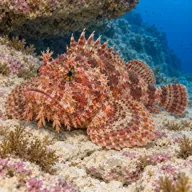
Scorpionfish
Often · Ċipullazza
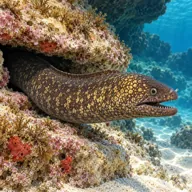
Mediterranean moray
Sometimes · Morina
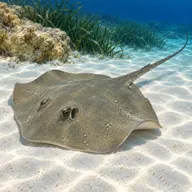
Common stingray
Sometimes · Boll
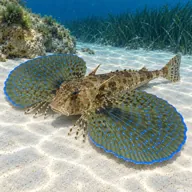
Flying gurnard
Sometimes · Bies · Summer
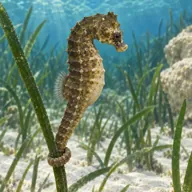
Short-snouted seahorse
Lucky day · Żiemel tal-baħar
Getting in and staying safe
Boat only in practice. Most centres run it as a short hop from St Paul's Bay or Mellieħa and moor in the channel, which also makes the surface interval pleasant. Determined shore divers sometimes look at the Selmun side, but the walk down over rough ground and the swim out across the channel is a lot of effort for very little wreck, and the channel carries small boat traffic all summer. Selmun has parking and a couple of places to get a coffee before you head down to the water.
- Busy small boat and rib traffic through the channel in summer, so use a delayed surface marker on ascent
- Current pushes through the gap when the wind funnels, and it can be brisker than the calm surface suggests
- Sharp, torn plate and protruding frames on the debris, so gloves and good buoyancy
- Snagged monofilament and lost lures around the metal, this is a popular angling spot
- Silt over the seagrass edges kicks up fast
- Jellyfish drifting through in late summer
A bit of history
Kingston was a K-class destroyer built by J. Samuel White at Cowes and commissioned in September 1939. She fought in the North Sea, then the Red Sea and the Mediterranean, took part in the Battle of Crete and at the Second Battle of Sirte in March 1942 was hit by a fifteen inch shell from the Italian battleship Littorio, which killed fifteen of her people and wrecked her. She was towed into Malta for repair and in April 1942 a Stuka finished the job while she sat in dry dock, and she was written off as a constructive total loss. In 1943 her two sections were floated out and scuttled here as a blockship to help close the channel and create sheltered anchorage. The salvage men came back in the early fifties and cut up whatever they could reach, which is why so little is left.
Divers say
Sign in to rate this site and leave a note for the next diver.
- No reviews yet. First one gets bragging rights.
Further reading: Wikipedia: HMS Kingston (F64) · Wrecksite entry for HMS Kingston · Malta Dive Sites: HMS Kingston