🐟 Fish · Hippocampus hippocampus
Short-snouted seahorse
Żiemel tal-baħarin Maltese, also Żiemel il-baħar, Żiemel tal-baħar ħalqu qasir, Żiemel
A stubby-nosed pony, rare and easy to miss
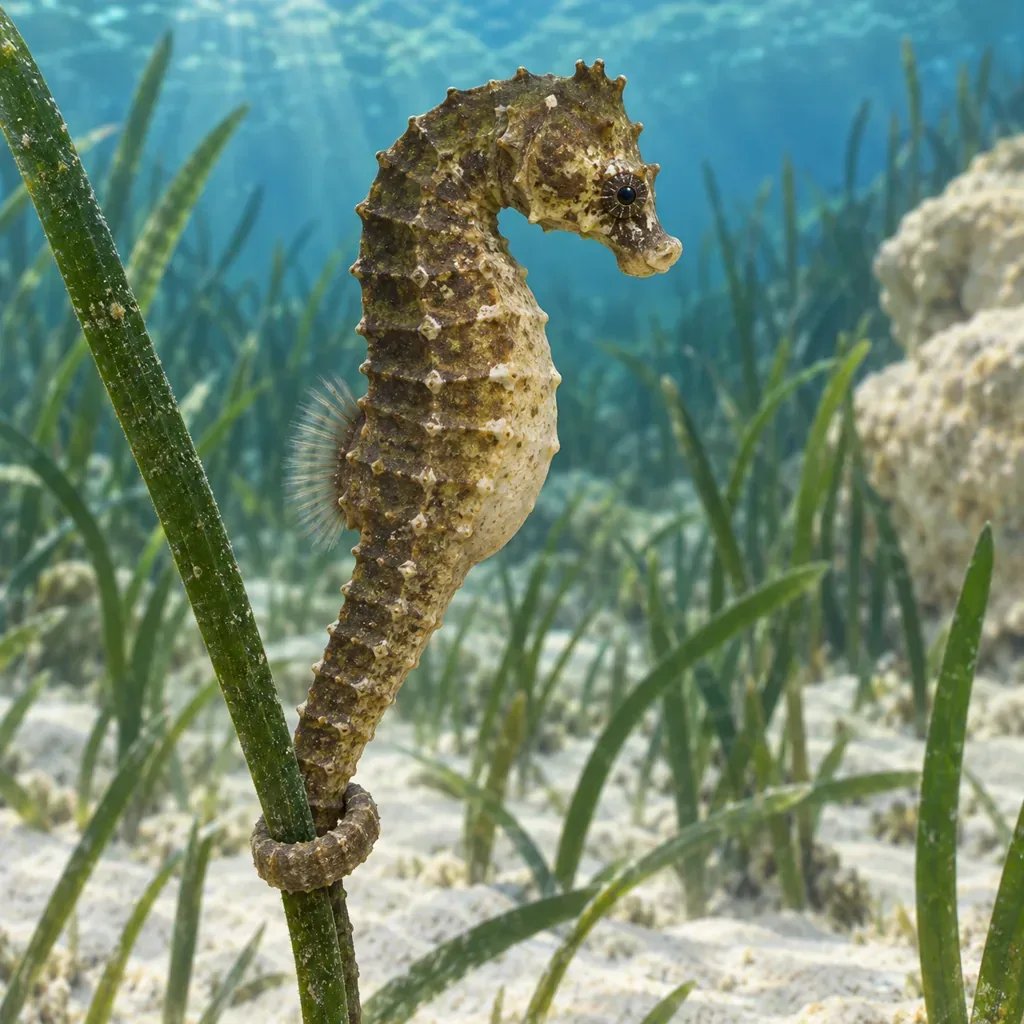
Meet the Short-snouted seahorse
This is the plainer of Malta's two seahorses. The body is the familiar upright, armoured S-shape of bony rings, held with the head bent forward at right angles and the prehensile tail curled around whatever it is gripping. The snout is short and deep, roughly a third of the head length or less, and the body is comparatively smooth, without the fleshy skin filaments that fringe the neck of the long-snouted species. Colours run from dark charcoal and chocolate through olive, orange and dull yellow, sometimes with faint pale speckles, and an individual can shift tone over days to match its background. Adults are usually 8 to 12 cm tall and reach about 15 cm.
Around the Maltese islands it lives on sheltered, sediment-rich bottoms: the edges of Posidonia meadows, patches of loose algae, dead seagrass matte and rubble in quiet bays, most often between about 2 and 25 metres. Mġarr ix-Xini, Ras il-Ħobż and other calm inlets have produced sightings, but nobody should expect one. Both Maltese seahorse populations are poorly known and very sparse, and most divers here go years without seeing either.
Seahorses barely move. They hold a home range of a few square metres, feed by flicking that short snout at passing mysids and copepods, and reproduce with the male carrying the eggs in a sealed belly pouch and giving birth to fully formed young. The young then drift as plankton for weeks before settling, which is one reason local numbers are so unpredictable.
When to look: All year, with slightly better odds in the calm, warm months from late spring to autumn when sheltered bays are clear and searchable.
Diving with them
- Search the boundary between Posidonia and sand, and any patch of loose drift algae or dead seagrass, at a very slow crawl.
- Look for the vertical line and the curled tail, not the animal: a seahorse reads as an odd upright stalk among horizontal blades.
- Never touch, move or reposition one for a photograph, and never pull it off its holdfast; both Maltese seahorses are legally protected.
- Keep strobes and torches off its eyes, take two or three frames and leave; repeated flash is known to stress syngnathids.
- Report sightings to a local marine NGO or dive centre rather than broadcasting the exact spot, because pinned locations attract collectors.
Can it hurt you?Harmless
Entirely harmless. A seahorse has no teeth, no spines and no venom, and cannot hurt a diver in any way.
Easily confused with
- Long-snouted seahorse (Hippocampus guttulatus), which has a snout longer than a third of the head, a maned fringe of skin filaments on the neck and back, and usually bright white or bluish spots
- Pipefish, which share the same tube snout and armoured rings but lie horizontally with no curled tail and no bent head
Where to meet them: 17 sites
Further reading: FishBase: Hippocampus hippocampus (size, depth, biology, IUCN and CITES status) · Aquatic Resources Malta: short-snouted seahorse, one of two Maltese seahorse species · Il-Miklem: Żiemel il-baħar = Hippocampus hippocampus and H. guttulatus · Atlam Subaqua Club Malta: seahorses in Maltese waters and their protection since 2006