🐟 Fish · Hippocampus guttulatus
Long-snouted seahorse
Żiemel tal-baħarin Maltese, also Żiemel il-baħar, Żiemel tal-baħar ħalqu twil, Żiemel
The maned seahorse of the seagrass edge
Meet the Long-snouted seahorse
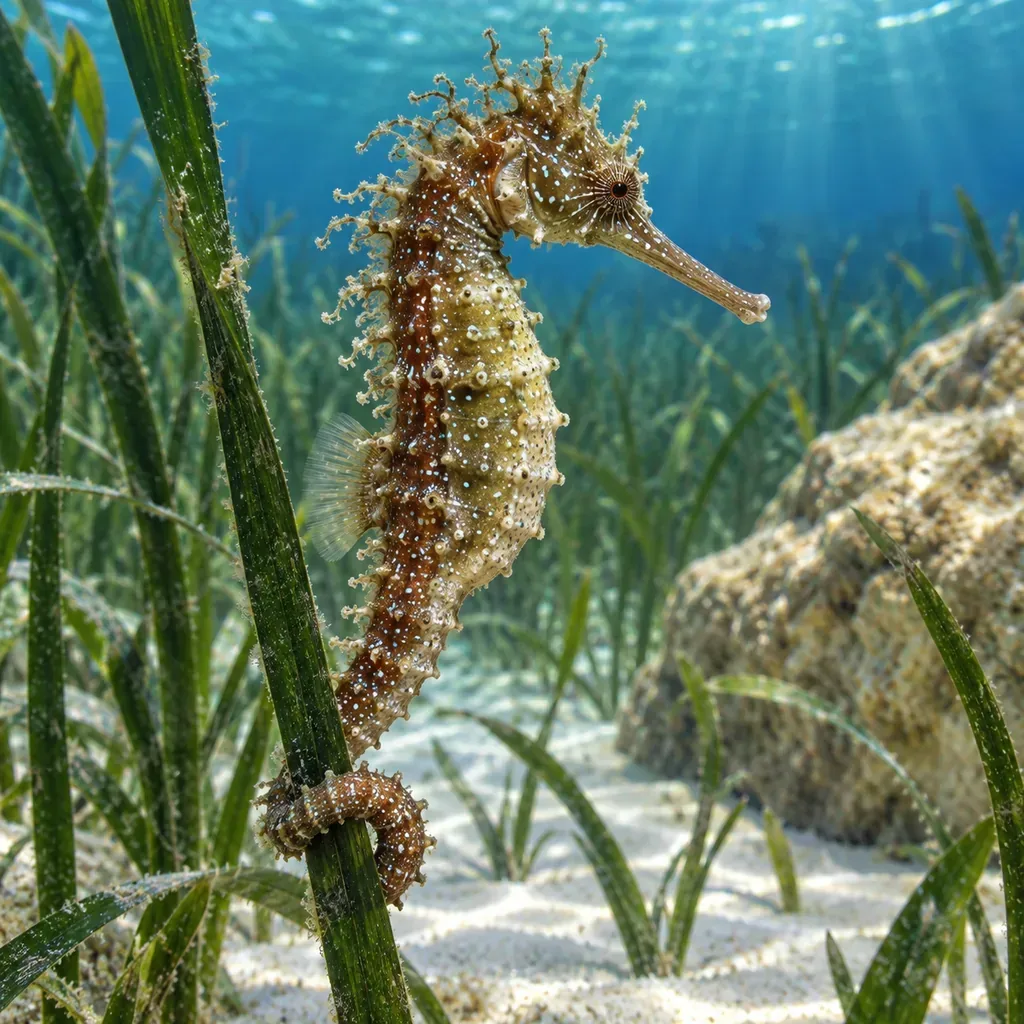
The long-snouted or spiny seahorse is the showier of the two species in Maltese water. It has the same upright, ringed, armoured body and curled tail, but the snout is noticeably long, more than a third of the head length, and the neck and upper back carry a row of fleshy skin filaments that look like a ragged mane. The bony tubercles on the rings are more pronounced, giving a knobbly outline. Colour ranges from greenish yellow and olive through reddish brown to near black, usually sprinkled with small bright white or bluish-white spots. Adults are commonly 10 to 15 cm and can reach about 21 cm.
It favours shallow, sheltered, well-vegetated ground: Posidonia meadows, mixed algae on rubble and quiet rocky inlets, mostly in the top 20 metres. Maltese and Gozitan sightings have come from Mġarr ix-Xini and Ras il-Ħobż, better known to divers as Middle Finger, and from other calm bays with good seagrass, but the animal is genuinely scarce here and finding one is a matter of luck and slow searching.
Long-snouted seahorses hold tiny home ranges, often only around twenty square metres, and pairs tend to stay faithful across a breeding season. The male broods the eggs for about three weeks in a belly pouch and can release several hundred miniature young at once. They are poor swimmers, using a whirring dorsal fin for propulsion and tiny pectoral fins as rudders, so they rely completely on camouflage and on holding tight to their anchor.
When to look: All year, best searched on calm, clear days from late spring to autumn when the sheltered seagrass bays are settled.
Diving with them
- Hover, do not fin, over the seagrass; a single careless kick clouds the exact patch you are searching.
- Look for the mane of skin filaments and the white speckling, which catch torchlight before the body shape registers.
- Check the bases of Posidonia clumps and the edges of rubble patches, roughly between 3 and 15 metres, where most Maltese records come from.
- Do not handle, uncurl or move the animal; it is protected in Malta and moving it off its holdfast can be fatal.
- Keep photography short and light gentle, and move on rather than circling the same animal for a whole dive.
Can it hurt you?Harmless
Entirely harmless. Seahorses have no teeth, spines or venom and pose no risk whatsoever to a diver.
Easily confused with
- Short-snouted seahorse (Hippocampus hippocampus), which has a short deep snout, a smoother body and no mane of skin filaments
- Pipefish, which have the same tube snout but a straight horizontal body and no bent head or gripping tail
- A broken Posidonia rhizome or a curled piece of drift weed, which fools most divers at least once
Where to meet them: 2 sites
Further reading: FishBase: Hippocampus guttulatus (size, depth, home range, brooding, IUCN and CITES status) · Atlantis Gozo Diving: long-snouted seahorse at Mġarr ix-Xini and Ras il-Ħobż · GBIF vernacular names for Hippocampus guttulatus, Maltese entries (Żiemel tal-baħar ħalqu twil)