Malta
Submarine Pen
A forty metre natural tunnel through the rock below the Valletta bastions, open at both ends with an air space inside, surrounded by boulders and a scatter of wartime junk. Sheltered enough to dive when everywhere else is blown out.
Sea conditions
Excellent right now
Flat, sheltered and calm
Forecast for the site, updated 02:18 AM
- Waves
- n/a
- Wind
- 3 km/h
- SSW, gusts 6
- Swell
- n/a
- Sea temp
- n/a
- air 25 °C
Next 7 days
Sunrise 06:46, sunset 19:04
Exposed to wind and swell from: NE (45°), E (90°). Deep inside Grand Harbour and tucked under the bastions, so it shrugs off almost all weather. Only a hard north easterly or easterly, which pushes swell straight through the harbour mouth, makes it uncomfortable. That shelter is the main reason to dive it: this is the card you play when the whole north west coast is closed. Best season: All year, and particularly useful in winter when exposed sites are unworkable.
The dive
Start at the steps by the Valletta fish market, swim about ninety metres along the foot of the bastions under the Lower Barrakka Gardens, and you reach a tunnel roughly forty metres long that you can enter from either end and surface inside. That is the core of the dive, and it is a good one: dark rock, a torch beam, and the odd feeling of taking your regulator out in a pocket of air inside a cliff.
The name is a historical mix-up worth knowing. The real submarine pens were cut into the rock across the water in Marsamxett, at Manoel Island and Lazzaretto Creek, where the Tenth Submarine Flotilla sheltered from bombing. The tunnel here is natural, but the label stuck and every dive log in Malta uses it.
Outside the tunnel the ground is a rubble slope of boulders with a drop-off running to twenty five or thirty metres, and it is littered with war debris and post-war rubbish thrown off the bastions above. That is part of the appeal for people who like rummaging. Octopus do very well here, and divers regularly report unusually large ones in the boulder holes, along with seahorses, morays and blennies in the shallower rock.
- A forty metre natural tunnel with an air pocket you can surface into
- Diveable in almost any weather, right under the Valletta bastions
- Reliably big octopus in the boulder holes outside
- War debris and harbour junk for anyone who enjoys a rummage
Typical plan
Enter at the fish market steps, swim the ninety metres on the surface or just below it, then descend to the tunnel at around thirteen metres. Run the tunnel with torches, surface briefly in the air space if the group is comfortable with it, and come out the far end. Work the boulders and the debris slope down to twenty five metres for ten to fifteen minutes, then ascend along the rock and follow the cliff foot back to the steps. Fifty minutes on a single 12 litre is comfortable; air is fine, nitrox 32 buys margin on the deeper part. Torch each, DSMB on you at all times, and listen for propellers.
What the bottom looks like
- 1Tunnel entrance, roughly 40 m long, open both ends13 m deep · 100 m out
- 2Air space inside the tunnel where you can surface12 m deep · 125 m out
- 3Boulder field outside the tunnel19 m deep · 175 m out
- 4Drop-off running to 25 to 30 m24 m deep · 200 m out
- 5War debris and post-war junk scattered on the slope27 m deep · 215 m out
Fallen Globigerina limestone boulders over silt and sand, with metal debris worked into the rubble.
Who you might meet
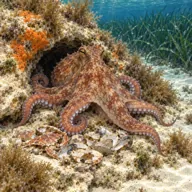
Octopus
Almost always · Qarnit
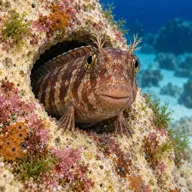
Blennies
Almost always · Budakkra
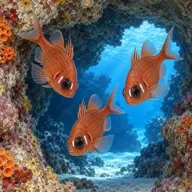
Cardinalfish
Almost always · Sultan iċ-ċawl
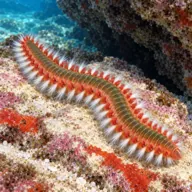
Fireworm
Almost always · Busuf
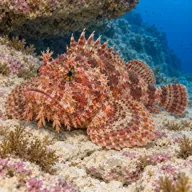
Scorpionfish
Often · Skorfna
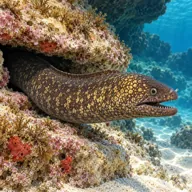
Moray eel
Often · Morina
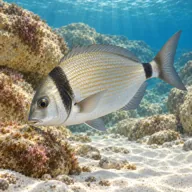
Two-banded seabream
Often · Sargu
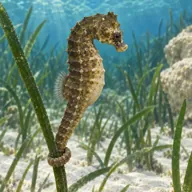
Short-snouted seahorse
Sometimes · Żiemel tal-baħar
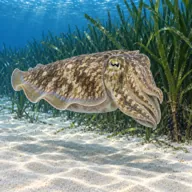
Cuttlefish
Sometimes · Siċċ · Spring
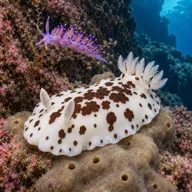
Nudibranchs
Sometimes · Spring
Getting in and staying safe
Shore dive, and the awkward part is not the swim but the setting. Kit up near the Valletta fish market and use the steps there, then swim north along the cliff foot for about ninety metres. Parking around the Marsamxett and fish market area is difficult on weekdays and easier at weekends. Bear in mind that this is inside Grand Harbour, a working commercial port: check the current position on permissions and port movements with a local centre before diving, because rules on harbour diving change and vessel traffic is not optional. Cafes and toilets are a short walk up into the city.
- Commercial ship traffic, cruise liners and tankers entering and leaving Grand Harbour, propellers audible and felt through the water
- Overhead environment in the tunnel with limited light
- Harbour visibility, commonly five to eight metres and sometimes much worse
- Depth to 30 m on the drop-off outside the tunnel
- Sharp metal and glass among the war debris
- Fishing line and discarded gear along the cliff foot
- Awkward shore entry and a long surface swim with kit
- Port access restrictions, do not assume the dive is permitted without checking
A bit of history
Grand Harbour absorbed some of the heaviest bombing of the Second World War, and the seabed and cliff foot around Valletta are still carpeted with the result. The genuine submarine pens associated with the Royal Navy's Tenth Submarine Flotilla were excavated in Marsamxett Harbour, not here, so this site's name is borrowed rather than earned. The rock itself is Globigerina limestone, the soft golden stone Valletta is built from, which is why the sea has been able to cut a tunnel through it at all.
Divers say
Sign in to rate this site and leave a note for the next diver.
- No reviews yet. First one gets bragging rights.
Further reading: Divers Guide: Submarine Pen, Malta · Malta Dive Sites: Submarine Pen · Malta Dive Sites: Valletta area · Scuba Diving: Malta's wartime shipwreck graveyard