🪱 Worms · Hermodice carunculata
Bearded fireworm
Busufin Maltese
Beautiful, slow, and genuinely worth not touching
Meet the Bearded fireworm
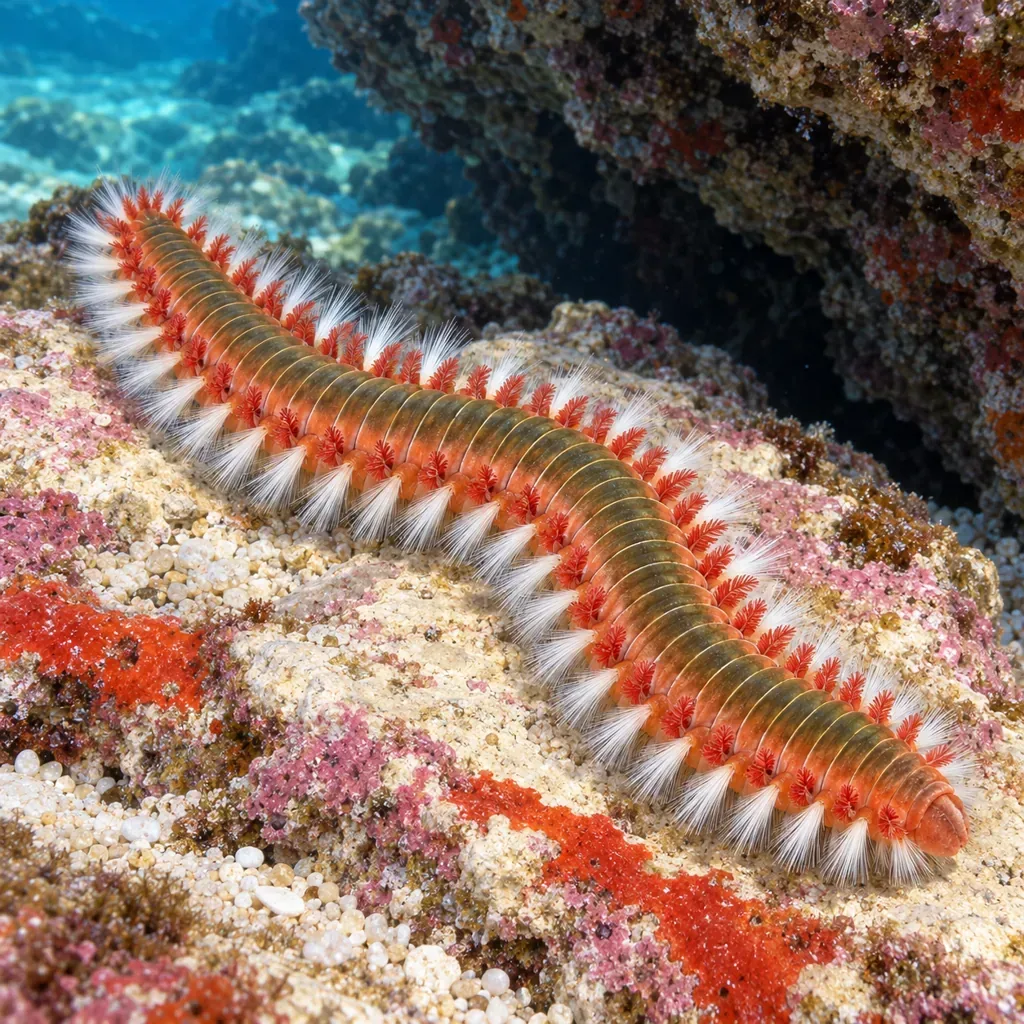
A bearded fireworm looks like a flattened centipede that has been coloured in by someone enjoying themselves. The segmented body is olive-green to rusty brown along the back, often with a coppery or greenish sheen, flushed orange-red down the sides, and every single segment carries a tuft of bright white bristles and a small scarlet gill plume. Most in Maltese waters are ten to fifteen centimetres long and about a centimetre wide, but they reach thirty. It moves in a slow, deliberate ripple, and when it is disturbed it flares those white tufts out sideways so the whole animal seems to double in width.
It lives on rocky bottoms, in boulder fields, under slabs, along wreck plating and around the edges of seagrass, mostly in the top thirty metres, and it is very much at home in shallow water where swimmers and snorkellers are. It is a scavenger and an opportunist, working its way over dead fish, discarded bait and anything else edible, and it is drawn to fish traps and nets, which has made it a real nuisance for Maltese artisanal fishers. Warmer seas appear to be helping it: divers and fishers around Malta and the central Mediterranean have been reporting more of them in recent years.
The colours are a genuine warning and the danger is real but manageable. The white bristles are hollow, brittle and loaded with an irritant, and they are designed to snap off in whatever touches them. They will go through a thin glove. If you are careful with your hands and knees, a fireworm is simply a beautiful thing to photograph.
When to look: All year, with more sightings reported in the warm months; often out in the open at night and around anything dead or baited.
Diving with them
- Never touch one, with or without gloves. The bristles go through thin neoprene and a bare-handed grab is a guaranteed bad afternoon.
- Watch where you put hands and knees on shallow rock, and be careful reaching into wreck structure at Um El Faroud or the Ċirkewwa tugs.
- It is slow and unbothered by divers, so it is an ideal macro subject; get level with it and light it from the side to make the white bristles glow.
- Keep your fins and gauges clear of it too. Bristles embedded in kit find your fingers later.
- If one is feeding on something dead, give it a minute and watch; it everts a soft pad of a mouth and works methodically.
- Photograph it in place. There is never a reason to move a fireworm.
Can it hurt you?Can hurt you
The hollow white bristles break off in the skin on contact and deliver an irritant, causing intense burning, itching and swelling that typically peaks quickly and lasts a few hours. It is not life-threatening, but it is genuinely painful and can leave the area sore and inflamed for days.
First aid: Do not rub the area: that pushes the bristles and the irritant deeper. Pull out any bristles you can see with tweezers, or lift them by pressing adhesive tape onto the skin and peeling it away. Immerse the area in comfortably hot water, hot enough to be effective without scalding, which helps break down the irritant; ice afterwards numbs it and gives fast relief. Vinegar or isopropyl alcohol on the site is also commonly used. Take an oral painkiller if needed. The injury is self-limiting, but seek medical help for a large exposure, a sting near the eyes, or any breathing difficulty or widespread rash.
Easily confused with
- Nothing else in Maltese waters really matches it, which is useful: the combination of a flat segmented body, white bristle tufts and red gill plumes is diagnostic.
- Flatworms and some elongated nudibranchs are the usual confusion at a glance, but they have no segments and no bristles, and they are harmless.
- Small juveniles are easily overlooked as a bit of orange algae on rock, so treat any centipede-shaped thing with white fringes as a fireworm.
Where to meet them: 47 sites
Italian E-boat
Malta
Merkanti Reef
Malta
Further reading: Sammut, Dangerous creatures of the Maltese sea Part 1 (Maltese name 'Busuf', injury and treatment) · TVM News Malta: fireworm numbers up with rising sea temperature · Fishes (MDPI): interactions of Hermodice carunculata with artisanal fisheries in Malta · Wikipedia: Hermodice carunculata · Atlantis Gozo Diving: bearded fireworm