Lantern Point · Comino
Lighthouse Reef
The outer face of Lantern Point: a wide chimney through the limestone plateau, huge boulder caverns below it, and a wall that keeps going past fifty metres. Only when the weather is perfect.
Sea conditions
Excellent right now
Flat, sheltered and calm
Forecast for the site, updated 02:29 AM
- Waves
- n/a
- Wind
- 4 km/h
- S, gusts 8
- Swell
- n/a
- Sea temp
- n/a
- air 25 °C
Next 7 days
Sunrise 06:47, sunset 19:05
Exposed to wind and swell from: W (270°), SW (225°), S (180°), SE (135°). Sources are consistent that this should be dived only when the weather is genuinely good. It faces the open south-western approaches and the channel, so anything from west through south-east builds swell on the face. A northerly or north-easterly gives it shelter behind the island. Current is described as limited but variable, and it can run hard on the point itself. Best season: June to early October, on settled days with light winds and a small sea.
The dive
Lantern Point is the south-western corner of Comino, marked by a small light, and it is the best-known dive on the island. Lighthouse Reef is the outer, deeper half of it, the part on the seaward side where the plateau ends and the bottom stops pretending to be a slope.
The standard opening is the chimney. A wide vertical shaft cuts down through the limestone plateau from around six metres and exits at sixteen into open water on the reef face. It is roomy enough not to feel like a squeeze, and dropping through it with the light coming down behind you is the image most divers take home from Comino. Below and beyond, house-sized boulders have piled up into caverns and swim-throughs, and past those the wall drops away into fifty metres and more.
The deeper you go the more the character changes: white tufted worms and fireworms on the rock, purple heart urchins and spiny starfish in the rubble, grouper and moray in the cracks, and in summer barracuda, squid and amberjack out in the blue. Visibility here is routinely twenty-five to forty metres, which is part of why the site has the reputation it does.
The repeated warning is exposure. Sitting on a point that juts into the channel, it needs settled weather and light winds, and current is variable rather than absent. Everyone who writes about it says the same thing: dive it when it is perfect, not when it is merely acceptable.
- Dropping through the chimney from six metres and popping out at sixteen
- Boulder caverns big enough to swim through without touching anything
- A wall that carries on past fifty metres into properly blue water
- Twenty-five to forty metres of visibility on the right day
Typical plan
Enter over the plateau, drop through the chimney and exit at sixteen, then run the wall out and down to a planned maximum in the thirty to forty metre band for ten to fifteen minutes. Come back up through the boulder caverns at twenty-five and finish shallow over the plateau. Nitrox 28 is the sensible mix and a deco-capable computer is standard practice here. DSMB deployed before ascent, and a torch for the chimney and the caverns.
What the bottom looks like
- 1Top of the chimney in the plateau6 m deep · 10 m out
- 2Chimney exit onto the reef face16 m deep · 25 m out
- 3Huge boulders forming caverns and swim-throughs23 m deep · 60 m out
- 4Lip of the outer drop-off28 m deep · 95 m out
- 5Wall face running past 50 m36 m deep · 140 m out
- 6Rubble and sand at depth50 m deep · 250 m out
Jointed coralline limestone plateau and wall with enormous collapsed boulders on the face, grading to rubble and sand at the deepest points.
Who you might meet
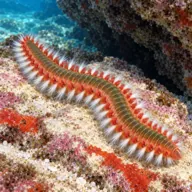
Fireworm
Almost always · Busuf
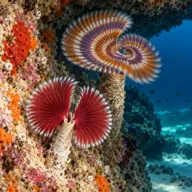
White tufted worm
Almost always
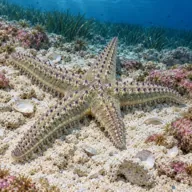
Spiny starfish
Almost always · Stilla tal-baħar
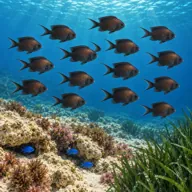
Damselfish
Almost always · Kaħlija
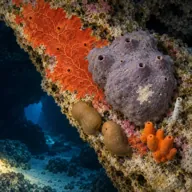
Encrusting sponges
Almost always · Sponża
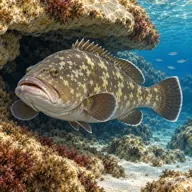
Dusky grouper
Often · Ċerna
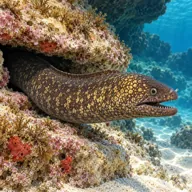
Mediterranean moray
Often · Morina
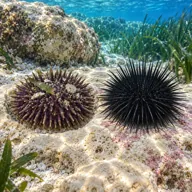
Purple heart urchin
Often · Rizzi
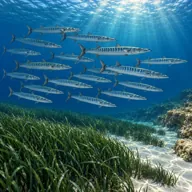
Barracuda
Sometimes · Lizz · Summer and early autumn
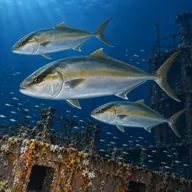
Greater amberjack
Sometimes · Aċċola · Late summer
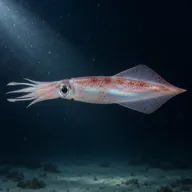
European squid
Sometimes · Klamar · Autumn
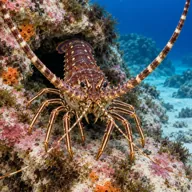
Spiny lobster
Sometimes · Awwista
Getting in and staying safe
Boat only, and there is no realistic alternative: the point is a cliff face on a car-free island. Around twenty minutes from Ċirkewwa, thirty to thirty-five minutes on a charter, and roughly forty-five minutes on a day boat from Sliema or Buġibba. Boats stand off the point rather than mooring, so this is usually a live drop with a live pick-up. Exit by ladder. No facilities anywhere nearby; the nearest kiosks are at the Blue Lagoon.
- Very exposed point, conditions can change fast
- Variable current, strongest around the tip
- Depth: the wall runs past fifty metres with no natural stopping point
- Narcosis and gas consumption at the deeper end
- The chimney is an overhead environment, single file with good buoyancy
- Caverns and swim-throughs among the boulders, some with restricted exits
- Live boat pick-up in open water, DSMB essential
- Marked thermocline below thirty metres outside high summer
A bit of history
The plateau and its chimney are cut into upper coralline limestone, the hard jointed cap rock that gives Comino and Cominotto their cliffs and vertical faces. The chimney is a solution and collapse feature exploiting a vertical joint, the same process on a smaller scale that produced Malta's sea arches, including the Azure Window at Dwejra which collapsed in a storm in March 2017. The small light on the point has given the site both its names.
Divers say
Sign in to rate this site and leave a note for the next diver.
- No reviews yet. First one gets bragging rights.
Further reading: Calypso SAC, Lighthouse Reef at Lantern Point · Divers Guide, Lantern Point · PADI, Lantern Point dive site · Paradise Diving, Lantern Point and Comino sites