⭐ Echinoderms · Marthasterias glacialis
Spiny starfish
Stilla tal-baħarin Maltese, also Salib il-baħar
The big pale hunter with purple-tipped spines
Meet the Spiny starfish
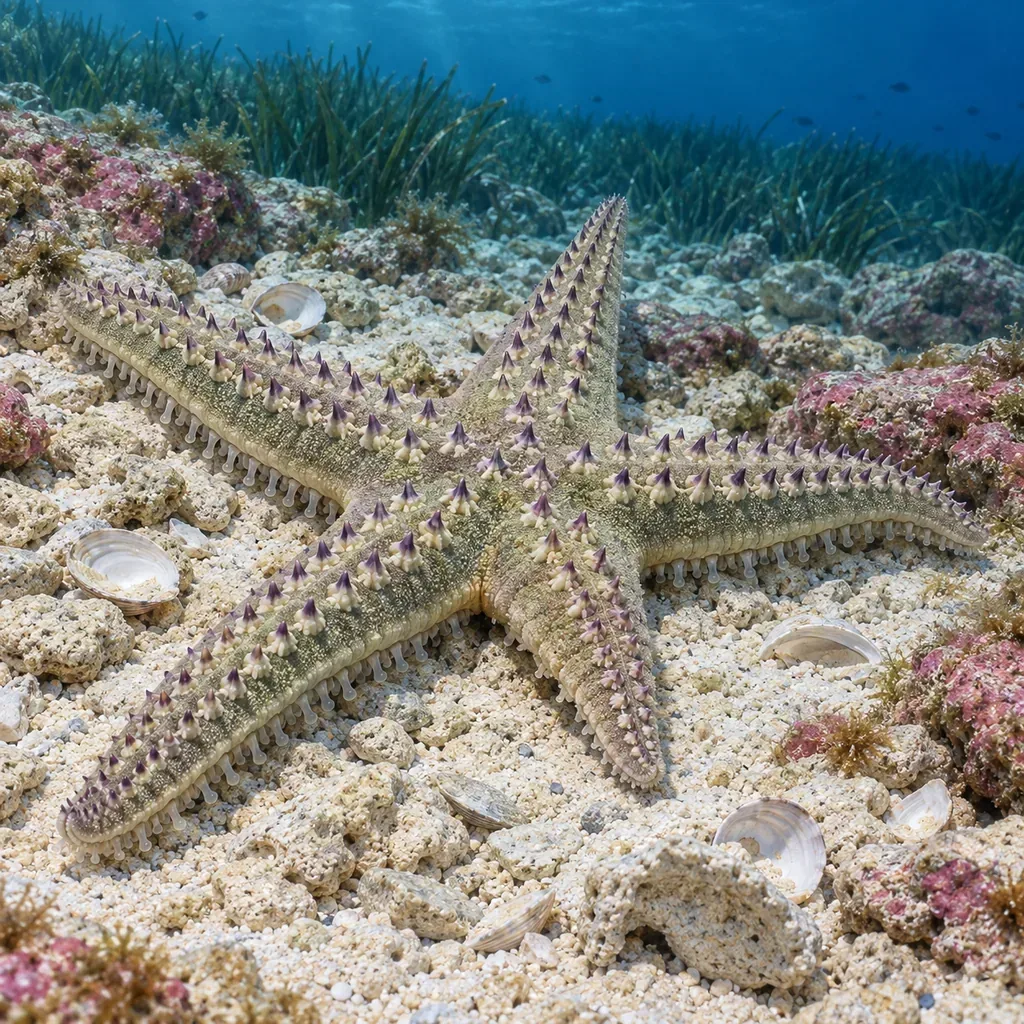
Where the red starfish is small and neat, this one is a heavyweight. Five long, tapering arms spread from a modest disc, and each arm carries three lengthwise rows of conspicuous conical spines, whitish at the base with purple or mauve tips, each one ringed by a fringe of tiny pincer-like structures. The body colour is variable and muted: dirty grey-brown, pale greenish, or fawn, often with a purplish flush along the arm ridges. Most you meet in Malta are twenty-five to thirty-five centimetres across, but they keep growing, and a real veteran can push past half a metre.
It is much less predictable than the red starfish. You may go several dives without one and then find two on the same reef, usually on mixed ground where rock meets sand or seagrass, on boulder slopes, and sometimes out on open sand hunting. Around the Maltese islands it turns up from about five metres down past fifty, and it is a fairly regular sight on wreck debris fields and rubble around sites like Ċirkewwa and the Blue Hole surrounds.
Unlike the grazing red starfish, this is a predator. It humps itself over clams, small gastropods and other slow invertebrates, pulls the shell apart with its arms, and pushes its stomach out through its mouth to digest the prey in place. A spiny starfish sitting in a strangely arched posture on sand is usually mid-meal, and if you come back ten minutes later it will barely have moved.
When to look: All year; more often found out in the open on night dives, when it moves onto sand and rubble to hunt.
Diving with them
- Scan the rubble and sand margins at the foot of boulder slopes rather than the reef face itself; that is where most are found.
- An arched, hunched posture on sand means it is feeding on a buried bivalve, which is worth watching for a minute without crowding it.
- It is big enough to fill a wide-angle frame from close in; include a boulder or seagrass edge so the scale reads.
- The spines are blunt and harmless, but handling rubs off the tiny pincers it uses to keep itself clean, so look rather than touch.
- Missing or half-length arms are normal; they regenerate, and an odd-looking individual is not a different species.
Can it hurt you?Harmless
Harmless. The spines look fierce but are blunt, and the animal has no venom and cannot bite anything that is not a shellfish.
Easily confused with
- Red starfish (Echinaster sepositus) — smaller, uniformly orange-red, with a soft granular skin and no rows of spines.
- Blue spiny starfish (Coscinasterias tenuispina) — similar spines but usually six to eight unequal arms and a mottled blue-grey cast, because it reproduces by tearing itself in half.
- Comb star (Astropecten spp.) — flat, stiff, sand-coloured arms with a neat fringe of plates along the edge; lives buried in sand, never clinging to rock.
Where to meet them: 4 sites
Further reading: MarLIN: Marthasterias glacialis (spiny starfish) · SeaLifeBase: Marthasterias glacialis · Dive Shack Malta marine life guide: spiny starfish · Snorkeling Report: Marthasterias glacialis