⭐ Echinoderms · Paracentrotus lividus and Arbacia lixula
Sea urchins
Rizziin Maltese, also Rizza (singular), Qanfud il-baħar
Black and purple pincushions on every rock
Meet the Sea urchins
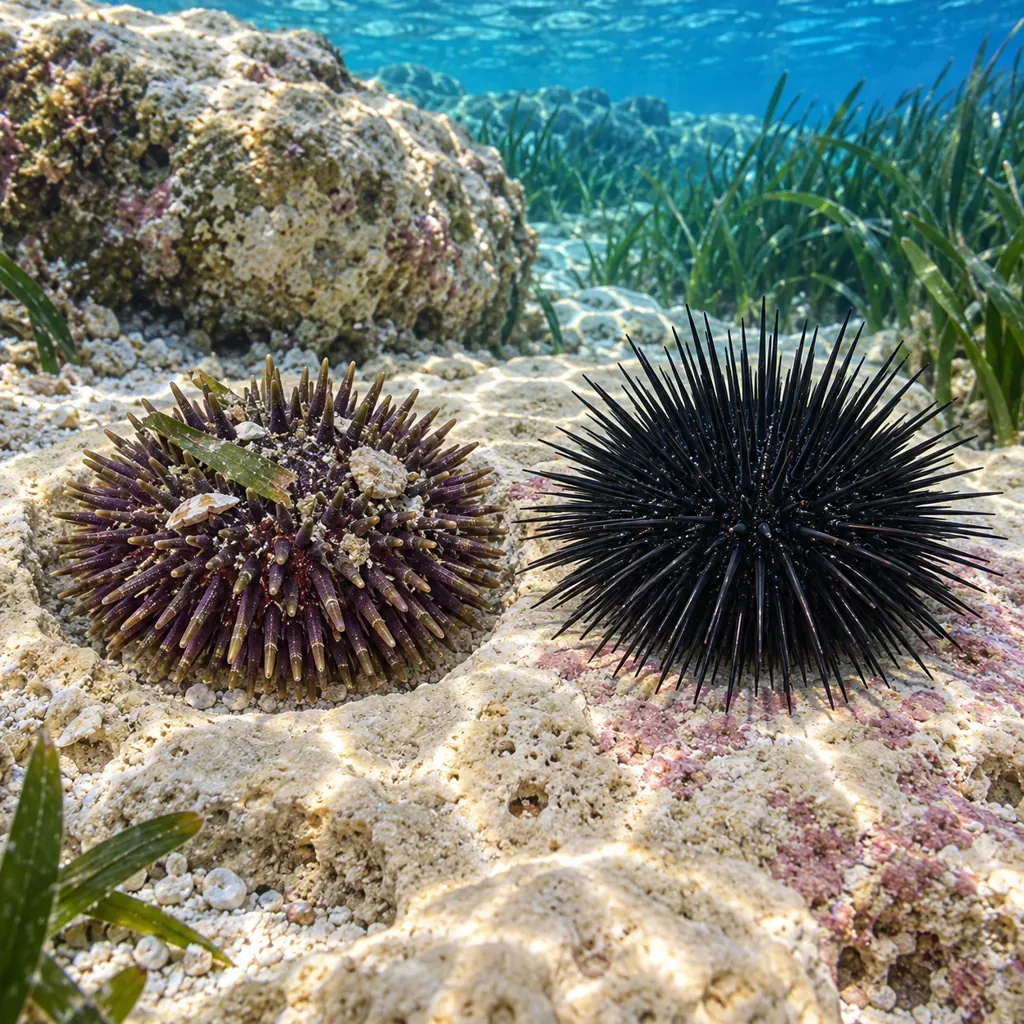
Two urchins dominate the shallow rock around Malta, Gozo and Comino and it is worth learning to tell them apart. Paracentrotus lividus, the one Maltese people call rizzi and used to eat, has a flattened test about the size of a plum, greenish underneath and clothed in fairly stout spines of purple, brown or olive. It habitually decorates itself with scraps of shell, pebbles and torn Posidonia leaves, and on soft globigerina rock it grinds itself a shallow hollow that it returns to. Arbacia lixula is the other one: jet black, slightly domed, with longer, more slender and more evenly spread spines and no camouflage habit at all. Its bare test, when you find an empty one, is greenish-white with five neat rows of pores.
Both sit out on open rock and in shaded cracks from the waterline down, and you will meet them most between the surface and about 20 metres, sometimes deeper. Paracentrotus also pushes into Posidonia meadows and shallow bays; Arbacia prefers bare, well-lit rock, where it scrapes off the pink coralline crust and can, in numbers, leave the stone looking bald. Around dive sites like Ċirkewwa, Ras il-Ħobż and the shore entries off Sliema they are among the first animals you see on the way in.
Count the spines as part of the animal's reach, not its size: a test of five or six centimetres carries spines of two or three more. They move slowly on hundreds of tube feet, and most feeding happens at night, which is when you will see them out on open rock rather than tucked under a ledge.
When to look: All year, at any depth from the entry steps down; they feed and move most at night.
Diving with them
- The commonest injury in Maltese diving happens on the shore entry, not underwater: look before you put a hand or a bare foot down on a shallow ledge.
- Booties and gloves stop almost all urchin injuries, and a knee on a ledge in surge is as risky as a hand.
- Look for the tell-tale hollows ground into soft rock; an empty hollow usually means the urchin is out feeding nearby.
- For photography, get low and light them from the side so the spine colour separates from the rock instead of flattening into it.
- Empty tests wash up after storms and are lovely, but leave them in place; they are food and shelter for other animals.
- Never lever one off the rock to show a buddy. Collection is illegal in Malta and the animal rarely survives being detached.
Can it hurt you?Handle with care
Neither Maltese urchin is venomous, but the spines are needle-sharp and brittle, so they punch into skin and snap off, most often in the palms of hands or the soles of feet. It hurts, it can be fiddly to clear, and an ignored spine can go septic.
First aid: Pull out any large projecting spines with tweezers. Leave shallow ones alone; the skin usually pushes them out over a few days. Soaking the area in comfortably hot water for five to ten minutes softens the skin and makes deeper spines far easier to lift after a day or two. Do not dig around in the wound. See a doctor if the site becomes hot, red, swollen or increasingly painful, which suggests infection.
Easily confused with
- Hatpin urchin (Centrostephanus longispinus) — very long, faintly banded, mobile spines and a deeper habitat; it is strictly protected, so admire and leave it.
- Violet urchin (Sphaerechinus granularis) — bigger, rounder, purple with short white-tipped spines, usually on sand or in seagrass rather than clamped to rock.
- Diadema setosum — an invasive Indo-Pacific urchin with extremely long black spines and an orange ring on the test; worth reporting if you are sure of it.
Where to meet them: 9 sites
Armier Bay
Malta
Xgħajra Reef
Malta
Further reading: Sammut, Dangerous creatures of the Maltese sea Part 2, J. Malta College of Family Doctors · Government of Malta press release: moratorium on sea urchin collection extended (2025) · MaltaToday: collecting rizzi now illegal in Maltese waters · Atlantis Gozo Diving: Paracentrotus lividus in Gozo · Il-Miklem: Rizza (Maltese name)