Malta
Xgħajra Reef
A quiet, barely written up reef off the Xgħajra seafront where wave erosion has carved a sinkhole and a knot of short tunnels and low arches. Shallow, atmospheric and almost entirely free of other divers.
Sea conditions
Good right now
Some chop (0.5 m E)
Forecast for the site, updated 01:45 AM
- Waves
- 0.5 m
- from E
- Wind
- n/a
- Swell
- 0.5 m
- 5 s period
- Sea temp
- 29 °C
Next 7 days
Exposed to wind and swell from: N (0°), NE (45°), E (90°), SE (135°). The coast here faces the open sea to the northeast, so a gregale or any easterly swell makes both the entry and the tunnels a bad idea. The prevailing northwesterly blows offshore and flattens the site nicely, which is when locals dive it. Calm and clear is not optional at a site with overheads and a rock entry. Best season: May to October in settled northwesterly weather, with best visibility from late summer into October. Winter is diveable on a rare flat day but the entry gets ugly fast..
The dive
Xgħajra is not on anybody's top ten list, which is exactly why this one is fun. About a hundred metres straight out from the old tower on the seafront, the shelf breaks into a limestone reef that centuries of swell have hollowed out from underneath. The centrepiece is a wide sinkhole that drops you into a main tunnel of roughly fifteen to twenty metres, with a scatter of shorter side passages of three to five metres branching off it. Some loop back out onto the reef at four or five metres, some simply stop.
The depths are modest. The reef base meets sand at around eighteen metres and most of the good stuff sits between five and twelve, so gas is rarely the limiting factor. What limits the dive is care: these are real overheads, they are low, and the floors are soft. A surge on a marginal day will push you into rock you were not planning to touch.
Above the tunnels the reef itself is genuinely healthy, with bream and damselfish stacked over the rock, wrasse working the cracks and parrotfish drifting past the tunnel mouths. It is a site for people who like poking about and do not need a wreck or a famous arch to enjoy themselves.
Be honest about the research here: almost nothing is published about Xgħajra Reef beyond one Maltese tech-diving write-up. Nobody runs guided trips. Treat the layout described here as a sketch, dive it with somebody who knows the entry, and expect to do some exploring of your own.
- A sinkhole entrance into a small but proper tunnel system
- Low limestone arches carved by wave action, dramatic in a torch beam
- Busy, healthy shallow reef stacked with bream and wrasse
- A site almost nobody dives, with passages still worth exploring
- Shallow enough that a single tank gives you a long, unhurried dive
Typical plan
Single tank, air, and a torch each. Swim out on the surface about a hundred metres heading north from the tower, drop onto the reef top at eight or nine metres, then work down the outside to the sand at eighteen just long enough to see the reef wall from below. Come back up to the sinkhole at around twelve, run the main tunnel if conditions are flat and both of you are comfortable with overheads, and exit through one of the side passages onto the shallow reef at four or five. Spend the back half of the dive between three and eight metres poking at the arches, which doubles as your safety stop. Forty five to sixty minutes is easy. Do not enter the tunnels in surge, and do not go beyond sight of daylight without cave training and a reel.
What the bottom looks like
- 1Top of the main reef, where the rock breaks up9 m deep · 95 m out
- 2Large sinkhole that forms the tunnel entrance12 m deep · 105 m out
- 3Sand at the foot of the reef, the deepest point18 m deep · 115 m out
- 4Main tunnel, roughly 15 to 20 metres long11 m deep · 125 m out
- 5Short side passages, some blind, some looping back out8 m deep · 140 m out
- 6Low arches and undercuts on the shallow reef5 m deep · 160 m out
- 7Broken rock and boulders on the shallow return3 m deep · 185 m out
Eroded limestone reef riddled with hollows and undercuts, dropping to a narrow band of sand and rubble at about eighteen metres.
Who you might meet
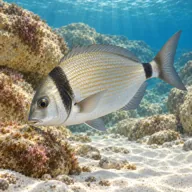
Two-banded bream
Almost always · Sargu
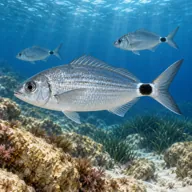
Saddled bream
Almost always · Kaħlija sewda

Damselfish
Almost always · Kaħlija
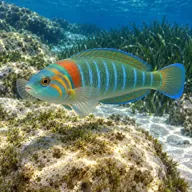
Ornate and peacock wrasse
Almost always · Ġurbell
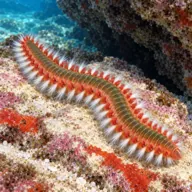
Bearded fireworm
Almost always · Dudu tan-nar
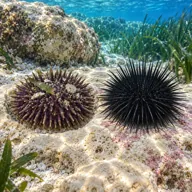
Sea urchins and encrusting sponges
Almost always · Rizzi
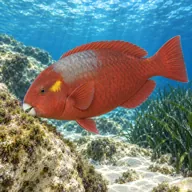
Mediterranean parrotfish
Often · Marzpan

Cardinalfish
Often · Re tat-trilji · Hovering inside the tunnels

Common octopus
Often · Qarnit
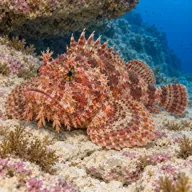
Scorpionfish
Often · Ċippullazza
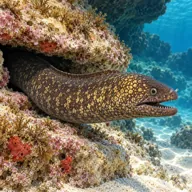
Mediterranean moray
Sometimes · Morina
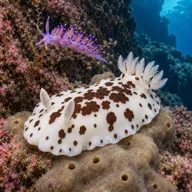
Nudibranchs
Sometimes · Spring
Getting in and staying safe
Park on the Xgħajra seafront, which is usually easy outside a summer Sunday, and walk to the rock ledges east of the village near the tower. There is no ladder and no slipway: you get in and out over low limestone shelves that are slippery with algae and unpleasant in any swell, so pick your spot at slack conditions and mark it. From the water head roughly north for about a hundred metres to pick up the reef. The village has a couple of cafes and a small promenade, but nothing dive-specific, no compressor and no rinse tank, so bring everything with you.
- Genuine overhead environment: low arches and short tunnels with no guideline and easy silt-out
- Surge pushes hard through the low passages on anything but a flat day
- Hundred metre surface swim each way with no midpoint to rest
- Slippery, awkward rock entry and exit with no ladder
- Site is effectively unmonitored, with no dive centre presence and slow help if something goes wrong
- Boat traffic and small fishing craft along this stretch of coast
- Discarded fishing line on the reef top
- Water quality can be poor after heavy rain, given coastal outfalls on this side of the island
- Jellyfish, including mauve stingers, drift in during late spring and summer
A bit of history
No wrecks and no legends, just geology. The reef is Maltese limestone that has been undercut and perforated by wave action over a very long time, which is how the sinkhole and its tunnel system formed. The tower on the shore nearby is one of the small coastal watch structures that dot this stretch of the southeastern coast, and Xgħajra itself grew from a scattering of fishermen's houses into a modest seaside village on the road between Valletta and Marsaskala.
Divers say
Sign in to rate this site and leave a note for the next diver.
- No reviews yet. First one gets bragging rights.
Further reading: Tech Diving Malta: Xghajra Reef write-up · Malta Dive Sites: Xghajra Reef · Wikivoyage: Diving in Malta, southeastern coast context