🐟 Fish · Muraena helena
Mediterranean moray
Morinain Maltese
A marbled ribbon in the dark of a crack
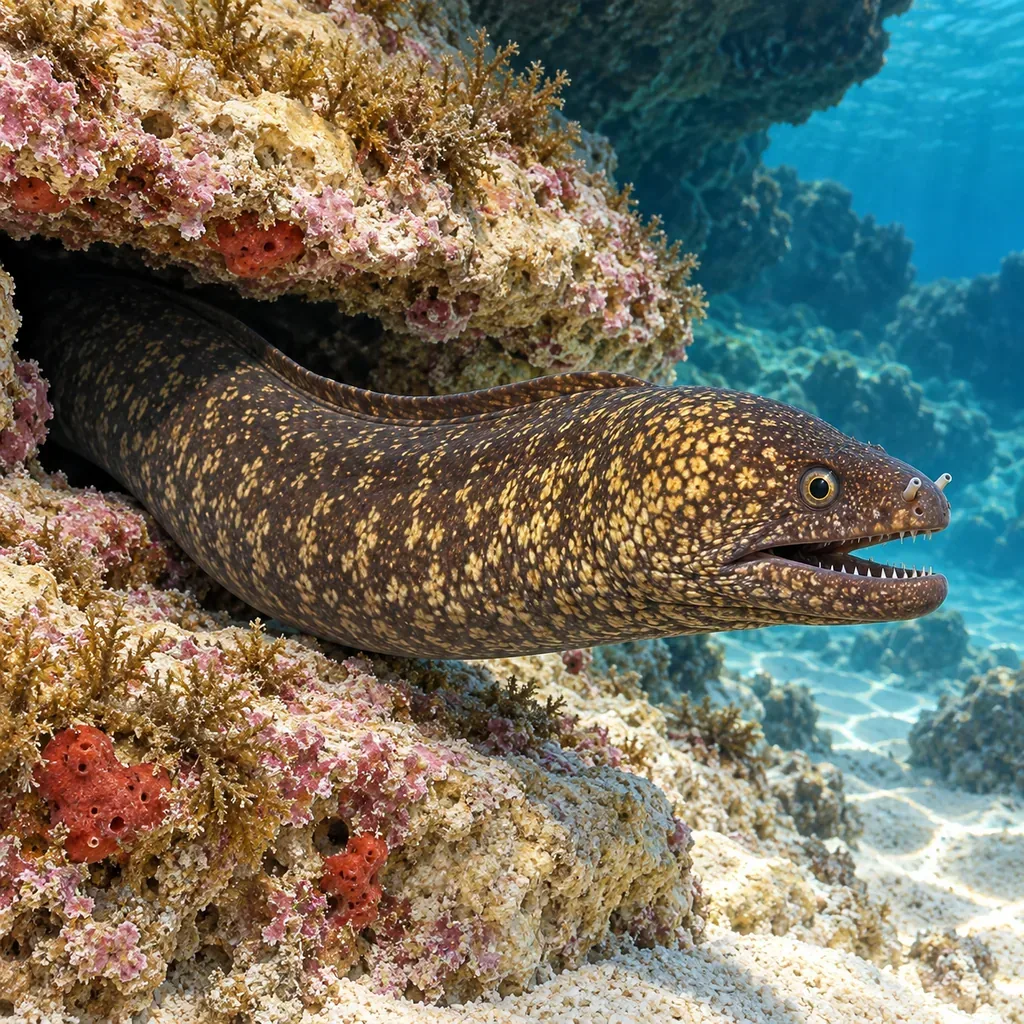
Meet the Mediterranean moray
A long, muscular, scaleless eel with no pectoral fins, so the body is a single smooth ribbon from the blunt head to the tail. The skin is dark brown to near-black, finely marbled and speckled with pale yellow and cream in a net-like pattern, and the dorsal fin runs as a low ridge along the whole back. The head is small with high-set eyes, a short snout and a mouth full of long backward-curving teeth. Nostrils show as short pale tubes above the lip.
What divers usually see is just a head sticking out of a crack, jaw opening and closing. That gaping is breathing, not threat: with no gill covers to pump water, a moray has to work its mouth constantly. It is a nocturnal hunter that leaves the hole after dark to take octopus, cuttlefish, small fish and crustaceans, and by day it stays wedged in rock. Around the Maltese islands it is common on boulder slopes, rubble at the foot of walls, cave mouths and wrecks, typically between 5 and 50 m.
Morina is a familiar name on the Maltese coast, and the eel has an old reputation it does not really deserve. Bites happen almost entirely to people who put a hand into a hole, feed it or handle one caught on a line.
When to look: All year; by day only the head shows, while night dives and dusk dives give the best chance of seeing one out and swimming.
Diving with them
- Scan low along the base of boulders and drop-offs for a pale-marbled head in shadow, and check the same cracks each time because morays hold a home range
- Keep your hands and fins clear of holes and never reach in blind, on any dive
- Come in slowly from the side rather than straight down the barrel of the hole; a moray that is comfortable will extend further out instead of withdrawing
- For photographs, light the head from above and slightly to one side to show the marbling, and wait for a moment when the jaw is nearly closed
- Never feed one or let a guide do so, as fed morays learn to come out at divers and are the usual cause of bites
- On night dives look for the whole animal moving over the reef, often with its head probing under stones
Can it hurt you?Can hurt you
It will not attack a diver, but if you put a hand in its hole or handle one it can deliver a serious bite. The long, backward-facing teeth and powerful jaws leave deep ragged wounds that tear as the eel twists, and they infect easily.
First aid: Leave the water calmly and control the bleeding with direct pressure. Irrigate the wound thoroughly with clean water, do not close it up, and go to a doctor or emergency department the same day: marine bite wounds usually need cleaning, antibiotics and a tetanus check.
Easily confused with
- Conger eel (Conger conger) is plain grey-brown with no marbling, has obvious pectoral fins and a wide flat-topped snout with fleshy lips
- Brown moray (Gymnothorax unicolor) is a uniform tan-brown with no pale net pattern
- Snake eels and the painted eel poke out of sand rather than rock and have pointed, hard-tipped tails
Where to meet them: 156 sites
Casper
Malta
Newwiela Point
Gozo
Further reading: Atlantis Gozo – Mediterranean moray on Gozo and Malta dive sites · Sammut, Dangerous creatures of the Maltese sea Part 2 (bites, Maltese names) · Wikipedia – Mediterranean moray · Reef Life Survey – Muraena helena