Anchor Bay · Malta
Anchor Bay Reef
A tumble of cliff fallen limestone blocks on both sides of the bay, stitched together with sand channels and Posidonia, making short swim throughs and cracks that are absolutely stuffed with small life. Twelve metres at the deepest.
Sea conditions
Excellent right now
Flat, sheltered and calm
Forecast for the site, updated 01:45 AM
- Waves
- 0.3 m
- from SE
- Wind
- n/a
- Swell
- 0.2 m
- 5 s period
- Sea temp
- 29 °C
Next 7 days
Exposed to wind and swell from: W (270°), NW (315°), SW (225°). Protected by cliffs and by the jetty breakwater, so it holds up when the north and east coasts are blown out. Any westerly puts swell into the bay and the sand stirs up between the boulders very quickly. Best season: May to October for warmth and visibility, though it is diveable all year when the wind sits in the east..
The dive
Anchor Bay is a slot cut between two high cliffs, and over the centuries those cliffs have been quietly shedding pieces of themselves into the water. The result is the reef: a field of enormous blocks, some balanced on each other, some half buried in sand, with gaps and arches and dead ends between them. The northern side has the better structure, where the boulders form proper swim throughs and the sand channels between them give you something to follow.
The depth range is three to twelve metres, which sounds unambitious until you realise how much time that buys you. This is a site for slow diving. Every overhang has a scorpionfish doing an unconvincing impression of a rock, every crack has a moray or a shrimp, and the Posidonia at the edges holds juvenile fish, the occasional cuttlefish and a good chance of an octopus caught out in the open.
It also works brilliantly at night. The bay is sheltered, the entry is a ladder, and the boulder field after dark turns into a completely different site: slipper lobsters out on the rock, octopus hunting, and the torch beams picking out colours the daylight flattens.
- Cliff fallen boulders forming genuine swim throughs at ten metres
- Macro heaven, with something living in every crack
- Shallow enough for very long dives and repeat dives
- One of Malta's better sheltered night dives
Typical plan
Single cylinder, no decompression concerns. In off the jetty ladders, pick a side, and work outward through the boulders to twelve metres, weaving the swim throughs where they are wide enough for your kit. Turn on gas or on time, come back shallower over the Posidonia, and spend the last quarter of the dive in three to six metres near the jetty. Sixty to seventy minutes is easy.
What the bottom looks like
- 1First big blocks off the jetty7 m deep · 60 m out
- 2Swim through between two leaning boulders10 m deep · 105 m out
- 3Sand channel at the deepest point12 m deep · 140 m out
- 4Rocky reef shelf on the northern side11 m deep · 175 m out
- 5Posidonia meadow along the edge of the sand8 m deep · 240 m out
- 6Shallow boulder garden near the jetty4 m deep · 285 m out
Angular limestone boulders and rubble separated by sand channels, with Posidonia taking over at the margins.
Who you might meet
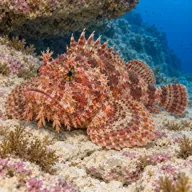
Red scorpionfish
Almost always · Ċippullazza

Damselfish
Almost always · Ċawl · Summer
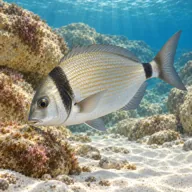
Two banded seabream
Almost always · Sargu
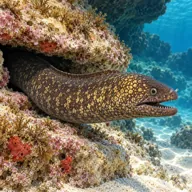
Mediterranean moray
Often · Morina
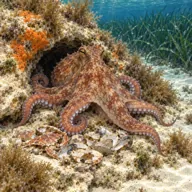
Common octopus
Often · Qarnit
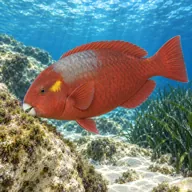
Mediterranean parrotfish
Often · Marlozz · Summer
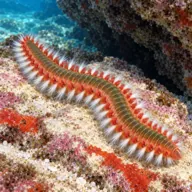
Bearded fireworm
Often · Busuf · Summer
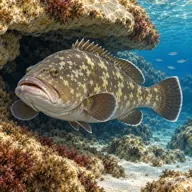
Dusky grouper
Sometimes · Ċerna
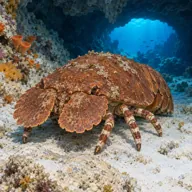
Slipper lobster
Sometimes · Ċikala
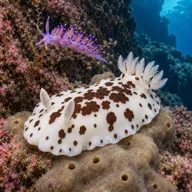
Nudibranchs
Sometimes · Spring
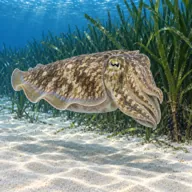
Cuttlefish
Sometimes · Siċċa · Spring
Getting in and staying safe
Down the dirt road to the concrete jetty on the south side, ladders on the inner face, and the reef starts within a few fin kicks either side. Because the boulder field runs along both walls of the bay you can choose your side to suit the light and the conditions on the day. Parking, toilets and a cafe are up at the Popeye Village entrance.
- Boat traffic in and out of the bay in summer
- Surge moving you around in the boulder gaps when there is westerly swell
- Genuine entrapment risk if you force a swim through in a twinset or a camera rig
- Sea urchin spines on the shallow rock
- Visibility dropping fast in bad weather
A bit of history
The reef is pure geology. The cliffs around the bay are Upper Coralline limestone, hard and prone to failing in large blocks rather than crumbling, so the seabed below them is a talus slope of clean angular rock. The same process is still going: in February 2023 a boulder came off the cliff during a storm and damaged part of the film set village above the bay.
Divers say
Sign in to rate this site and leave a note for the next diver.
- No reviews yet. First one gets bragging rights.
Further reading: Malta Dive Sites: Anchor Bay reef · Dive Shack Malta: Anchor Bay · New Dimension Scuba: Anchor Bay · Wikipedia: Popeye Village and Anchor Bay