Malta
Scotscraig
A stubby Scottish car ferry that ended her career as a film prop and now sits upright in 21 metres off Anchor Bay. Shallow, quiet and rarely visited, which is exactly why the fish like her.
Sea conditions
Excellent right now
Flat, sheltered and calm
Forecast for the site, updated 01:45 AM
- Waves
- 0.3 m
- from SE
- Wind
- n/a
- Swell
- 0.2 m
- 5 s period
- Sea temp
- 29 °C
Next 7 days
Exposed to wind and swell from: W (270°), NW (315°), N (0°). Needs a calm day with the wind anywhere in the southern half of the compass. Anything out of the west or northwest builds swell along this coast fast, and the site silts up for days afterwards. Best season: May to October, with September and October giving the warmest water and the steadiest spells; winter trips happen but only in a settled southerly..
The dive
Everything about this little wreck is faintly absurd, in the best way. She spent fifteen years shuttling cars across a cold Scottish estuary, retired to Malta, got a cameo in a Robin Williams musical, was parked on the seabed as a makeshift breakwater, and then drowned herself on the way to her next job. Now she lies flat and upright on seagrass, shingle and sand at about 21 metres, twenty five metres of rusting steel that looks bigger than it measures because she is so wide across the beam.
The diving is gentle. You drop onto open deck at roughly 15 to 18 metres, potter along the rails, and drift through the open spaces where the vehicle deck used to be. The hull plating is opening up in places, which is bad news for the ship and good news for anyone who likes swimming through structure, and the lower deck can be entered by divers with the right training and a light. The famous photo op is a row of toilets still bolted in place, waiting for passengers who stopped coming in 1966.
Because hardly anyone bothers with her, the residents have grown comfortable. Morays and congers own the broken plating, a grouper or two patrol the stern, octopus tuck into every hole, and the odd stingray flaps off the sand when you swim over. Visibility here is usually a step down from the north Malta average, and it turns properly murky after a blow, so pick a settled day.
At 21 metres with a big shallow shelf of seagrass to potter over on the way back up, she makes a lovely second boat dive of the day, and she is well within reach of a newly qualified diver with a guide.
- A complete little ferry sitting upright in easy recreational depth
- The unlikely Popeye film connection, with the village still standing ashore
- Toilets still bolted to the deck, the most photographed fixture on the wreck
- Barely dived, so the marine life is settled and unbothered
- Ideal as a relaxed second dive of a boat day
Typical plan
Descend the marker to the deck at 15 to 18 metres, work the length of the hull one way at deck level, then drop to the sand at 21 metres for a lap around the keel, watching the plating for eels. Come back up over the deck, spend the back half of the dive on the seagrass shallower than 15 metres and finish with a mid-water safety stop under a DSMB. Around 40 minutes on a single 12 litre of air is comfortable; nitrox 32 buys you a lazier pace and a cleaner second dive.
What the bottom looks like
- 1Main deck, bow section18 m deep · 20 m out
- 2Superstructure and the surviving toilets17 m deep · 40 m out
- 3Stern, keel line on the sand21 m deep · 55 m out
- 4Shingle and sand apron around the hull21 m deep · 70 m out
- 5Posidonia meadow off the wreck18 m deep · 120 m out
Seagrass giving way to coarse shingle and sand, with the hull sitting squarely on the bottom.
Who you might meet
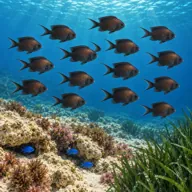
Mediterranean damselfish
Almost always · Ċawl
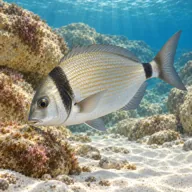
Two-banded seabream
Almost always · Sargu
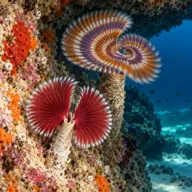
Tube worms and sponges on the plating
Almost always
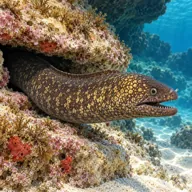
Moray eel
Often · Morina
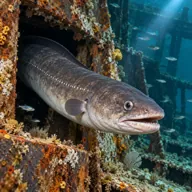
Conger eel
Often · Gringu
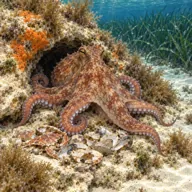
Common octopus
Often · Qarnit
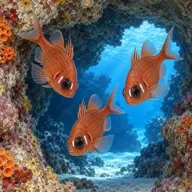
Cardinalfish
Often · Sultan iċ-ċawl
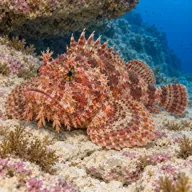
Scorpionfish
Often · Cippullazza
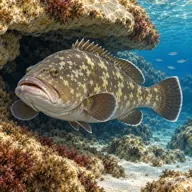
Dusky grouper
Sometimes · Cerna
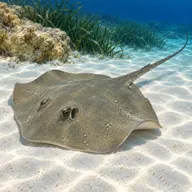
Common stingray
Sometimes · Boll
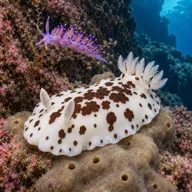
Nudibranchs
Sometimes · spring
Getting in and staying safe
Boat only, no shore option: she is far too far out to swim. Most charters run from Cirkewwa or Mellieha and make the hop in well under half an hour, often pairing her with Anchor Bay or Ghar it-Trozz on the same trip. There is no fixed shotline, so the skipper drops a marker or anchors into the sand nearby. Anchor Bay itself has parking, toilets and a cafe if you are meeting a boat there, but the bay is busy with Popeye Village tourist craft.
- Visibility is often poorer than elsewhere in Malta and collapses after bad weather
- Penetration of the lower deck is a genuine overhead: silt, no natural light, training and a reel needed
- Corroded steel plating with sharp edges and snag points
- Boat traffic in and out of Anchor Bay, including tourist craft; carry a DSMB
- Exposed swell on the surface can make the pick-up lively
- Lost fishing line and net snagged on the superstructure
A bit of history
MV Scotscraig was launched in 1951 from the Caledon yard in Dundee for the Dundee Harbour Trust, working the Tay crossing between Dundee and Newport-on-Tay with room for a handful of cars and a crowd of foot passengers. She was named for a spot near Tayport. The Tay Road Bridge put the ferries out of business in 1966, and she and her sister Abercraig were sold south to Malta, where Abercraig was eventually broken up. Scotscraig found a second act on the Popeye production at Anchor Bay, filmed through the first half of 1980, serving as a supply and camera platform; the film set survives ashore as Popeye Village. Afterwards she was sunk deliberately as a working breakwater while the concrete jetty at Anchor Bay was poured, then refloated and taken under tow. Bad weather caught her in transit, she took water, parted the tow and went down, most likely in 1981.
Divers say
Sign in to rate this site and leave a note for the next diver.
- No reviews yet. First one gets bragging rights.
Further reading: Divers Guide: Scott Graig dive site · Wikipedia: Tay Ferries · Wikipedia: Popeye Village, Anchor Bay · Wrecksite: MV Scotscraig